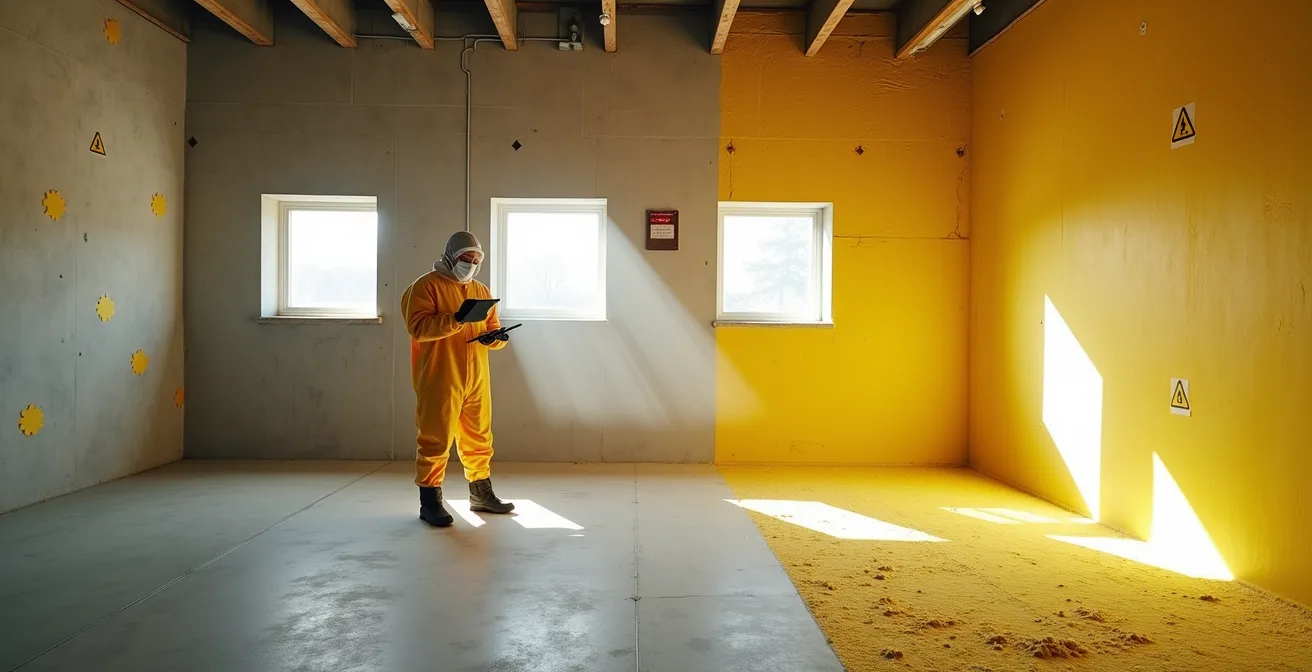
That “cash deal” on spray foam insulation isn’t a saving; it’s a high-stakes gamble with your home’s insurability.
- Non-compliant materials (lacking ULC certification or with poor fire/smoke ratings) represent an unquantifiable risk that most Canadian insurers will refuse to cover after a fire.
- In the event of a claim, the lack of certified paperwork from a licensed installer is often treated as definitive proof of non-compliance, leading to claim denial.
Recommendation: Immediately investigate your insulation’s compliance status and gather all related documentation. This isn’t just about building codes; it’s about the validity of your insurance contract.
You thought you got a great deal. The contractor offered a significant discount for cash, the job was done quickly, and your home felt warmer almost immediately. But now, a nagging thought is keeping you up at night: was it all too good to be true? As an insurance broker, I see this scenario play out with heartbreaking regularity. Homeowners believe they are protected, only to discover after a fire that their “savings” have led to a catastrophic financial loss because their insurance claim was denied.
The common advice is to “hire certified professionals” and “use approved materials.” While true, this advice often fails to explain the critical link between technical building standards and the fine print of your insurance policy. The issue isn’t just about meeting the National Building Code of Canada (NBCC); it’s about avoiding a material breach of your insurance contract. An insurer’s primary concern is quantifiable risk. Uncertified, “grey market” spray foam represents an unknown, unquantifiable fire and health hazard they are unwilling to cover.
This guide will not just list the rules. It will walk you through the mindset of an insurance adjuster. We will decode the technical ratings they look for, explain how they spot fraudulent products, and detail the exact paperwork that stands between you and a denied claim. The goal is to arm you with the knowledge to assess your own situation and take corrective action before it’s too late. Your home is likely your biggest asset; let’s ensure it’s properly protected.
This article provides a detailed breakdown of the key compliance issues from an insurance perspective. By understanding these points, you can better assess your risk and ensure your property remains insurable.
Summary: Uncovering the Insurance Risks of Non-Compliant Spray Foam
- What Does the “S102” Flame Spread Rating Actually Mean?
- How to Verify if the ULC Stamp on Your Insulation is Fake?
- Why Smoke Development Ratings Matter More Than Flame Spread in High-Rises?
- Can You Leave Exposed Insulation in a Commercial Garage According to Code?
- The Paperwork You Need to Save 15% on Your Commercial Property Insurance
- The Hidden Health Risks of Grey Market Insulation Materials
- Why General Liability Insurance is Non-Negotiable for Insulation Pros?
- How Stone Wool Insulation Can Buy You 15 Extra Minutes During a Fire?
What Does the “S102” Flame Spread Rating Actually Mean?
When an insurance adjuster investigates a fire claim, they aren’t just looking at the cause of the fire; they’re scrutinizing how it spread. This is where the CAN/ULC S102 test becomes critically important. This standard is the benchmark in Canada for measuring the surface burning characteristics of a material. It assigns two crucial numbers: the Flame Spread Rating (FSR) and the Smoke Developed Classification (SDC). For insulation to be considered safe and compliant, Canadian building codes require insulation materials to meet an FSR of less than 25 and an SDC of less than 50.
Think of the FSR as a measure of speed. It determines how quickly flames will travel across a material’s surface compared to a standard reference. A low number is paramount. To put this in perspective, non-compliant materials can have FSR numbers that are drastically higher, allowing a small fire to become an uncontrollable inferno in minutes. This is a risk no insurer is willing to take on knowingly. If the foam installed in your home doesn’t have documented proof of meeting this standard, the insurer will argue that the material itself was a primary contributor to the loss, giving them grounds for denial.
The difference between compliant and non-compliant materials is stark. The following table, based on data from the Canadian Wood Council, illustrates how different materials perform, with ULC-certified foam in the safest category.
| Material | Flame Spread Rating (FSR) | Classification |
|---|---|---|
| ULC-certified spray foam | <25 | Class A (Most fire-resistant) |
| Fiber-cement board | 0 | Non-combustible reference |
| Lumber (any species) | 150 | Class C |
| Douglas fir plywood | 150 | Class C |
Seeing that standard lumber has an FSR six times higher than compliant foam demonstrates why an insurer would see uncertified foam as an unacceptable hazard. It’s not just foam; it’s a specific, engineered, fire-resistant system they are insuring. Without proof of compliance with standards like CAN/ULC S705.1 for the material and S705.2 for the installation, you have a product of unknown quality and risk.
How to Verify if the ULC Stamp on Your Insulation is Fake?
The ULC stamp is the most visible sign of compliance, but unfortunately, counterfeit products are a reality in the “grey market.” A fraudulent stamp on a drum of spray foam can fool a homeowner, but it won’t fool a forensic investigator after a claim. From an insurance perspective, the burden of proof is on you, the homeowner, to demonstrate that the product installed is legitimate. So how can you protect yourself?
First, the verification process starts before the product even arrives. It begins with the contractor. A legitimate installer who uses ULC-certified products will be certified themselves. In Canada, look for certifications from organizations like the Canadian Urethane Foam Contractors Association (CUFCA) or recognized third-party quality assurance programs. These professionals are trained to identify and correctly apply compliant materials. Their license is a key piece of your “documentary proof.” For example, Caliber installers are licensed for a period of five years, after which they must be re-evaluated, ensuring their knowledge is current.
Second, insist on seeing the documentation for the specific product being used on your job. This includes the product data sheets and the CCMC (Canadian Construction Materials Centre) evaluation report number. This number is your golden ticket. You can look it up on the National Research Council’s CCMC registry online to confirm the product’s compliance with Canadian standards. A “cash deal” contractor will be evasive when asked for this paperwork. A professional will provide it without hesitation because it’s part of their standard process.
Finally, be wary of deals that seem too good to be true. Certified materials and licensed labour have a cost. A significantly lower price is often a red flag that corners are being cut, likely starting with the use of cheaper, uncertified, and uninsurable materials. For an insurer, the absence of a clear paper trail from a certified installer to a CCMC-listed product is tantamount to an admission of non-compliance.
Why Smoke Development Ratings Matter More Than Flame Spread in High-Rises?
While Flame Spread Rating (FSR) measures how fast a fire grows, the Smoke Developed Classification (SDC) measures how much it blinds you. In any building, but especially in multi-story structures like high-rises or even multi-level single-family homes, smoke is often the silent killer. It incapacitates occupants and obstructs escape routes long before the flames arrive. This is why, from a life safety and insurance liability perspective, an SDC rating can be even more critical than the FSR.
This is a point many homeowners miss. As Sprayfoam Solutions Toronto, a Canadian-based expert, warns in their analysis of building code rules, non-compliance has direct insurance consequences:
Insurance claims could be denied after a fire or a mold issue
– Sprayfoam Solutions Toronto, Building Code Rules for Spray Foam in Ontario
The CAN/ULC S102 standard requires a very low smoke rating. For a product to be compliant, insulation manufacturers report CAN/ULC compliance with an SDC of less than 50. Non-compliant foams can produce thick, toxic smoke at an alarming rate, turning a survivable situation into a fatal one. For an insurer, a material that significantly increases the risk of injury or death due to smoke inhalation represents a massive liability. They will argue that the use of such a material created a hazard far beyond what the policy was intended to cover.

The image above visualizes the terrifying speed at which smoke can fill upper levels, trapping occupants. A low SDC value means the insulation contributes very little to this smoke, keeping escape routes clearer for longer. This is not a trivial detail; it is a core component of a building’s life safety system. Using a “grey market” product with an unknown SDC is like disabling the sprinklers to save money—it’s a risk that fundamentally alters the safety profile of your home and, consequently, the terms of your insurance contract.
Can You Leave Exposed Insulation in a Commercial Garage According to Code?
This question comes up frequently, not just for commercial properties but also for residential garages, basements, and workshops. The answer from both a building code and an insurance standpoint is an emphatic no, not without protection. Spray polyurethane foam is a combustible material. While ULC-certified foam is fire-resistant, it is not fireproof. The National Building Code of Canada requires it to be separated from interior spaces by a thermal barrier.
A thermal barrier is a material that is applied over the foam to slow down its temperature rise in a fire. The most common thermal barrier is 1/2-inch drywall, but that is not always practical in a garage or workshop. In these cases, a special type of fire-retardant coating, known as an intumescent paint, can be used. However, this is where many “cash deal” contractors make a critical error. Not just any fire-retardant paint will do. The paint itself must be tested and certified as a thermal barrier system over the specific type of foam used. According to a technical analysis by Paint to Protect, a Canadian coating specialist, one such compliant coating, DC315, must meet Canadian CCMC 14036-R code to be recognized as a valid thermal barrier.
If an unapproved paint—or no barrier at all—is used, an insurer will view this as a major breach of safety standards. In a fire, the exposed foam can ignite, releasing toxic smoke and accelerating the fire’s spread, drastically increasing the scale of the damage. An adjuster will immediately flag the lack of a proper, documented thermal barrier as a reason to question the validity of the claim. Below is a checklist to ensure your exposed foam is compliant.
Action Plan: Verifying Exposed Spray Foam Compliance
- Check NBCC sections on thermal barriers for your space’s specific use (e.g., vehicle storage is a higher-risk occupancy).
- If foam must be exposed, confirm a ULC-listed intumescent coating meeting CCMC 14036-R standards was applied.
- Verify the coating was applied to the correct thickness as per the manufacturer’s specifications—this is a critical detail.
- Retain all documentation for the intumescent coating, including product data sheets and the applicator’s invoice, for insurance purposes.
- Never leave spray foam exposed in a habitable space or garage without an approved and documented thermal barrier.
The Paperwork You Need to Save 15% on Your Commercial Property Insurance
While the title refers to commercial insurance, the principle is universal and applies directly to your home: documentation is everything. In the world of insurance, if it isn’t written down, it didn’t happen. The idea of a discount is a good way to frame the value of proper paperwork. While you may not get a “discount” on your home insurance for doing things correctly, what you are truly “buying” is the guarantee that your policy will actually respond when you need it most.
After a loss, your insurance company will launch an investigation. The adjuster will ask for a complete record of the work performed. A homeowner who can produce a neat file containing a contract, the installer’s certification, the CCMC report for the foam, and the data sheets for the thermal barrier is in a position of strength. This paperwork is irrefutable proof that you acted in good faith and took all necessary steps to comply with safety standards. It shuts down any argument from the insurer that you contributed to the risk by using substandard materials or methods.
Conversely, imagine telling the adjuster, “I paid a guy in cash, I don’t have his last name, and I’m not sure what product he used.” From an insurer’s perspective, you have just admitted to negligence. You willingly introduced an unknown and unquantifiable hazard into your home. This lack of documentation gives them a powerful reason to deny the claim based on material misrepresentation or failure to disclose risk.
The “cash deal” contractor vanishes after the job is done, leaving you with all the liability. The money you “saved” is insignificant compared to the potential cost of an uninsured fire. Start today by creating a file for your insulation project. Collect every scrap of paper you have. If you have nothing, your next step should be to get a certified professional to inspect the installation and provide you with a report on its compliance status. That report then becomes the first document in your file.
The Hidden Health Risks of Grey Market Insulation Materials
Beyond the immediate and devastating risk of fire, non-compliant “grey market” insulation materials introduce another insidious threat: health risks. Legitimate spray foam products are complex chemical systems that must be manufactured to exacting standards. When applied correctly by a certified professional, they are inert and safe. However, uncertified products may have improper chemical ratios, contain hazardous impurities, or fail to cure properly. This can lead to the off-gassing of volatile organic compounds (VOCs) into your home’s air for months or even years, potentially causing respiratory issues and other health problems.
From an insurance perspective, this creates a secondary avenue for claim denial. Most home insurance policies contain exclusions for pollution, contamination, and mold. If it’s determined that the non-compliant foam created a toxic environment or led to a mold problem (as it may not provide a proper air/vapor barrier), your insurer could deny the claim based on these exclusion clauses. You could be left with a home that is not only a fire risk but also uninhabitable, with no financial recourse to fix it.
The danger is not hypothetical. Insurers are acutely aware of the risks associated with improper installations, and they scrutinize them carefully.
Case Study: Kings Mutual Insurance and the Failed Thermal Barrier
A stark real-world example comes from a report by CBC News in Nova Scotia involving Kings Mutual Insurance. In several cases, the insurance company found that an intumescent paint applied as a thermal barrier was not acceptable. The insurer discovered instances where the paint had chipped or was applied too thinly, failing to provide adequate coverage. This demonstrates the level of detail an insurer will investigate. It wasn’t enough that a “fire-retardant paint” was used; it had to be the correct paint, applied to the manufacturer’s specifications, and maintained properly. The failure to meet these specific requirements was enough to jeopardize coverage.
This case highlights a crucial point: compliance is not a checkbox. It is a rigorous standard that must be met and documented. The “grey market” thrives on cutting these corners, passing on not just fire risk, but potential health and liability risks directly to the unsuspecting homeowner.
Why General Liability Insurance is Non-Negotiable for Insulation Pros?
Understanding a contractor’s insurance is crucial because it reveals the risks you, the homeowner, inherit when you hire someone without it. A professional insulation contractor carries several types of insurance, not because they are optional, but because the risks of the job are too high to operate without them. The “cash deal” operator is gambling, and they are using your house as the poker table.
The most basic coverage is General Liability Insurance. This protects against property damage and bodily injury *during* the operation. For example, if the contractor’s equipment malfunctions and damages your property, their insurance covers it. Without this, you would have to sue the contractor personally—a difficult and often fruitless endeavor. As insurance specialists at Profoam highlight, the risks are diverse: “Equipment Malfunction can lead to uneven application, damaged property, or project delays. Chemical Exposure-Spray foam materials contain chemicals that may pose health risks”. A professional prices their insurance into the job; an uninsured operator simply transfers that risk to you.
However, the most critical coverage for spray foam is Completed Operations coverage, often combined with a Pollution Liability policy. This protects against claims that arise *after* the job is finished, sometimes years later. If your house burns down two years after the installation and the fire is traced back to improperly installed foam, this is the coverage that responds. A contractor operating without it is leaving a trail of uninsured liability. Your insurance company will seek to recover their payout from the responsible party (the contractor), but if the contractor is uninsured and has no assets, your insurer may look for reasons to invalidate your own policy, such as your decision to hire an unqualified professional.
The table below breaks down the essential coverages a legitimate spray foam contractor in Canada should have. Their certificate of insurance is proof of their professionalism and your protection.
| Coverage Type | What It Protects | Why It’s Critical |
|---|---|---|
| General Liability | Bodily injury, property damage claims | Fundamental protection against operational claims |
| Completed Operations | Claims after job completion | Covers fires occurring years after installation |
| Tools & Equipment | Spray foam guns, machinery | Minimizes downtime from theft or breakdown |
| Workers’ Compensation | Employee injuries, chemical exposure | Legal requirement and moral imperative |
Key Takeaways
- ULC compliance isn’t optional; it’s the fundamental basis of your insurance coverage against fire when spray foam is involved.
- The installer’s certification and the material’s CCMC paperwork are your only verifiable proof in a potential claim dispute. No paper, no proof.
- Exposed spray foam, particularly in garages or basements, always requires a specific, documented thermal barrier. A simple coat of paint is not enough.
How Stone Wool Insulation Can Buy You 15 Extra Minutes During a Fire?
After exploring the many compliance pitfalls of spray foam, it’s fair to ask: are there less complicated, inherently safer alternatives? For homeowners prioritizing fire safety above all else, stone wool insulation presents a compelling option. The fundamental difference is simple: spray foam is a combustible material that is treated to be fire-resistant, whereas stone wool is an inherently non-combustible material.
Stone wool is made from basalt rock and slag, which are melted down and spun into fibers. It simply does not burn and can withstand temperatures exceeding 1,000°C. This means it doesn’t contribute fuel to a fire, nor does it produce significant toxic smoke. In a fire, this non-combustibility provides precious, life-saving time. Those “15 extra minutes” can be the difference between a safe evacuation and a tragedy, especially in rural areas where fire department response times are longer. An insurer sees a home insulated with stone wool as a much lower risk profile from a fire-spread perspective.
While closed-cell spray foam offers a higher R-value per inch, stone wool is often used in fire-rated wall assemblies to achieve 1-hour or 2-hour fire-resistance ratings. This is a level of performance that spray foam can only achieve as part of a complex system involving thermal barriers. Furthermore, as required by the NBCC, spray foam is completely unsuitable for fire-stopping applications (sealing gaps around pipes and wires in fire-rated walls). Stone wool is one of the primary materials used for this critical life safety task.
Choosing an insulation material is a balance of thermal performance, cost, and risk management. While compliant spray foam is a safe and effective product when installed perfectly, stone wool offers a more straightforward path to fire safety. For a risk-averse homeowner, or one looking to correct a non-compliant installation, it represents a robust, insurable, and worry-free solution that any insurance company will readily accept.
Now that you understand the risks, the next logical step is to conduct a thorough review of your own installation. If you have any doubts, do not wait for a disaster. Contact a certified insulation professional for an inspection and consult with your insurance broker to ensure your policy is not in jeopardy.
Frequently Asked Questions on Spray Foam, Stone Wool, and Fire Safety
How does stone wool contribute to fire-rated assemblies?
Stone wool is non-combustible and can contribute to achieving 1-hour or 2-hour fire-resistance ratings in wall assemblies, while spray foam must be protected with thermal barriers.
Can spray foam be used for fire-stopping applications?
No, spray foam is completely unsuitable and illegal for fire-stopping applications around penetrations in fire-rated walls as required by the NBCC. Stone wool is the appropriate material.
What’s the difference in fire response time coverage?
Stone wool’s non-combustible nature provides crucial extra minutes during evacuation, particularly important in rural areas where fire department response times can exceed urban averages.