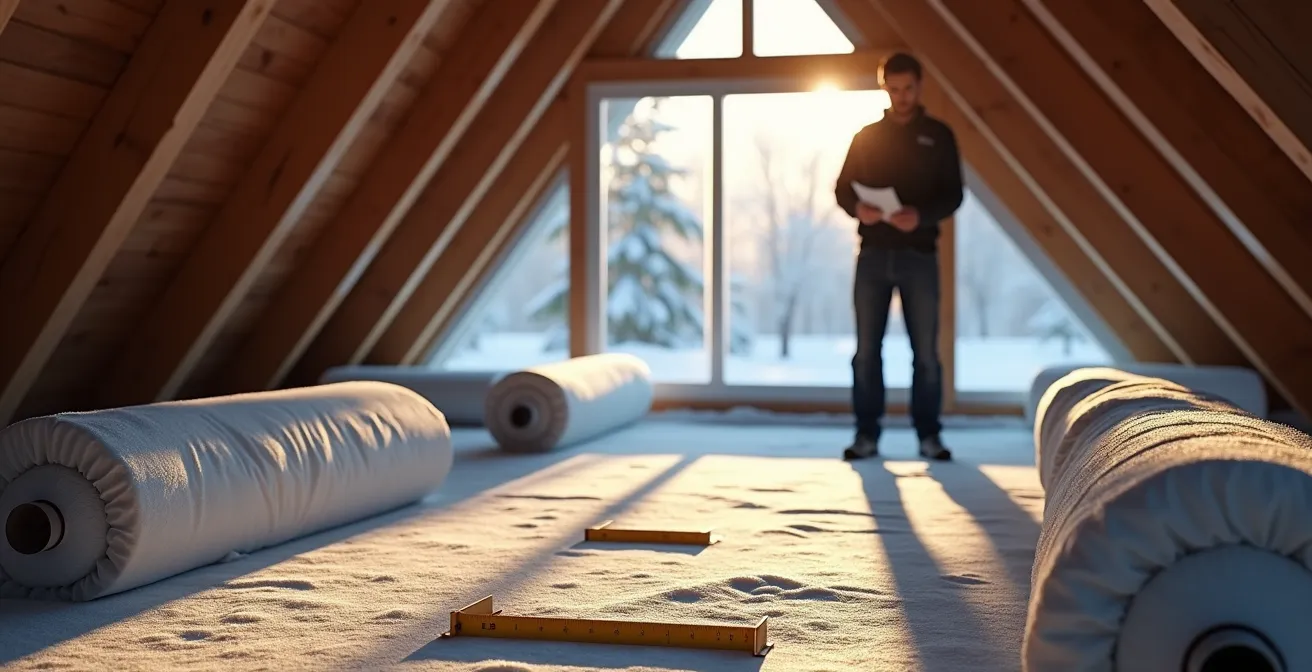
The 20% you save on generic insulation isn’t a saving; it’s a down payment on a voided insurance policy and a devalued home.
- Canadian Construction Materials Centre (CCMC) certification is the non-negotiable proof of compliance your insurer and municipal building officials require.
- Without verifiable documentation (CCMC numbers on invoices, registry printouts), your insulation upgrade is considered a liability, not an asset, during an appraisal or insurance claim.
Recommendation: Treat every insulation bag and contractor invoice as legal evidence: verify the CCMC number, document everything, and immediately refuse any non-compliant material.
As a homeowner, especially a DIY enthusiast, the temptation to save 20% on a pallet of generic rock wool or unbranded spray foam is understandable. You see the R-value, you feel the material, and you think, “It’s all the same, right?” This is a costly mistake. The real risk isn’t just a slightly colder attic; it’s a catastrophic financial chain reaction that begins the moment that uncertified material crosses your threshold. Your home insurance policy is a contract built on the foundation of compliance with Canadian building codes and standards. Introducing a non-verified, “grey market” product breaks that contract.
Most advice focuses on thermal performance and fire safety, which are critical. But they miss the central point of liability. As an inspector, I don’t just see insulation; I see a paper trail. When a fire investigator or an insurance adjuster arrives, they aren’t testing the R-value of the ashes. They are looking for documentation. They are looking for a CCMC number that proves the material met rigorous national standards for safety and performance. If that proof doesn’t exist, your claim can be denied in its entirety. You didn’t just buy cheaper insulation; you bought 100% of the liability for any resulting damage.
This article is not about choosing insulation. It’s about protecting your single largest investment. We will move beyond the platitudes and treat your insulation project like a legal case file. You will learn the forensic verification techniques to confirm a product’s legitimacy, the questions to ask a contractor to expose scams, and the documentation strategy that turns a simple upgrade into a value-adding asset. This is your guide to ensuring your home is not just insulated, but also insurable.
To navigate this critical topic, we have structured this guide to address every point of failure, from hidden health risks to the fine print in the National Building Code. This table of contents will guide you through the essential checks and knowledge needed to secure your home.
Summary: Navigating Insulation Compliance to Protect Your Home Insurance
- The Hidden Health Risks of Grey Market Insulation Materials
- How to Verify the CCMC Number on Insulation Bags in 2 Minutes?
- Brand Name vs. Generic Rock Wool: Is the 20% Savings Worth the Risk?
- The Scam Where Contractors Swap Premium Foam for Cheap Filler
- How Documenting Certified Upgrades Adds $5,000 to Your Home Appraisal?
- Why General Liability Insurance is Non-Negotiable for Insulation Pros?
- How to Verify if the ULC Stamp on Your Insulation is Fake?
- Why Does the 2020 National Building Code Require Higher R-Values?
The Hidden Health Risks of Grey Market Insulation Materials
Beyond the financial and structural risks, non-certified insulation materials introduce an unknown variable into your home’s indoor environment. CCMC-approved products undergo rigorous testing not just for performance, but also for their chemical composition and off-gassing. “Grey market” products have no such oversight. They may contain volatile organic compounds (VOCs), undeclared fire retardants, or even mould-sustaining binders that can compromise your family’s health over time. These materials can be a primary contributor to “Sick Building Syndrome,” with symptoms that are often misattributed to other causes.
While it’s reassuring that Statistics Canada data from 2014-2015 shows the average Canadian household has VOC levels far below Health Canada’s limits, this is a testament to the effectiveness of existing material standards. Introducing an unregulated product is a reckless gamble that can spike these levels unpredictably. The responsibility for any resulting health issues falls squarely on the homeowner who chose to install an unverified substance within their walls.
Your first line of defense is vigilance. If you or your family begin experiencing persistent, unexplained symptoms after an insulation project, you must consider the new materials as a potential source. Proper ventilation is not a cure for a toxic product; it is a temporary mitigation measure. The only real solution is to ensure that what goes into your walls is proven to be safe from the start.
Homeowner Checklist: Monitoring for Sick Building Syndrome
- Monitor for persistent headaches or dizziness when at home that improve when you are away.
- Check for new or worsened respiratory irritation, including coughing, throat soreness, or breathing difficulties.
- Document any eye, nose, or throat irritation that correlates with time spent indoors, especially in newly insulated areas.
- Note any unusual fatigue or difficulty concentrating that seems to lift when you leave the house.
- Track any new skin irritation or allergic reactions that developed after the insulation work was completed.
How to Verify the CCMC Number on Insulation Bags in 2 Minutes?
The CCMC mark is not a sticker; it’s a searchable registration number linked to a public database. Any legitimate manufacturer is proud of this certification and displays it clearly. A missing, obscured, or poorly printed number is an immediate red flag. Verification is not optional; it is a mandatory due diligence step for every homeowner and contractor. This process is your first and most powerful tool to reject fraudulent or non-compliant materials before they are even unloaded from the truck. Think of it as a forensic verification of your material’s identity.
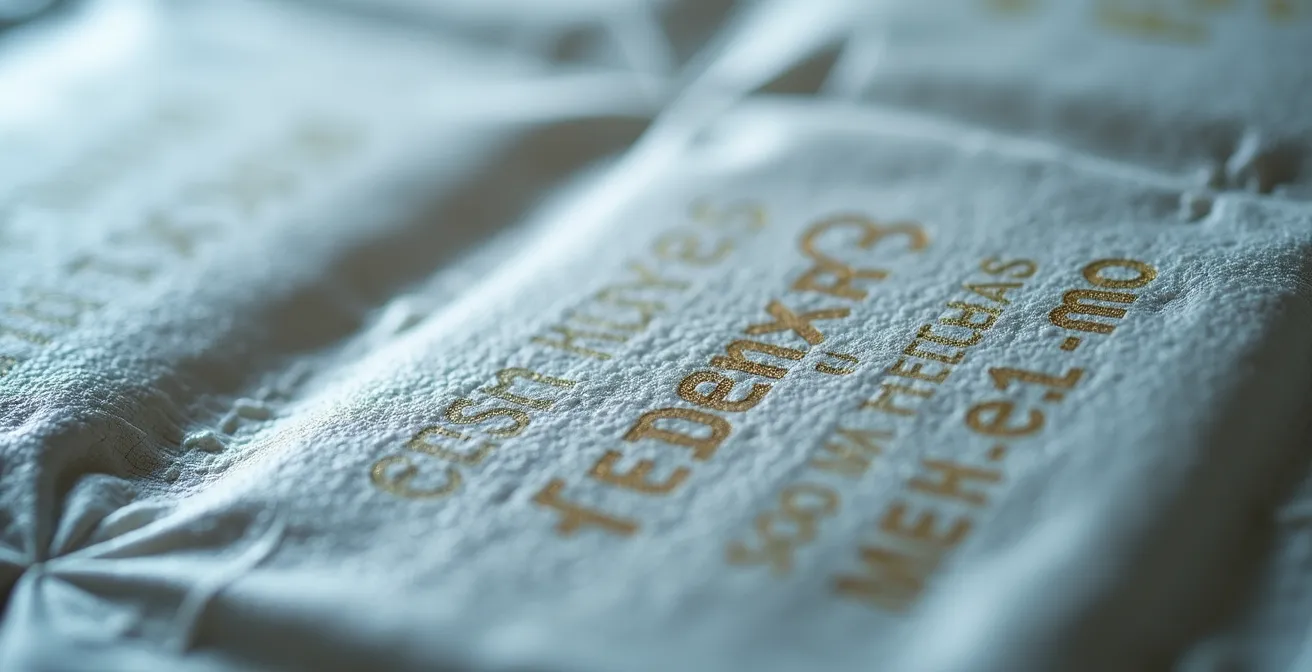
The image above highlights the textural surface where you will find this critical information. The number itself, typically in a XXXXX-L or XXXXX-R format, is your key. Never trust the logo alone; counterfeiters can easily replicate a graphic. The number’s validity in the national registry is the only proof that matters. If a supplier or contractor dismisses your request to verify the number, you have your answer: refuse the shipment and find a reputable source.
This simple, two-minute check is the dividing line between a compliant, insurable upgrade and a costly, dangerous mistake. It transfers the burden of proof back to the manufacturer and supplier, where it belongs. Do not be rushed or intimidated. It is your right and your responsibility to perform this check.
Action Plan: CCMC Number Verification
- Step 1: Locate the CCMC Mark: Find the official CCMC mark and the associated 7-digit number on the product packaging or technical data sheet.
- Step 2: Access the Registry: Navigate to the NRC’s official CCMC Registry search page at nrc.canada.ca/ccmc-registry.
- Step 3: Enter the Number: Type the CCMC number precisely into the search field and execute the search.
- Step 4: Cross-Reference Details: Verify that the product name, manufacturer name, and report number on the registry entry EXACTLY match the product in your possession.
- Step 5: Check the Date: Confirm the ‘Last Modified Date’ on the report to ensure the evaluation is current and has not expired or been withdrawn.
Brand Name vs. Generic Rock Wool: Is the 20% Savings Worth the Risk?
The choice between a CCMC-certified brand and a generic alternative is not a simple cost comparison. It is a risk assessment. The upfront “savings” on generic materials are an illusion that evaporates when you calculate the total cost of ownership and liability. As the National Research Council Canada states, the CCMC’s role is foundational to the industry’s trust. This is a fact that building officials and insurers rely on heavily.
Building officials nationwide look to the CCMC to base their decisions on using new products.
– National Research Council Canada, NRC Story on CCMC’s Role in Canadian Construction
A certified product comes with a guarantee of performance, backed by a reputable manufacturer and the NRC. Its R-value is stable, its fire resistance is proven, and its composition is known. A generic product comes with none of these assurances. Its R-value may degrade rapidly, it may not perform as expected in a fire, and it could be disqualified during a home appraisal. The following analysis shows that the initial $500 savings can lead to losses exceeding $10,000 over a decade, not including the catastrophic risk of a denied insurance claim.
| Cost Factor | CCMC-Certified Rock Wool | Generic/Non-Certified | 10-Year Impact |
|---|---|---|---|
| Initial Material Cost (2000 sq ft) | $2,500 | $2,000 | -$500 savings |
| Installation Labor | $1,500 | $1,500 | $0 difference |
| Annual Heating Cost Increase (degraded R-value) | $0 | $120-180/year | +$1,200-1,800 loss |
| Insurance Claim Risk (fire/damage denial) | $0 | Full liability risk | +$100,000+ potential loss |
| Resale Value Impact | +$5,000 | -$2,000 to -5,000 | -$7,000-10,000 loss |
| Required Replacement Timeline | 25-30 years | 10-15 years | +$3,500 replacement cost |
The Scam Where Contractors Swap Premium Foam for Cheap Filler
One of the most insidious scams in the industry involves spray foam insulation. A homeowner pays for a premium, CCMC-certified closed-cell foam, but the contractor, either through negligence or deliberate fraud, uses a cheaper, non-compliant, or even open-cell foam. The products can look identical once applied, but their performance, fire resistance, and vapour barrier properties are vastly different. This bait-and-switch doesn’t just cheat you out of money; it creates a dangerous, non-compliant assembly in your walls that can lead to moisture damage, structural issues, and voided insurance.
Your protection against this is, once again, rigorous verification and documentation. For spray foam, this extends beyond the product to the installer. Reputable installers are certified through a quality assurance program like CALIBER, which is approved by CCMC. This certification is not for life; the Caliber installer certification program approved by CCMC provides a 5-year license validity for installers, ensuring they are up-to-date with standards. You must demand to see this license and verify its validity. You must also demand daily batch records that show the CCMC numbers for the specific drums of isocyanate and resin used on your property each day.
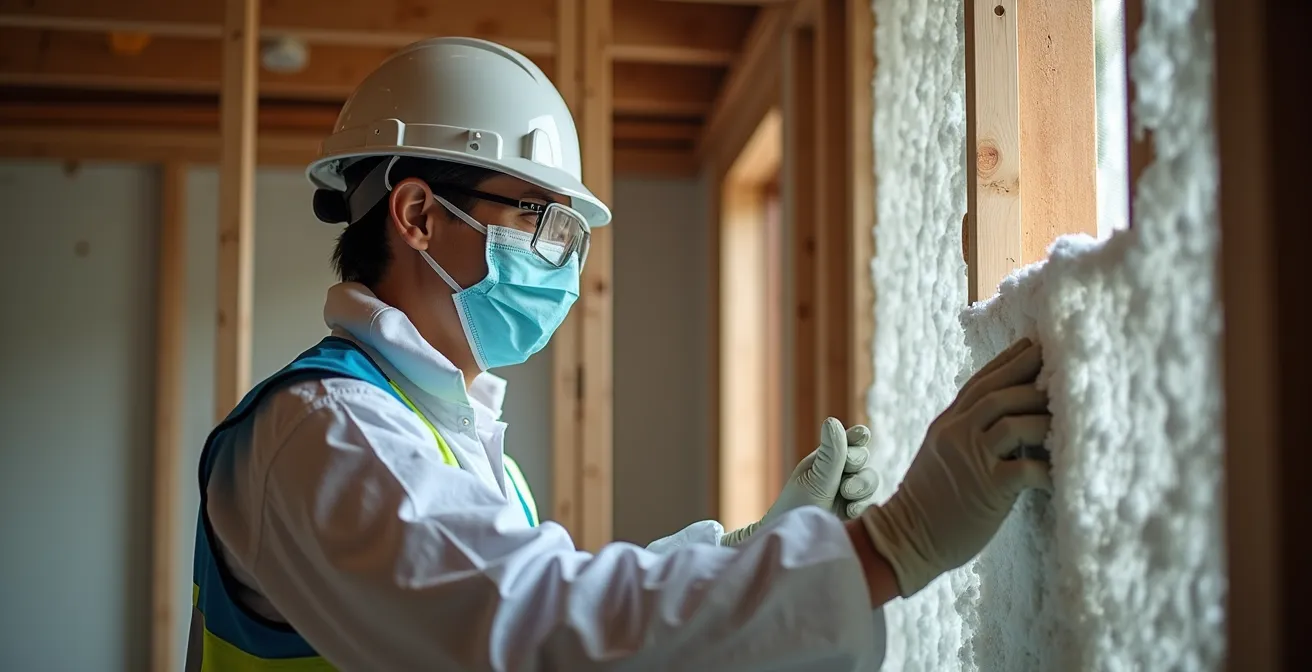
A professional, certified installer will welcome this scrutiny as it validates their quality. A fraudulent one will make excuses. Do not proceed until you have this documentation in hand. The checklist below outlines the non-negotiable questions you must ask before any spray foam work begins.
Contractor Vetting Checklist for Spray Foam Installers
- Ask: ‘Are your installers certified under a CCMC-approved program like CALIBER and compliant with the CAN/ULC-S705.2 standard?’
- Request: ‘May I see the valid, photo-ID installer license for each person working on my property before work begins?’
- Demand: ‘Will you provide the material data sheets for both the isocyanate and resin components, clearly showing the CCMC numbers?’
- Verify: ‘Can you provide proof of both General Liability AND Pollution Liability insurance specific to spray foam application?’
- Document: ‘Will you provide daily batch records with the specific lot numbers and CCMC numbers for all materials used on-site?’
How Documenting Certified Upgrades Adds $5,000 to Your Home Appraisal?
An undocumented upgrade has no value. In fact, it can be a detriment. When a home appraiser cannot verify the quality and compliance of an improvement, they must assume the worst-case scenario. An unidentifiable insulation job is not an asset; it’s a potential problem that a future buyer will have to deal with. Conversely, a fully documented, CCMC-certified insulation upgrade is a tangible asset that directly increases your home’s value. The National Research Council reports that over 6,000 regulators across Canada trust CCMC assessments, and professional appraisers are part of this group.
To realize this value, you must create what I call a “Home Energy Passport.” This is not just a folder of receipts; it is a professional dossier that provides irrefutable proof of the quality and compliance of your energy upgrades. This dossier transforms your expenditure into a documented, verifiable asset that an appraiser can confidently include in their valuation, often adding thousands of dollars to your home’s price. A $5,000 increase in appraisal value for a properly documented insulation project is a conservative estimate.
Documentation Strategy: The Home Energy Passport
Creating a comprehensive “Home Energy Passport” is the key to capitalizing on your investment. This file provides appraisers with verifiable proof of compliance. Your passport must contain: (1) Printouts of the CCMC evaluation reports from the official registry for every product used. (2) Contractor invoices that itemize specific product names and their corresponding CCMC numbers. (3) Dated photographs of the installation in progress, showing the product packaging with CCMC marks visible before it is covered. (4) If applicable, the post-upgrade EnerGuide rating assessment report, which quantifies the energy performance improvement.
This level of documentation removes all ambiguity. It proves to any appraiser, insurer, or potential buyer that the work was done correctly, with compliant materials, adding real, quantifiable value to your property. It’s the ultimate manifestation of turning a compliance requirement into a financial win.
Why General Liability Insurance is Non-Negotiable for Insulation Pros?
When you hire an insulation contractor, you are not just buying a product; you are temporarily transferring a significant amount of risk to a third party. However, this risk transfer is only effective if the contractor is properly insured. General Liability (GL) insurance is the absolute minimum, but for spray foam, it is insufficient. You must demand proof of Pollution Liability insurance as well. This specific coverage is designed to cover damages from chemical overspray, off-gassing, and environmental contamination—risks inherent to spray foam application that are often excluded from standard GL policies.
Hiring an uninsured or underinsured contractor is equivalent to accepting all that liability yourself. If their faulty application causes damage to your neighbour’s property, or if a chemical leak requires environmental cleanup, you could be held financially responsible. A professional contractor understands this and invests in proper coverage. Their insurance certificate is a key indicator of their professionalism and financial stability. Do not take their word for it; you must verify it yourself.
The CCMC itself provides a framework for accountability, noting in its evaluation documents that building officials have the power to enforce quality control. As stated in one CCMC document, “Building officials can contact the SQAP provider to request site-audits at a specific building site.” This underscores the web of accountability that legitimate contractors operate within. Your verification of their insurance is simply you playing your part in that system.
Action Plan: Contractor Insurance Verification
- Request a Certificate: Ask for a current Certificate of Insurance showing both General Liability and Pollution Liability coverage.
- Note the Broker: Identify the insurance broker or company name and their contact phone number from the certificate.
- Make the Call: Call the broker directly to confirm the policy is active, has not lapsed, and that premiums are paid.
- Verify Coverage: Confirm that the policy covers the specific work being done (e.g., “spray polyurethane foam installation”) and that the coverage amounts meet provincial minimums (typically $2 million for GL).
- Document Everything: Keep a record of your verification call, including the date, time, and the name of the representative you spoke with.
How to Verify if the ULC Stamp on Your Insulation is Fake?
Alongside the CCMC mark, the Underwriters Laboratories of Canada (ULC) stamp is another critical indicator of safety, specifically related to fire performance. The ULC mark certifies that a product has been tested to meet specific fire resistance and surface burning characteristics standards, such as the CAN/ULC-S102 test. A missing or fake ULC stamp on a product that should have one (like foam plastics or fire-rated mineral wool) means its fire performance is unknown and cannot be trusted. In the event of a fire, this is a fatal flaw for your insurance claim.
Verifying a ULC stamp requires a similar forensic mindset to checking a CCMC number. Fake stamps often have tell-tale signs:
- Poor Print Quality: Legitimate ULC marks are sharp and professionally printed. Fakes are often blurry, have inconsistent ink, or incorrect proportions.
- Missing File Number: A genuine ULC mark is almost always accompanied by a file number (e.g., “ULC File R12345”). A missing number is a major red flag.
- Generic Language: Look for the specific standard the product is certified to (e.g., “CLASSIFIED TO CAN/ULC-S102”). Vague terms like “ULC Fire Rated” are suspicious.
The best way to verify is to use the file number on the ULC Online Certifications Directory. If the number doesn’t bring up the exact product from the exact manufacturer, the stamp is fraudulent. This is particularly crucial for older homes, as unidentified insulation can pose severe risks. For instance, it’s widely recommended that insulation in properties built before 1987 may contain asbestos and should be tested, highlighting the danger of unknown materials. A fake ULC stamp presents a similar, albeit different, type of hidden danger.
Key Takeaways
- CCMC certification is not an optional “nice-to-have”; it is the mandatory proof of compliance required by Canadian building codes and insurers.
- Your primary defense is documentation. Treat invoices, CCMC registry printouts, and installation photos as legal evidence to protect your investment.
- The financial risk of using non-certified materials—from denied insurance claims to decreased home value—far outweighs any initial cost savings.
Why Does the 2020 National Building Code Require Higher R-Values?
The final piece of the compliance puzzle is understanding that the standards are constantly evolving. The 2020 National Building Code of Canada (NBC) introduced a tiered system for energy efficiency, pushing for higher R-values across the country to improve building performance, reduce energy consumption, and increase resilience. As the NRC explains, these “Energy performance tiers are established to provide a framework for achieving higher levels of energy efficiency.” This means that what was compliant in 2015 may no longer be sufficient for new construction or major renovations today.
Using a non-certified product is a double failure in this context. Not only does it lack proof of safety, but it also has no verifiable R-value. You cannot prove it meets even the lowest tier of the current code. This is particularly important as requirements vary significantly by climate zone. An R-value suitable for Vancouver is grossly inadequate for Calgary or Winnipeg. Using a product with an unverified R-value means you are likely failing to meet the specific legal requirement for your location.
The table below, based on the NBC 2020 framework, illustrates how demanding these requirements are. Meeting them requires precision-engineered products whose performance is guaranteed—a guarantee that only comes with CCMC certification. Choosing a generic product is not just a risk; it is a guaranteed failure to comply with the current national standard.
| City | Climate Zone | HDD Range | Attic R-Value | Above-Grade Wall | Basement Wall |
|---|---|---|---|---|---|
| Vancouver | Zone 4 | <3000 | R-40 | R-20 | R-12 |
| Toronto | Zone 5 | 3000-3999 | R-50 | R-24 | R-15 |
| Calgary | Zone 7A | 5000-5999 | R-60 | R-29 | R-20 |
| Winnipeg | Zone 7B | 6000-6999 | R-60 | R-29 | R-20 |
| Edmonton | Zone 7B | 6000-6999 | R-60 | R-29 | R-20 |
Your home is your most significant investment. Do not compromise its structural and financial integrity for a few hundred dollars. Inspect every material, verify every certification, and demand proof. Your future self—and your insurer—will thank you for your diligence.