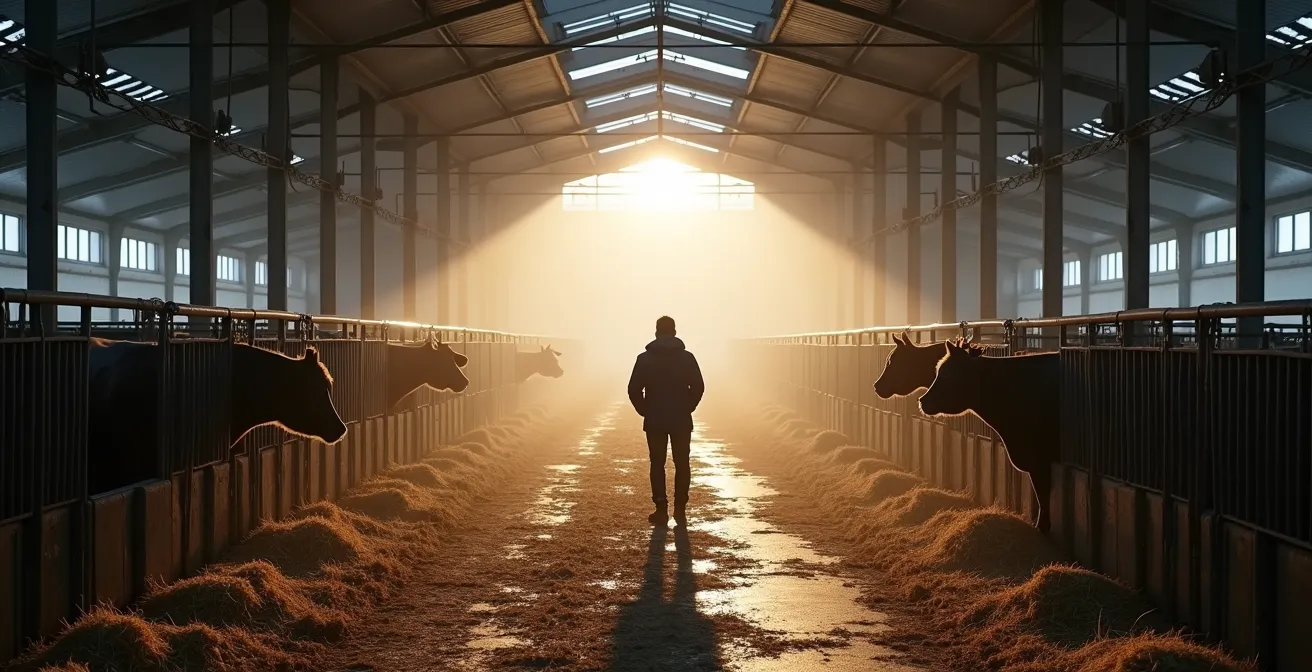
Condensation in your metal barn isn’t just water; it’s a direct attack on your animals’ health and your bottom line.
- An uninsulated roof creates an “indoor rain” effect by allowing warm, moist interior air to hit the cold metal, fostering respiratory disease in livestock.
- A complete system—a continuous air seal, a robust thermal barrier, and balanced ventilation—is the only permanent fix, not piecemeal solutions.
- The right insulation materials, like closed-cell spray foam, not only provide high R-values but also create a pest-proof and moisture-impenetrable barrier that withstands harsh farm conditions.
Recommendation: Stop patching symptoms. Invest in a complete building envelope assessment to design a system that delivers a return in animal health, reduced spoilage, and energy savings within a few seasons.
If you’re a Canadian farmer, you know the sight all too well. It’s -20°C outside, but inside your steel-clad barn, it feels like it’s raining. Water drips from the purlins, runs down the walls, and soaks the bedding. You hear a few more coughs from the cattle than you’d like. This isn’t just a nuisance; it’s a direct assault on your operation’s productivity. That constant dampness is a breeding ground for bacteria and viruses, leading to respiratory infections, increased vet bills, and poor feed conversion. Your animals are burning energy just to stay warm, not to grow.
Many people think the solution is just to “add some insulation” or “put in a bigger fan.” They might install some fibreglass batts, which quickly become saturated, mouldy, and a perfect home for rodents. Or they’ll add powerful exhaust fans that just pull more cold air in, creating drafts and driving up heating costs. These are common, costly mistakes that treat the symptoms, not the disease. They fail to address the core physics at play in a high-moisture environment like a livestock barn.
The truth is, solving condensation and improving animal welfare isn’t about a single product. It’s about creating a complete, high-performance building envelope. This means thinking like an engineer, not just a handyman. The real key lies in mastering the ‘Unbreakable Trio’: a continuous air barrier, an effective thermal barrier, and balanced, properly engineered ventilation. Forget patching the problem; the goal is to build a dry, healthy, and productive “building-within-a-building” that protects your livestock and your investment from the harsh realities of a Canadian winter.
This guide will walk you through the practical, no-nonsense steps to transform your metal barn from a condensation-plagued liability into a high-performance agricultural asset. We’ll cover everything from the underlying science to the specific materials and installation details that make all the difference.
Summary: A Systematic Approach to Barn Insulation and Health
- The “Raining Inside” Phenomenon: How to Stop Condensation in Metal Barns?
- How to Stop Rats from Nesting in Your Barn Insulation?
- The Starter Strip Mistake That Lets Mice Under Your New Siding?
- Fiberglass vs. Rigid Board: Which Can Withstand Pressure Washing?
- Natural vs. Mechanical Ventilation: What Works for 100 Head of Cattle?
- Spray Foam in Heritage Barns: Is It Safe for the Timber?
- How to Maintain 4°C and 90% Humidity Without Rotting the Structure?
- How Insulating Warehouse Ceilings Reduces Heating Costs by 40%?
The “Raining Inside” Phenomenon: How to Stop Condensation in Metal Barns?
That “indoor rain” you’re seeing is condensation, and it’s a simple, destructive process. Your livestock generate a massive amount of heat and moisture just by breathing. When this warm, humid air rises and hits the cold surface of your uninsulated metal roof, the temperature of the air drops instantly. As it cools, it can no longer hold the same amount of moisture, so the water vapour turns back into liquid water—the dew point—right on your ceiling. This is the source of your wet bedding, slippery floors, and, most critically, the damp, chilly air that causes respiratory stress in your animals.
The solution is not just insulation; it’s a three-part system known as the Unbreakable Trio: a continuous air barrier, a continuous thermal barrier, and balanced ventilation. The air barrier (often achieved with closed-cell spray foam or meticulously taped membranes) stops the warm, moist interior air from ever touching the cold metal structure. The thermal barrier (the insulation itself) keeps the interior surface of your wall or ceiling warm, well above the dew point. Finally, balanced ventilation removes excess moisture in a controlled way, without creating cold drafts.
One Alberta cattle operation provides a stark example. They were fighting severe winter condensation, replacing thousands of dollars in soaked bedding annually. By investing CAD $18,000 to install R-30 closed-cell spray foam that created both an air and thermal barrier, they achieved a 100% elimination of indoor rain. The benefits went far beyond a dry ceiling; they saw a 35% reduction in heating costs and saved over CAD $3,000 per year on bedding alone. The entire investment was paid back in under four years, primarily through direct operational savings and improved animal health.
Action Plan: Calculate Your Barn’s Dew Point
- Measure interior temperature and humidity using a digital hygrometer to establish your baseline conditions.
- Check Environment Canada’s data for your specific region’s winter design temperature to know what you’re up against.
- Use an online dew point calculator to determine the exact surface temperature at which condensation will form in your barn.
- Identify thermal bridges—areas like steel purlins and fasteners that transfer cold—using an infrared camera or a simple thermal detector.
- Commit to the “Unbreakable Trio” by designing a system with a continuous air barrier, thermal barrier, and balanced ventilation to address the root cause.
How to Stop Rats from Nesting in Your Barn Insulation?
A warm barn in the dead of winter isn’t just appealing to your livestock; it’s a five-star hotel for rodents. Traditional insulation materials like fibreglass or open-cell foam are a rodent’s dream. They offer no resistance to chewing and provide perfect, warm nesting material. Once they’re in, they tunnel, defecate, and destroy the insulation’s R-value, creating cold spots and re-introducing the condensation problems you tried to solve. This isn’t just a structural issue; it’s a major biosecurity risk.
The key to rodent-proofing isn’t bait or traps; it’s selecting an insulation material that is physically impenetrable. Closed-cell spray foam insulation is the leading choice for this application. Once cured, it becomes a hard, dense plastic with no seams or gaps. There’s nothing for a mouse or rat to grab onto or chew through. According to Canadian insulation specialists, a properly installed layer of closed-cell foam creates a 100% airtight seal that physically blocks rodent entry points. They simply cannot get through it.
This image gives you a close-up look at the dense, non-porous structure of the material.

As you can see, the cellular structure is completely sealed. Unlike fibreglass, which is just a collection of fibres, this is a solid barrier. For maximum protection in a barn, a hybrid approach is often best: install rigid foam boards for the first few feet off the ground as a tough physical shield, then apply closed-cell spray foam above for a seamless, monolithic seal that bonds directly to the structure, leaving no gaps or cracks for pests to exploit.
The Starter Strip Mistake That Lets Mice Under Your New Siding?
You can have the best insulation in the world, but one tiny oversight at the very bottom of your wall can render it all useless. The starter strip—the piece that anchors the first course of siding at the base of the wall—is a common entry point for mice. Many builders use cheap vinyl starter strips, which become brittle in the cold. After a few Canadian freeze-thaw cycles, they crack, warp, or pull away from the foundation, creating a perfect, hidden highway for rodents to get behind your siding and into the wall cavity.
This is a critical failure of the building envelope. It’s not just about mice; this gap also allows cold air to blow in behind your insulation, creating a “wind-washing” effect that dramatically reduces its effective R-value. The solution is to treat the bottom of your wall with the same seriousness as your roof. According to Canadian building envelope research, durable metal starter strips last over 20 years, compared to just 5-7 years for typical vinyl strips in our climate.
To create a truly rodent-proof base for your walls, follow a specific protocol:
- Start with critter-proof metal flashing that runs from the concrete slab at least six inches up the wall.
- Bend the top edge of this flashing outward at a 45-degree angle to create a physical barrier that mice can’t climb over.
- Use a heavy-duty, galvanized metal starter strip (minimum 26-gauge) and install it over the flashing, sealing the top edge with a continuous bead of polyurethane sealant.
- Ensure your weather-resistant barrier (the building wrap) overlaps and covers the top of the starter strip flashing, directing any water outward.
This multi-layered, robust approach creates a physical barrier that is simply too tough and well-sealed for pests to defeat. It’s a small detail that protects the integrity of your entire insulation system.
Fiberglass vs. Rigid Board: Which Can Withstand Pressure Washing?
A barn is not a house. It’s a working environment that needs to be cleaned, often with high-pressure water, to maintain biosecurity and animal health. This is where many common insulation materials fail spectacularly. Fibreglass batts are the worst offender. A direct hit with a pressure washer will tear them apart, and even ambient moisture will cause them to clump, sag, and become a breeding ground for mould. They are completely unsuitable for any area that requires regular washing.
This is a critical factor when choosing your thermal barrier. You need a material that is not only a good insulator but also durable, water-resistant, and compliant with hygiene standards like those from the Canadian Food Inspection Agency (CFIA). Foil-faced rigid boards (like Polyisocyanurate) are a better option, as the foil provides a washable surface, but the many seams between boards must be perfectly sealed with high-quality tape to prevent water intrusion. If water gets behind the board, it can become trapped against the structure.
The following table, based on an analysis of materials for agricultural buildings, breaks down the durability of common insulation types.
| Material Type | Pressure Washing Resistance | CFIA Compliance | Chemical Resistance | Lifespan |
|---|---|---|---|---|
| Closed-Cell Spray Foam | Excellent | Yes | High | 80-100 years |
| Rigid Board (Foil-Faced Polyiso) | Good with proper sealing | Yes | Moderate-High | 25-30 years |
| Fiberglass Batts | Poor | No | Low | 15-20 years |
| PVC-Lined Panels | Excellent | Yes | Excellent | 30-40 years |
As the data shows, closed-cell spray foam and PVC-lined panels are the top performers for durability and cleanability. Closed-cell spray foam has the added advantage of forming a monolithic, seamless barrier with no joints for water or bacteria to hide in, making it a superior choice for long-term biosecurity and maintenance in a demanding farm environment.
Natural vs. Mechanical Ventilation: What Works for 100 Head of Cattle?
A perfectly insulated and air-sealed barn is only two-thirds of the solution. Without proper ventilation, you’ve just created a thermos bottle that will trap every bit of moisture, ammonia, and CO2 your animals produce. Air quality will plummet, and you’ll be right back to having sick animals. For a herd of 100 cattle, you need a system designed to handle a massive moisture load and provide consistent air quality, even at -30°C.
The debate between natural (passive) and mechanical (fan-driven) ventilation is often framed as an either/or choice, but for a Canadian climate, the best solution is almost always a hybrid system. Natural ventilation, using ridge and soffit vents, works beautifully during milder weather, using the natural stack effect (hot air rising) to move air with zero energy cost. However, on still, cold winter days, it can be insufficient. On windy days, it can be too much, causing drafts. According to Canadian barn design standards, a minimum of 6-8 air changes per hour (ACH) is required to maintain air quality, a target that natural ventilation alone can’t reliably meet year-round.
A smart hybrid system uses natural ventilation as its baseline and supplements it with mechanical systems only when needed. This involves a few key components:
- Ridge and soffit vents appropriately sized for passive airflow.
- Heat Recovery Ventilators (HRVs) rated for low-temperature operation. These are crucial. They exhaust stale, moist air while using its heat to pre-warm the incoming fresh, cold air, saving enormous amounts of energy.
- Sensors for CO2 and ammonia that automatically trigger the mechanical systems when air quality drops below a set threshold.
- A temperature-based controller that relies on natural ventilation above a certain temperature (e.g., -10°C) and automatically switches to the HRV system during deep cold snaps.
This approach gives you the best of both worlds: the energy efficiency of a passive system and the guaranteed performance of a mechanical one, ensuring your herd has fresh, dry air no matter what the weather is doing outside.
Spray Foam in Heritage Barns: Is It Safe for the Timber?
Insulating a century-old timber frame barn presents a unique challenge. These structures were designed to be leaky, allowing the massive timbers to “breathe” and dry out. Applying the wrong insulation can be a death sentence, trapping moisture against the wood and causing catastrophic rot from the inside out. This is a legitimate fear among owners of heritage properties, and it’s why many hesitate to use modern insulation like spray foam.
The primary concern with closed-cell spray foam is its permanence and its function as a vapour barrier. Because it has a very low perm rating, it stops moisture from passing through. If applied incorrectly—for example, on the inside of a wall that gets wet from the outside—it can trap water against the timbers. However, when used strategically, it can be the best way to protect them. According to 2024 Canadian insulation standards, closed-cell foam provides a superior R-value of R-6.5 per inch compared to R-3.8 for open-cell foam, making it a much more effective thermal barrier in a thinner application.
The key is to use it as part of a system that understands moisture drive. For many heritage barns in places like Ontario and Quebec, a “flash and batt” system is becoming the preservation-minded approach. This involves applying a thin layer (1-2 inches) of closed-cell spray foam directly to the exterior sheathing. This thin layer acts as a perfect air seal and vapour barrier, protecting the timbers from the high interior humidity of the barn. Then, the rest of the wall cavity is filled with a “breathable” insulation like mineral wool batting. This allows the timber structure itself to dry out to the exterior should it ever get wet, while the foam layer provides the crucial protection from the inside.
For priceless structures, embedding wireless moisture sensors into key beams before insulating allows for real-time monitoring of the wood’s health. It’s an insurance policy that combines modern performance with heritage preservation.
How to Maintain 4°C and 90% Humidity Without Rotting the Structure?
While livestock barns deal with removing moisture, specialized agricultural buildings like potato or vegetable storage facilities have the opposite problem: they need to maintain very high humidity at a low temperature to prevent produce from drying out. A target of 4°C and 90% humidity is a recipe for disaster in a typical metal building. It creates a constant, high-pressure moisture drive, pushing water vapour into the wall and roof assemblies where it will condense and cause rot, rust, and structural failure.
The solution here is a counter-intuitive but critical building science principle for cold climates. As building science consultant Mark Lawton of Morrison Hershfield explains, the physics are absolute:
For a structure kept cold year-round like vegetable storage, the primary vapour barrier must be on the outside of the insulation, a counter-intuitive principle critical for preventing interstitial condensation in Canadian climates.
– Mark Lawton, Morrison Hershfield Building Science
This approach is often called “outsulation.” Instead of insulating from the inside, you wrap the entire exterior of the building in a thick layer of rigid foam insulation, creating a perfect air and vapour barrier on the outside. This keeps the entire metal structure on the “warm” side of the insulation (relative to the cold exterior), so the dew point is never reached within the wall assembly. The metal frame stays dry and protected.
Case Study: Prince Edward Island Potato Storage Facility Success
A PEI potato storage facility, facing significant spoilage issues, implemented an “outsulation” strategy. They wrapped the exterior of their metal building with R-30 rigid foam, creating a perfect air barrier. This approach kept the entire metal structure on the warm side of the dew point. After 10 years, thermal imaging showed zero moisture penetration and no structural decay. More importantly, the facility reported a 15% reduction in potato spoilage, providing a clear and significant return on their investment.
Key takeaways
- Condensation is the primary enemy in a metal livestock barn, directly impacting animal health and structural integrity.
- There is no single-product solution. A successful outcome depends on the “Unbreakable Trio”: a continuous air barrier, a continuous thermal barrier, and balanced ventilation.
- Material choice is critical. Closed-cell spray foam offers a unique combination of high R-value, durability, and an integrated air, vapour, and pest barrier.
How Insulating Warehouse Ceilings Reduces Heating Costs by 40%?
While the primary driver for insulating a livestock barn should be animal health and productivity, the financial benefits from energy savings are a significant and highly predictable bonus. In a large, high-ceilinged metal building, the vast majority of heat is lost straight through the uninsulated roof. Because heat rises, creating a robust thermal barrier at the ceiling level is the single most effective action you can take to slash your heating bill.
Modern insulation materials, particularly closed-cell spray foam, offer remarkable thermal resistance. Based on a 2025 Canadian insulation market analysis, spray foam can reduce energy bills by up to 50% thanks to its high R-value and its ability to stop heat loss from air leakage. This isn’t just a theoretical number; it’s a proven result seen in agricultural operations across Canada. Consider a 10,000 sq ft Manitoba hog barn that invested CAD $25,000 to insulate its ceiling with R-38 closed-cell spray foam. Their annual propane heating bill immediately dropped from CAD $18,000 to $10,800—a 40% reduction that saved them $7,200 in the first year alone.
But the real story is in the productivity gains. The more stable, draft-free environment led to an 8% improvement in the hogs’ feed conversion ratio. This performance boost was worth an additional CAD $12,000 per year to the operation. When they factored in a 35% grant from the Canadian Agricultural Partnership program, their actual out-of-pocket cost was only $16,250. With combined annual savings and productivity gains of over $19,000, the project’s payback period was less than two years. This demonstrates that insulation is not an expense; it is a high-yield investment.
The evidence is clear: treating your barn’s insulation as a complete system protects your animals, cuts your costs, and boosts your productivity. The next logical step is to move from theory to action by getting a professional assessment of your building’s specific needs.
Frequently Asked Questions on Why Uninsulated Metal Roofs Kill Livestock Productivity in Winter?
What is the ‘Flash and Batt’ hybrid technique for heritage barns?
Apply 1-2 inches of closed-cell spray foam to air-seal and protect timber from interior moisture, followed by mineral wool batting that allows the structure to breathe – a balanced approach gaining traction in Ontario and Quebec heritage barns.
Can spray foam insulation be reversed for future timber inspection?
No, spray foam is permanent. For heritage barns requiring future inspection capability, use high-performance membrane systems with rigid boards that can be disassembled for timber frame maintenance.
How can I monitor timber moisture content after insulation?
Embed wireless moisture sensors into key structural timbers before covering with insulation. This allows real-time monitoring of wood health and prevents catastrophic failure while preserving the heritage structure.