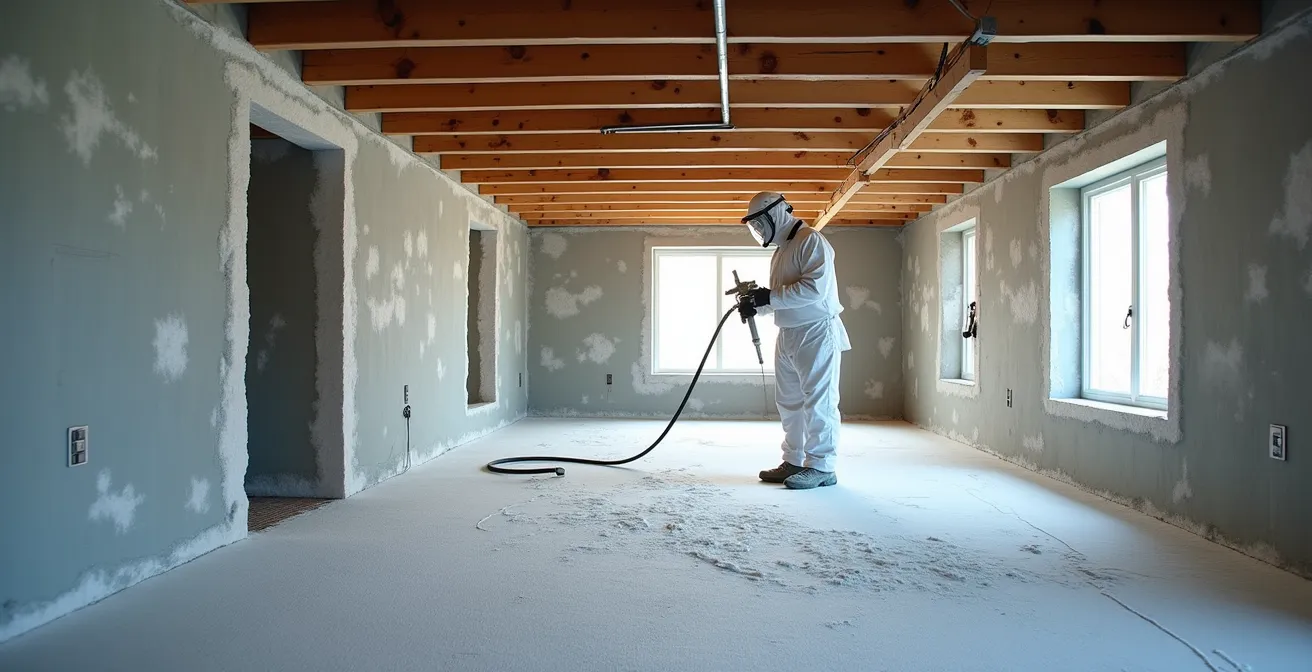
For older Canadian homes, eliminating drafts isn’t about R-value—it’s about creating a perfect, monolithic air seal that corrects structural inconsistencies, a task only closed-cell spray foam can achieve.
- Traditional insulation like fiberglass fails in irregular joist spaces, allowing air leakage (the primary source of heat loss) to continue.
- Closed-cell spray foam acts as an all-in-one air barrier, vapour barrier, and high-performance insulator that structurally adheres to old framing.
Recommendation: Instead of focusing on R-value alone, demand a blower door test to measure the actual airtightness (ACH) of your home before and after insulation work.
If you own an older Canadian home, you know the feeling: that persistent, creeping cold from the floors, no matter how high you crank the thermostat. You’ve likely been told the solution is to “add more insulation” and focus on achieving a high R-value. This is the most common advice, and for older homes with non-standard framing—crooked, uneven, and unpredictable joist spaces—it’s fundamentally wrong. The real culprit isn’t a lack of fluffy insulation; it’s air leakage. Your home’s original building envelope is compromised, and simply stuffing it with more fiberglass is like trying to carry water in a leaky bucket.
The problem with the century-old houses we love, from Toronto Victorians to Prairie farmhouses, is that their rim joists and header spaces are a chaotic web of pipes, wires, and uneven wood. Trying to seal this with batts or rigid foam boards creates dozens of seams and gaps, which are highways for cold air. This is where the entire conversation needs to shift from R-value to performance. The true solution lies in building envelope correction, creating a single, unbroken, and structurally integrated barrier that stops air dead in its tracks. This is not just insulation; this is building science in action.
This guide abandons the myth of R-value as the ultimate goal. As a certified applicator, I will demonstrate why a professionally installed, closed-cell spray foam system is the only method that creates the monolithic air seal required to permanently fix the drafts and high heating bills that plague older Canadian homes. We will cover the correct material choice, critical safety protocols, and the real-world metrics that prove its superiority, showing you how to solve the problem at its structural source.
For homeowners who prefer a visual format, the following video demonstrates a different, though related, technique using rigid foam. It highlights the complexity of manually sealing joist ends, which helps to understand the advantages of a monolithic spray foam application.
To fully understand why this approach is so critical, this article will break down the essential technical aspects, safety considerations, and financial justifications. We will move from the foundational science of the material to the tangible results you can measure in your home’s performance and comfort.
Summary: Fixing Irregular Joists with Spray Foam
- Open Cell vs. Closed Cell: Which One Belongs in Your Basement Rim Joist?
- How to Vacate Your Home Safely During the 24-Hour Off-Gassing Period?
- The “Fishy Smell” Warning: What Indicates a Bad Spray Foam Mix?
- How to Stop Cold Floors Above the Porch with Spray Foam?
- Is Spray Foam Worth 3x the Price of Fiberglass for a Garage Conversion?
- What Does a Blower Door Test Score of 3.5 ACH Mean for Your Home?
- Spray Foam or Rigid Board: Which is Best for the Header Space?
- Why Your Heating Bill is High Even With R-60 in the Attic?
Open Cell vs. Closed Cell: Which One Belongs in Your Basement Rim Joist?
When we talk about spray foam, it’s not one-size-fits-all. The choice between open-cell and closed-cell foam is the most critical decision, and for the damp, cold environment of a Canadian basement rim joist, there is only one correct answer: closed-cell foam. Open-cell foam is like a sponge; it’s soft, pliable, and it will absorb and hold moisture. Using it below grade is asking for trouble with mould and rot. Its low density also means it provides a lower R-value per inch, typically around R-3.5 to R-4.
Closed-cell foam, by contrast, is a rigid, dense material. Its cellular structure is completely sealed, making it impermeable to water and vapour. This is crucial because, in a single application, it serves as your insulation, your air barrier, and your vapour barrier, as required by Canadian building codes. You don’t need to add a separate poly sheet, which is nearly impossible to install perfectly in an irregular joist space anyway. It provides a much higher insulating value, with most professional-grade products delivering an R-value of R-6 to R-6.5 per inch. This allows us to achieve high R-values in the shallow cavities of a rim joist.
Meeting Ontario Building Code in a Single Step
The Ontario Building Code demands a minimum of R-12 for basement walls. As detailed in an analysis by basement insulation specialists in the region, applying just two inches of closed-cell spray foam to the rim joists not only achieves this R-12 value but also satisfies the code’s vapour barrier requirements simultaneously. This one-step application eliminates the complex, failure-prone process of taping and sealing that would be necessary if using open-cell foam or other insulation types, making it the most reliable method for code compliance.
This table, based on a technical comparison for Canadian applications, clearly lays out why closed-cell is the superior choice for below-grade work, especially in regions where radon is a concern.
| Property | Open-Cell Foam | Closed-Cell Foam |
|---|---|---|
| R-Value per inch | R-3.5 to R-4 | R-6 to R-6.5 |
| Vapour Permeance | High (requires separate barrier) | Low (acts as vapour barrier) |
| NBC Code Compliance | Requires additional vapour barrier | Meets code in single application |
| Cost per sq ft | $0.44-$0.65 | $1.00-$1.50 |
| Radon Mitigation | Not effective | Acts as soil gas barrier |
How to Vacate Your Home Safely During the 24-Hour Off-Gassing Period?
The most important part of any spray foam job isn’t the foam itself—it’s the safety of the occupants. The two components of spray foam create a chemical reaction that releases vapours, or “off-gasses,” as it cures. While the foam is inert and stable once fully cured, exposure during the curing period is hazardous. That’s why any reputable, certified applicator will insist that the home is vacated by all people and pets for a minimum of 24 hours. This is not a suggestion; it’s a mandatory safety protocol.
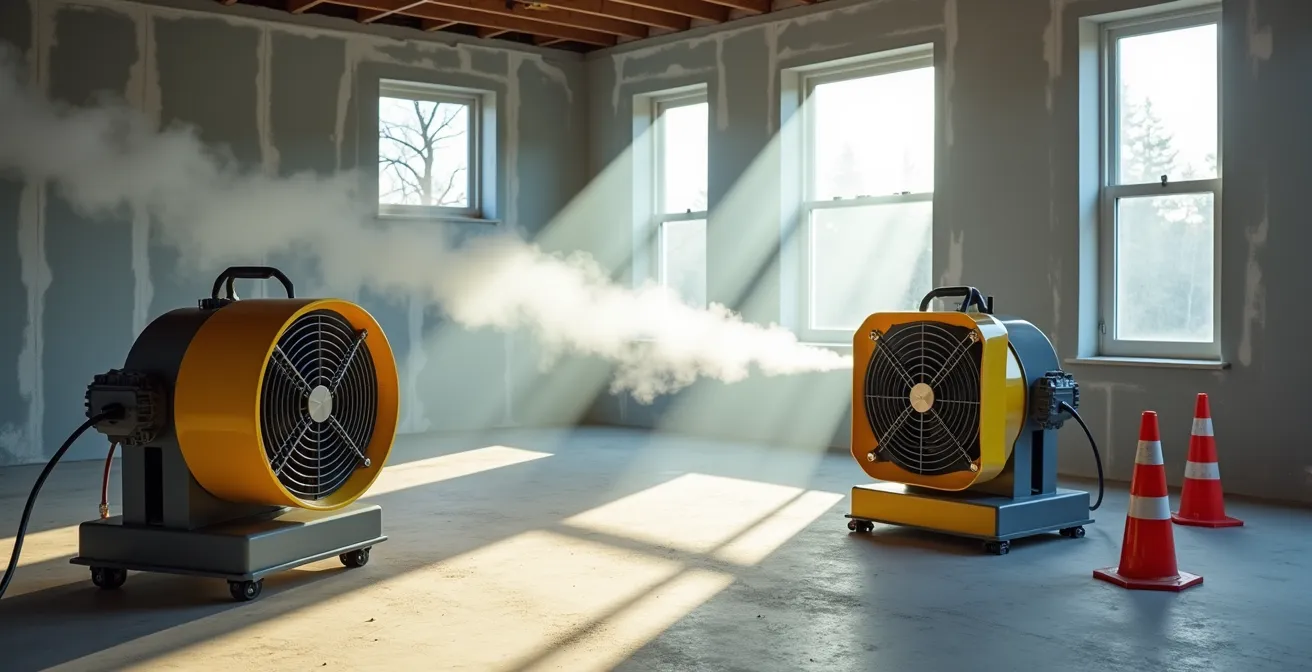
During this period, our job is to ensure active ventilation. We set up powerful fans and air scrubbers, creating negative pressure to exhaust the curing vapours directly to the outside. Simply opening a window is not enough. The goal is a complete air exchange to ensure that by the time you return, the indoor air quality is safe. This process must be managed by a professional who understands the chemistry and the building’s airflow dynamics.
A key part of our responsibility is to ensure the work is done according to Canadian standards. A certified installer will be CUFCA (Canadian Urethane Foam Contractors Association) accredited and use products that comply with the CAN/ULC-S705.2 standard. This is your assurance that both the material and the installation methods meet Canada’s strict safety and performance requirements. Don’t be afraid to ask for proof of certification; a true professional will be proud to show you.
Your Action Plan: Safe Evacuation for Spray Foam Installation
- Verify installer’s CUFCA certification and confirm they use products compliant with CAN/ULC-S705.2.
- Arrange guaranteed accommodation for all occupants and pets for a full 24-48 hours, not just one day.
- If installation occurs in winter, schedule it for a day with temperatures above -10°C and set your thermostat to at least 15°C to prevent pipes from freezing.
- Document any pre-existing conditions in the work area with photographs for your own records and warranty purposes.
- For ultimate peace of mind, consider requesting post-installation VOC (Volatile Organic Compound) testing from a third-party certified professional.
The “Fishy Smell” Warning: What Indicates a Bad Spray Foam Mix?
In a perfect installation, the cured foam should be completely odourless. However, if you ever detect a persistent, sharp, often-described-as-“fishy” smell days or weeks after the job is done, this is a major red flag. This odour is caused by unreacted amine catalysts, a clear sign that the foam was mixed “off-ratio.” The two chemical components (Side A and Side B) must be mixed at a precise 1:1 ratio and at the correct temperature and pressure. If the equipment is poorly calibrated or the technician is inexperienced, the chemistry is thrown off.
This isn’t just an unpleasant smell; it indicates the foam did not cure properly and may never fully cure. It will not have the specified R-value, it may not adhere correctly to the substrate, and it could continue to off-gas harmful chemicals indefinitely. The cause is almost always installer error. This is a complex chemical process happening on-site, and the equipment requires constant monitoring and calibration. During curing, the foam is undergoing a powerful exothermic reaction. As one technical bulletin notes:
During curing, the foam may reach core temperatures as high as 325°F for short periods of time
– MCA Technical Bulletin
This intense heat is part of a proper reaction. An off-ratio mix fails to complete this reaction properly. If this happens, there is only one solution: complete removal and replacement. Do not let any contractor tell you they can “paint over it” or “seal it in.” The defective material must be physically cut out and disposed of, the area thoroughly ventilated, and the job redone correctly at the contractor’s expense. This is why choosing an installer with a long track record, proper CCMC approval, and a written warranty is so important. It’s your only protection against a costly and hazardous mistake.
How to Stop Cold Floors Above the Porch with Spray Foam?
One of the most common complaints in older Canadian homes is the notoriously cold floor in a room situated above an unheated porch or a cantilevered overhang. Homeowners often find that even with thick fiberglass batts packed into the joist space below, the floor remains freezing in winter. The reason is simple: wind-washing. Cold winter wind blows through the porch ceiling, goes right through the seams of the fiberglass, and strips all the heat from the floor above. The R-value of the batts becomes almost meaningless because air is moving freely around and through it.
This is a classic case where only a monolithic air seal will work. When we apply closed-cell spray foam in this situation, we are doing far more than just insulating. The foam expands to fill every single crack and crevice, bonding directly to the floor sheathing above and the joists around it. It creates a completely solid, airtight, and structural block. Wind can no longer penetrate the assembly. The result is dramatic, transforming a perennially cold room into a comfortable living space.
The problem is so significant that in some homes, these uninsulated rim joists in cantilevered areas can account for up to 15-25% of a home’s total heat loss. It’s a massive thermal bridge hidden out of sight.
Toronto Cantilevered Floor Case Study
A 1973 home in Toronto had a severe problem with freezing floors over the front porch. A thermal imaging inspection, detailed in a report by a local Canadian insulation firm, revealed that wind-washing had compressed the existing R-20 fiberglass, reducing its effective performance to less than R-10. After professionals removed the failed batts and applied 3 inches of closed-cell spray foam (achieving a true R-18), the floor’s surface temperature increased by a remarkable 8°C. This completely eliminated the condensation and cold that had made the room unusable in winter for decades.
Is Spray Foam Worth 3x the Price of Fiberglass for a Garage Conversion?
When converting a garage into a living space, the cost question always comes up. On a square-foot basis, a professional closed-cell spray foam installation can seem significantly more expensive than buying fiberglass batts from a big-box store. For example, general spray foam insulation costs in Toronto range from $1.00-$1.50 per board foot for a professional job, whereas fiberglass might be a third of that. So, is the premium justified? Absolutely, and the reason lies in total project cost, long-term performance, and property value.
First, consider the “all-in-one” advantage. To properly insulate a garage wall with fiberglass to meet Canadian building codes, you need the batts, a separate vapour barrier (poly sheeting), and a huge amount of labour to meticulously tape and seal every seam, outlet box, and penetration to create an air barrier. This is time-consuming and prone to error. With closed-cell spray foam, the insulation, air barrier, and vapour barrier are all installed in a single application. The labour savings are substantial and close the initial cost gap significantly.
Second, the energy savings are not comparable. Because spray foam creates a perfect air seal, it dramatically reduces heating and cooling costs over the life of the home. The payback period for the initial investment is much faster. Finally, a garage conversion insulated with spray foam is a high-quality, high-performance space. It’s warmer, quieter, and more durable, which translates directly to a higher property value. The following analysis, based on data from a home improvement cost guide, breaks down the true return on investment.
| Factor | Fiberglass R-20 | Closed-Cell Foam R-20 |
|---|---|---|
| Material Cost/sq ft | $0.40-$1.20 | $3.00-$4.00 |
| Labor for Code Compliance | High (vapor barrier complexity) | Low (all-in-one application) |
| Annual Energy Savings (GTA) | $200-300 | $400-600 |
| Property Value Increase | $5,000-8,000 | $12,000-18,000 |
| Payback Period | 8-10 years | 4-6 years |
What Does a Blower Door Test Score of 3.5 ACH Mean for Your Home?
In the world of building science, R-value is an increasingly outdated metric. The true measure of a home’s energy performance is its airtightness, and we measure this with a blower door test. This test depressurizes your house to 50 Pascals (a standard pressure difference) and measures how much air leaks in per hour. The result is expressed as ACH50, or Air Changes per Hour at 50 Pa. A score of 3.5 ACH means that every hour, enough air is leaking through gaps and cracks to replace the entire volume of air in your house 3.5 times. It’s a very common score for older, un-air-sealed homes.
To put that number in perspective, Natural Resources Canada offers a powerful visualization. As stated in their technical requirements, the impact is staggering:
A score of 3.5 ACH is equivalent to having a 2-foot square hole in your building envelope operating 24/7
– Natural Resources Canada, R-2000 Home Standard
Imagine a window left wide open all winter long. That’s the reality of a 3.5 ACH home. This is why simply adding R-60 insulation to your attic while ignoring air leaks at the foundation level is a waste of money. You’re trying to heat a house with a giant hole in it. Our goal with a professional spray foam application at the rim joists and other key leakage points is to dramatically lower this ACH score. Modern high-performance building codes in Canada, like the upper tiers of the BC Energy Step Code, now mandate scores of 1.5 ACH or even lower. Achieving these numbers is impossible without a continuous, monolithic air barrier—something only spray foam can reliably provide in a retrofit situation.
Spray Foam or Rigid Board: Which is Best for the Header Space?
For the handy homeowner, the “cut-and-cobble” method of insulating a rim joist (also called a header space) is tempting. This involves cutting pieces of rigid foam board to fit into each joist bay and sealing the edges with canned foam or caulk. While it seems like a cost-effective DIY approach, it is fundamentally flawed and vastly inferior to a professional spray foam application for one critical reason: it fails to create a monolithic seal.
An older home’s header space is never perfectly square. It’s filled with pipes, electrical wiring, and uneven, warped wood. Trying to cut a piece of rigid board to fit perfectly around these obstructions is impossible. Every cut, every seam, and every joint is a potential air leak. The long-term durability of the seal relies entirely on the caulk or canned foam used in the gaps, which will inevitably dry out, crack, and fail over time. As data shows, air leakage through unsealed rim joist penetrations accounts for up to 40% of heat loss in that area. The cut-and-cobble method simply can’t address this effectively.
Professional, two-part spray foam, on the other hand, expands in place, flowing around every pipe and wire and bonding tenaciously to the wood. It becomes one solid, seamless, and permanent piece. There are no joints to fail, no tape to peel, and no gaps for air to find. It’s a complete building envelope correction. This comparative analysis, drawing from a Fine Homebuilding project guide, illustrates the stark differences in quality and durability.
| Method | Time Required | Air Seal Quality | Cost | Durability |
|---|---|---|---|---|
| Cut-and-Cobble Rigid Foam | 4-6 hours/100 sq ft | Moderate (relies on caulk/tape) | $200-300 | 5-10 years (tape fails) |
| Professional Spray Foam | 1-2 hours/100 sq ft | Excellent (monolithic) | $600-800 | 25+ years |
| DIY Spray Foam Kit | 2-3 hours/100 sq ft | Good (if properly applied) | $300-400 | 20+ years |
Key Takeaways
- Air leakage, not low R-value, is the main cause of heat loss in older homes with irregular framing.
- Closed-cell spray foam is the only material that provides insulation, an air barrier, and a vapour barrier in one monolithic application.
- The true measure of performance is a home’s airtightness score (ACH) from a blower door test, not its theoretical R-value.
Why Your Heating Bill is High Even With R-60 in the Attic?
It’s one of the most frustrating homeowner experiences: you spend thousands to blow R-60 insulation into your attic, the highest recommended level, yet your heating bills barely budge and your floors are still cold. This happens because you’ve only addressed one part of a whole-house system. Heat loss in a home is governed by the stack effect, especially during cold Canadian winters. Warm, buoyant air rises and escapes through any small leaks in your attic. This creates a negative pressure at the lowest levels of your house, sucking cold air in through the path of least resistance—your unsealed rim joists.
Your house is acting like a chimney. You can put a cap on the chimney (the attic insulation), but if the fireplace flue is wide open at the bottom (the leaky basement), it will continue to draw cold air in. The rim joist area, while making up a tiny fraction of your home’s total surface, is often the single largest source of air infiltration. As a startling building science study reveals, rim joists can be responsible for over 15% of total air leakage from less than 2% of the building envelope’s area. This disproportionate impact is why attic insulation alone is an incomplete solution.

This is why modern building codes across Canada are shifting focus. As one expert from the Building Science Corporation noted in a review of Canadian performance standards, “The shift towards performance-based targets like airtightness scores in codes like the BC Energy Step Code is official recognition that stopping air leakage is as critical as high R-values.” To truly lower your heating bills and improve comfort, you must treat your house as a system. You must stop the stack effect at its source by creating a perfect, monolithic air seal at the foundation level. Only then will your attic insulation be able to do its job effectively.
By sealing the rim joists, you are not just insulating; you are performing a fundamental correction to your home’s building envelope, finally allowing you to take control of your energy costs and comfort. To begin this process, the next logical step is to get a professional assessment that includes a blower door test to quantify your home’s specific air leakage problems.