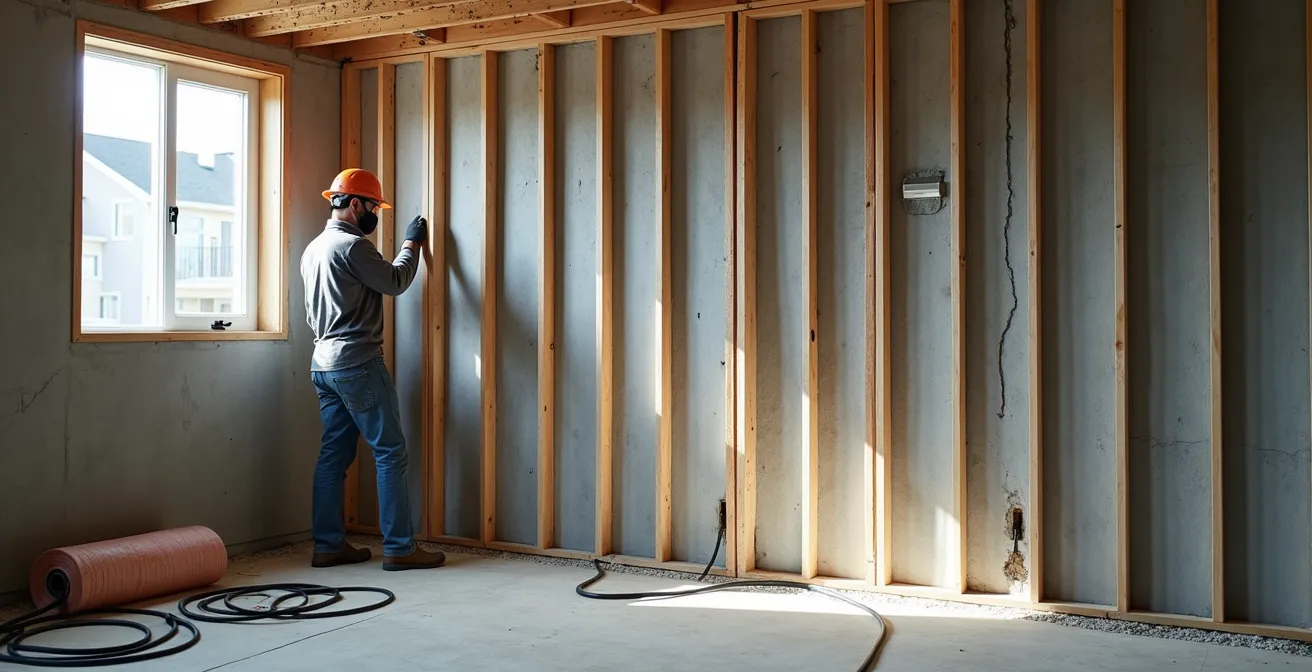
Choosing mineral wool for your Canadian basement is an investment in your home’s long-term structural health, not just a thermal upgrade.
- Unlike fiberglass which acts like a sponge, mineral wool is hydrophobic, actively repelling bulk water and allowing the wall assembly to breathe and dry out.
- Its superior density provides significant fire resistance and soundproofing, transforming your basement into a safer, quieter living space.
Recommendation: For any below-grade space in Canada, prioritize mineral wool to prevent the inevitable mold and rot cycle associated with moisture-trapping insulations.
If you’re finishing a Canadian basement, you know the fear. It’s that subtle, musty smell that signals a damp, unhealthy space. Many homeowners reach for standard pink fiberglass insulation because it’s familiar and cheap. They frame a wall, stuff it in, and hope for the best. But as an installer who has seen what goes on behind those walls years later, I can tell you that this is often a recipe for disaster. Concrete foundations are inherently damp, and trapping that moisture with an absorbent material like fiberglass creates a perfect breeding ground for mold and rot.
The conversation around insulation often gets stuck on R-value, but in a basement, that’s only half the story. The real issue is moisture management. The common advice is to just “add a vapor barrier,” but that doesn’t solve the problem of moisture coming from the concrete itself. This is where the standard approach fails, leading to costly tear-outs and health hazards down the line.
But what if the insulation itself could be the core of your moisture management strategy? The key isn’t to just block heat transfer; it’s to choose a material that works with the unique physics of a below-grade environment. Mineral wool isn’t just a slightly better version of fiberglass; it’s a completely different class of material. It functions as a complete performance system—one that repels water, resists fire, deadens sound, and, most importantly, allows your walls to breathe. It turns your basement from a potential liability into a permanent, healthy extension of your home.
This article will walk you through why we pros consistently choose mineral wool for basement projects. We’ll break down its unique properties, show you how to handle it correctly, and demonstrate why the initial cost premium is one of the smartest investments you can make for the longevity and value of your Canadian home.
Summary: The Professional’s Guide to Mineral Wool for Basements
- How Is Stone Spun into Fiber to Create Fire-Resistant Batts?
- How to Cut Mineral Wool Around Outlets Without Losing R-Value?
- Mineral Wool vs. Fiberglass: Which One Justifies the 30% Cost Premium?
- The Itch Factor: How to Handle Rock Wool Comfortably During Installation?
- Where to Place Mineral Wool to Silence a Noisy Upstairs Teenager?
- Why “Breathable” Insulation Saves Wood Frames from Rotting?
- Why Putting Fiberglass Against Concrete is a Recipe for Mold?
- Which Insulation Gives the Highest R-Value per Inch for Thin Walls?
How Is Stone Spun into Fiber to Create Fire-Resistant Batts?
It sounds like alchemy, but turning solid rock into fluffy insulation is a straightforward, albeit intense, industrial process. It all starts with basalt, a volcanic rock, often sourced from quarries right here in the Canadian Shield. This raw material is the foundation of mineral wool’s incredible durability and fire resistance. The process begins by heating the basalt rock and recycled steel slag in a furnace to a molten state, reaching temperatures that can exceed 1600°C.
Once liquefied, this molten mixture is spun into fine fibers, much like making cotton candy. High-speed spinning wheels fling the liquid rock, and as it cools, it forms incredibly resilient, hair-like strands. A binder is added to help the fibers cohere, and they are then collected and compressed by a hydraulic press into dense, semi-rigid batts. These batts are then cut to fit standard Canadian building dimensions for stud cavities and joist spacing.
This manufacturing process is precisely what gives mineral wool its standout characteristics. Because it’s born from rock, its fire resistance is inherent. Unlike fiberglass, which melts at a much lower temperature, a key safety study shows that mineral wool’s melting point reaches an incredible 3000°F (1600°C). This means that in the event of a house fire, mineral wool insulation acts as a fire-stop, helping to contain the blaze and giving your family precious extra time to get to safety. It’s not just insulation; it’s a critical component of your home’s passive fire protection system.
How to Cut Mineral Wool Around Outlets Without Losing R-Value?
One of the biggest advantages of working with mineral wool is its semi-rigid nature. Unlike floppy fiberglass batts that compress and lose R-value if you so much as look at them wrong, mineral wool holds its shape. This makes cutting it for a precise fit around obstacles like electrical outlets and pipes a clean and efficient process, crucial for maintaining a continuous thermal barrier.
The best tool for the job is not a utility knife, but a long, serrated blade. A bread knife from the kitchen (that you’ll dedicate to insulation jobs) or a specialized insulation knife works perfectly. To cut around an outlet box, first press the batt firmly into the stud cavity so it makes an impression of the box’s edges. Pull the batt out and place it on a piece of plywood or scrap drywall. Using the impression as your guide, make a clean, full-depth cut with your serrated knife. You can easily carve out the exact shape of the box.
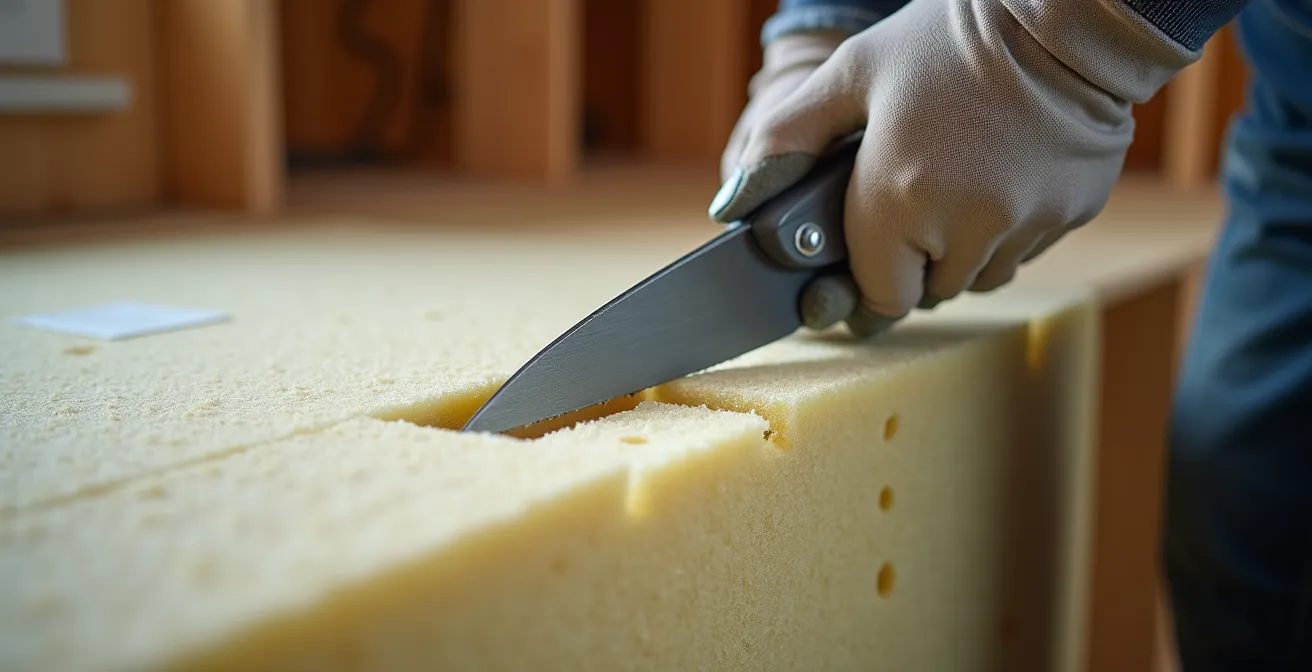
The beauty of this method is that the rigidity of the mineral wool allows you to create a perfect friction fit. The piece you cut out for the box can be placed back into the wall to insulate the small space behind the box, and the main batt slides back in, fitting snugly around the box with no compression and no gaps. This meticulous fit is something you simply can’t achieve with fiberglass, which tends to bunch up and create air pockets, leading to thermal bridging and significantly reduced performance. A proper cut means you maintain the full R-value of the wall assembly.
Mineral Wool vs. Fiberglass: Which One Justifies the 30% Cost Premium?
Let’s be blunt: yes, mineral wool costs more upfront. You can expect to pay anywhere from 25% to 50% more than you would for standard fiberglass batts. For a homeowner on a tight budget, that can be a tough pill to swallow. However, framing the decision as a simple cost comparison is a mistake. You’re not just buying insulation; you’re investing in performance, safety, and the long-term health of your home. The question isn’t “Can I afford mineral wool?” but rather “Can I afford not to use it in a high-risk area like a basement?”
The premium price buys you a fundamentally superior product across every meaningful metric for a below-grade application. Fiberglass is essentially a one-trick pony: it traps air to slow heat transfer. Mineral wool does that, but it also manages moisture, blocks fire, and deadens sound far more effectively. In a damp Canadian basement, fiberglass’s tendency to absorb and hold moisture makes it a liability. Once it gets wet, its R-value plummets, and it becomes a food source for mold. Mineral wool, being hydrophobic (water-repellent), prevents this entirely.
When you look at the performance data, the value proposition becomes clear. It’s not just an incremental improvement; it’s a leap in capability that directly addresses the primary risks of a finished basement. The following table, based on a detailed performance analysis, lays out the facts.
| Feature | Mineral Wool | Fiberglass |
|---|---|---|
| R-Value (2×4 wall) | R-15 | R-13 |
| R-Value per inch | R-4.0 | R-3.0 |
| Fire Resistance | Melts at 3000°F | Melts at 1200°F |
| Moisture Resistance | Hydrophobic | Absorbs water |
| Soundproofing (STC) | 45-52 | 39-42 |
The higher R-value, phenomenal fire resistance, and critical moisture-handling properties mean you’re buying peace of mind. The extra cost is insurance against mold remediation, rotted studs, and poor acoustic performance. In the long run, it’s the more economical choice.
The Itch Factor: How to Handle Rock Wool Comfortably During Installation?
There’s no sugarcoating it: working with any fibrous insulation can be an itchy affair, and mineral wool is no exception. The tiny, spun-rock fibers can irritate the skin, eyes, and respiratory tract. However, the discomfort is temporary and easily managed with the right personal protective equipment (PPE). For us pros, gearing up is second nature, and it’s a non-negotiable part of the job for ensuring comfort and safety.
The key is to minimize contact. This means covering your skin, protecting your eyes, and, most importantly, wearing a quality respirator. While the fibers are not considered carcinogenic like asbestos—the IARC (International Agency for Research on Cancer) confirms the body can expel them if inhaled—breathing in any kind of dust is something to be avoided. A good N95 or P100 mask is essential. For skin, a long-sleeved shirt, pants, and nitrile-coated gloves provide an effective barrier and improve your grip on the batts.
Ventilation is also your best friend. Setting up a simple box fan in a window to exhaust air out of the basement will keep the airborne fiber count to a minimum. When the installation is done, a thorough cleanup with a HEPA-filtered shop vacuum (not a broom, which just kicks dust up) will capture any lingering fibers. By following these simple steps, you can make the installation process virtually itch-free.
Your Essential Safety Checklist for Handling Mineral Wool
- Wear an N95 or P100 respirator mask (readily available at stores like Canadian Tire).
- Use safety glasses with side shields to protect your eyes from airborne fibers.
- Wear a long-sleeved shirt and long pants to minimize skin contact.
- Use nitrile-coated work gloves for better grip on the batts and skin protection.
- Set up a box fan in a window, pointing outward, to create negative pressure and ventilate the space.
- Use a HEPA-filtered shop vacuum for a thorough cleanup after installation is complete.
Where to Place Mineral Wool to Silence a Noisy Upstairs Teenager?
One of the most celebrated “side effects” of installing mineral wool is its incredible acoustic performance. If you’re turning your basement into a home office, a movie room, or just a quiet retreat, the last thing you want is to hear every footstep, dropped object, and blast of music from the floor above. This is where mineral wool’s density becomes a massive asset, turning your basement ceiling into a powerful sound barrier.
The most effective place to install it is in the joist cavities of the basement ceiling. By completely filling the space between the floor joists of the main level, you’re not just adding thermal insulation; you’re creating a dense medium that absorbs sound waves and stops them from traveling through the structure. The high density and non-directional fiber structure of mineral wool are exceptionally good at converting sound energy into tiny amounts of heat, effectively killing the noise.
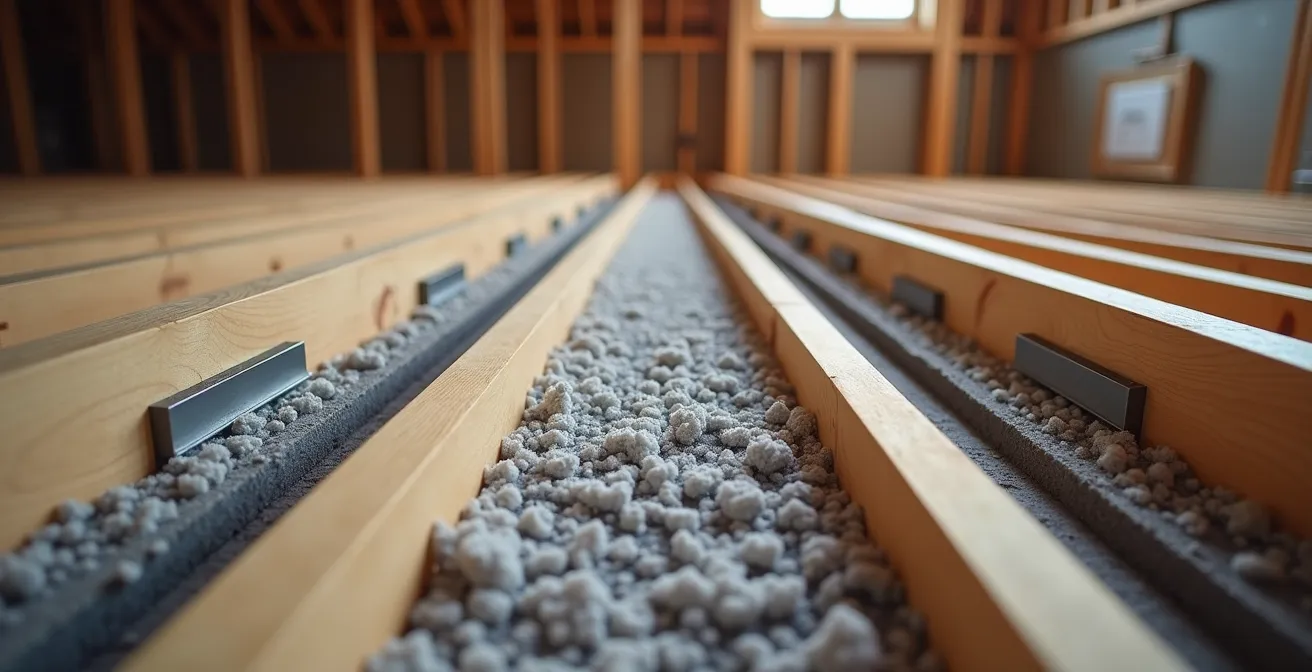
For maximum effect, use a product specifically designed for acoustics, like Rockwool Safe’n’Sound®. These batts are engineered for optimal sound absorption. When installed correctly in a standard ceiling assembly, Rockwool Safe’n’Sound achieves a Sound Transmission Class (STC) rating of up to 50. An STC rating of 50 means that loud speech from the other side is barely audible. This is the difference between clearly hearing a conversation upstairs and only being aware of faint, muffled sounds. For the cost of the material, it’s one of the highest-impact soundproofing upgrades you can make to a home.
Why “Breathable” Insulation Saves Wood Frames from Rotting?
This is the single most important concept to understand for a Canadian basement, and it’s where mineral wool truly leaves fiberglass in the dust. The term “breathable” doesn’t mean air can pass through it freely. It refers to a material’s ability to be vapor permeable. It means that while the insulation repels bulk water (like a leak), it allows water in its gaseous form (vapor) to pass through and dry out. This property is the key to preventing rot in your wood framing.
Your concrete foundation walls are constantly wicking moisture from the surrounding soil. This moisture becomes vapor and will try to move into your basement. If you install a non-breathable insulation or an impermeable vapor barrier on the wrong side of the wall, you trap this moisture right against your wooden studs and the bottom plate of your frame. A damp piece of wood is a dinner bell for mold and rot. Over the years, this trapped moisture will slowly decay the structural components of your wall, leading to catastrophic failure that is hidden behind your drywall.
Mineral wool solves this problem with its dual nature. As the experts at ROCKWOOL Group explain:
Engineered to repel water, yet allowing water vapour to pass through its structure, stone wool will not be adversely affected by moisture and will maintain its performance.
– ROCKWOOL Group, Basement Insulation Technical Guide
This means any incidental moisture that gets into the wall cavity—either from the exterior concrete or from interior humidity—doesn’t get trapped. It can dry to the interior (in winter) or the exterior (in summer), keeping the wood studs dry and safe. By acting as a moisture-managing system, breathable mineral wool protects the very structure of your investment, ensuring your finished basement is built to last.
Why Putting Fiberglass Against Concrete is a Recipe for Mold?
Placing standard fiberglass insulation directly against a concrete foundation wall is one of the most common and costly mistakes in basement finishing. It seems logical—fill the cavity you just framed—but it ignores the fundamental physics of a below-grade environment. According to Natural Resources Canada, uninsulated basements can account for about 25% of a home’s total heat loss, so insulating is a must. However, *how* you insulate is everything.
Concrete is a porous material that acts like a sponge, constantly drawing moisture from the ground. When you press absorbent fiberglass insulation against it, you create a direct pathway for that moisture to wick into the batt. Furthermore, warm, humid interior air can find its way into the wall cavity. When this warm air hits the cold concrete surface, it cools, and the moisture in the air condenses—a process called condensation. This leaves the fiberglass batt permanently damp.
A damp fiberglass batt is a perfect habitat for mold. It provides moisture, a food source (the paper backing and organic dust), and a dark, stagnant space. Within a few seasons, this can lead to a serious mold colony, poor indoor air quality, and the eventual rotting of the wood studs in your wall. You’ve spent thousands finishing your basement, only to create an unhealthy and structurally unsound space. Mineral wool, being hydrophobic and inorganic, does not absorb water and does not support mold growth. It creates a critical break in this moisture chain, protecting your wall assembly from the inside out.
Key Takeaways
- Mineral wool is a complete moisture management system; its ability to repel water while allowing vapor to dry is its most critical feature in a basement.
- The cost premium over fiberglass is an investment in long-term structural health, preventing future expenses from mold remediation and rot repair.
- Proper installation is key to performance. Its rigidity allows for precise cuts and a gap-free fit that maintains its full R-value, unlike compressible fiberglass.
Which Insulation Gives the Highest R-Value per Inch for Thin Walls?
While R-value isn’t the only factor to consider in a basement, it’s still a crucial part of the equation, especially when space is tight. In some older homes or in situations with thick foundation walls, you may want to build a thinner 2×4 interior wall to maximize your floor space. In these cases, the R-value per inch of your insulation becomes very important. You need to get the most thermal resistance possible out of that 3.5-inch stud cavity.
This is another area where mineral wool outperforms standard fiberglass. With an R-value of around R-4.0 per inch, it allows you to achieve a total of R-14 to R-15 in a 2×4 wall. Fiberglass typically provides only R-3.0 to R-3.7 per inch, maxing out at around R-13 for the same cavity. That extra R-2 might not sound like much, but it contributes to a warmer, more comfortable space and lower energy bills over the life of the home.
Of course, there are other insulation types with even higher R-values. As this comparative analysis of insulation materials shows, spray foam and rigid foam boards lead the pack for pure thermal resistance. However, they come with their own trade-offs, including higher costs, complex installation (for spray foam), and a lack of the acoustic and fire-resistance benefits that are inherent to mineral wool.
| Insulation Type | R-Value per inch | Best Application |
|---|---|---|
| Closed-cell spray foam | R-6 to R-7 | Maximum R-value, air sealing |
| Polyiso board | R-6 | Exterior continuous insulation |
| Mineral wool | R-4 | Fire resistance, sound control |
| Fiberglass batts | R-3 | Cost-effective cavity fill |
For a DIY-friendly basement project, mineral wool hits the sweet spot. It offers a significant R-value upgrade over fiberglass in thin walls while also delivering the crucial benefits of fire safety, sound dampening, and moisture management. It represents the best overall value proposition for creating a high-performance, multi-functional living space.
By choosing mineral wool, you’re not just insulating for warmth. You are making a conscious decision to build a healthier, safer, and more durable living space. It’s the professional’s choice for a reason: it addresses all the risks of a below-grade environment, ensuring your finished basement is a valuable asset for decades to come, not a hidden problem waiting to emerge.