Smart zoning isn’t just an upgrade; it’s a fundamental shift that makes whole-house heating an obsolete and costly model for Canadian homeowners.
- It directly solves thermal imbalances (hot upstairs, cold basement) that a single thermostat can’t fix.
- By heating only occupied spaces, it can cut energy expenses by up to 35%, especially when paired with Time-of-Use rates.
Recommendation: The most effective approach combines professional ductwork dampers with variable-speed equipment for maximum efficiency and system protection.
For any owner of a large Canadian home, the winter routine is frustratingly familiar. The hydro bill arrives, a testament to the high cost of keeping a vast space comfortable. Yet, comfort remains elusive. The upstairs bedrooms become saunas while the basement stays perpetually chilly. Guest rooms and formal dining areas, empty most of the year, are heated to the same 21°C as the family room you actually live in. The standard solution—a single thermostat acting as a blunt instrument for the entire house—is clearly failing. Many try workarounds like closing vents in unused rooms, a practice that can dangerously increase static pressure and damage your furnace.
Some turn to smart thermostats, which are a step in the right direction but only optimize *when* you heat, not *what* you heat. They still treat your home as a single, monolithic block. The real issue is the outdated paradigm of “broadcast” heating, a one-size-fits-all approach that’s fundamentally inefficient. What if the solution wasn’t just a smarter schedule, but a complete re-architecture of your home’s climate control? What if you could apply surgical precision to your heating, treating each area as a distinct zone with its own needs?
This is the promise of smart HVAC zoning. It’s not just another feature; it’s a paradigm shift away from wasteful, whole-house conditioning toward an intelligent, on-demand system. This article will deconstruct the case for smart zoning, moving beyond the simple sales pitch. We will explore how to retrofit existing systems, quantify the real-world savings of not heating empty spaces, examine the technical requirements for protecting your equipment, and ultimately demonstrate why this technology makes heating your entire home an obsolete practice.
To fully understand how this efficiency is achieved, this guide breaks down the core components of smart zoning, from retrofitting existing furnaces to maximizing savings. Explore the sections below to see how you can transition to a more intelligent and economical home climate system.
Summary: Why Smart Zoning Makes Whole-House Heating Obsolete
- Can You Add Zoning to an Existing Forced Air Furnace?
- How Zoning Fixes the Temperature Difference Between Floors?
- Are Mini-Splits the Ultimate Zoning Solution for Old Homes?
- How Much Can You Save by Keeping Guest Rooms at 15°C?
- The Bypass Damper: How to Protect Your Furnace When Zones Close?
- Why is Your Head Hot and Your Feet Cold in the Living Room?
- The Mistake of Heating Empty Rooms That Spikes Your Hydro Bill by 15%
- Do Smart Thermostats Actually Save Money or Is It Just Hype?
Can You Add Zoning to an Existing Forced Air Furnace?
Yes, absolutely. Retrofitting an existing forced-air system is one of the most common ways Canadian homeowners adopt zoning. The process transforms your single-zone HVAC from a blunt instrument into a precise, multi-zone system. The core of this upgrade involves installing a series of dampers inside your existing ductwork. These dampers, controlled by a central panel and thermostats in each designated zone, open and close to direct heated or cooled air only where it’s needed. This immediately stops the energy waste of conditioning empty rooms and begins to tackle uneven temperatures.
By implementing a zoned system, you gain granular control over your home’s climate, allowing you to set the guest room to an energy-saving 15°C while keeping the living room at a comfortable 21°C. This level of control has a significant impact on energy consumption. In fact, according to estimates from the U.S. Department of Energy, a properly installed zoning system can lead to substantial savings, with some homeowners seeing as much as a 35% reduction in heating and cooling expenses. The key is choosing the right technology for your home’s specific layout and your budget.
Several retrofit options are available, each with different costs and installation complexities. The following table provides a clear comparison for Canadian homeowners considering the upgrade.
| System Type | Installation Cost | DIY Feasible | Best For |
|---|---|---|---|
| Smart Vents (Flair/Keen) | Under $1,000 | Yes | Simple 2-3 zone setups |
| Insertable Dampers (Arzel) | $2,000-$4,000 | Partial | Hidden ductwork retrofits |
| Professional Zone System | $3,000-$6,000 | No | Complex multi-zone with bypass |
| AI-Powered Smart Zoning | $2,500-$5,000 | No | Maximum efficiency & learning |
While some simpler systems like smart vents appear DIY-friendly, a full-fledged, efficient zoning system requires professional expertise, particularly for electrical work and ensuring your furnace is protected. Understanding the line between a DIY project and a professional job is crucial.
Action Plan: DIY vs. Professional Installation for Canadian HVAC Zoning
- Assess system type: DIY is feasible for smart vents like Flair that replace registers; professional installation is mandatory for systems requiring cutting into ductwork and wiring control panels.
- Check certifications: In provinces like Ontario (TSSA) and BC (BCSA), any work on ductwork or gas furnaces requires certified professionals.
- Evaluate electrical work: Wiring a zone control panel to the furnace is not a DIY task and requires a licensed HVAC technician to ensure safety and warranty compliance.
- Consider system protection: Installing bypass dampers or pressure relief systems to protect your furnace from high static pressure is a complex task best left to professionals.
- Demand post-installation testing: A professional’s job isn’t done until they’ve performed system balancing and static pressure tests to ensure the system runs efficiently and safely.
How Zoning Fixes the Temperature Difference Between Floors?
The classic Canadian home comfort problem—a sweltering upstairs in the summer and a cold main floor in the winter—is a direct result of physics and a single-zone HVAC system. This phenomenon, known as thermal stratification, occurs because warm air is less dense and naturally rises, while cool air is denser and sinks. A single thermostat, typically located on the main floor, can’t possibly account for this. It reads the temperature in one spot and tells the system to turn on or off, completely ignorant of the 5°C temperature difference between the basement and the master bedroom.
Zoning surgically corrects this imbalance. By dividing the home into distinct zones (e.g., upstairs, main floor, basement), each with its own thermostat, the system can respond to the actual temperature in each area. When the upstairs zone’s thermostat registers that it’s too hot, it can call for cool air independently, even if the main floor is perfectly comfortable. This stops the endless cycle of over-cooling one area to compensate for another.
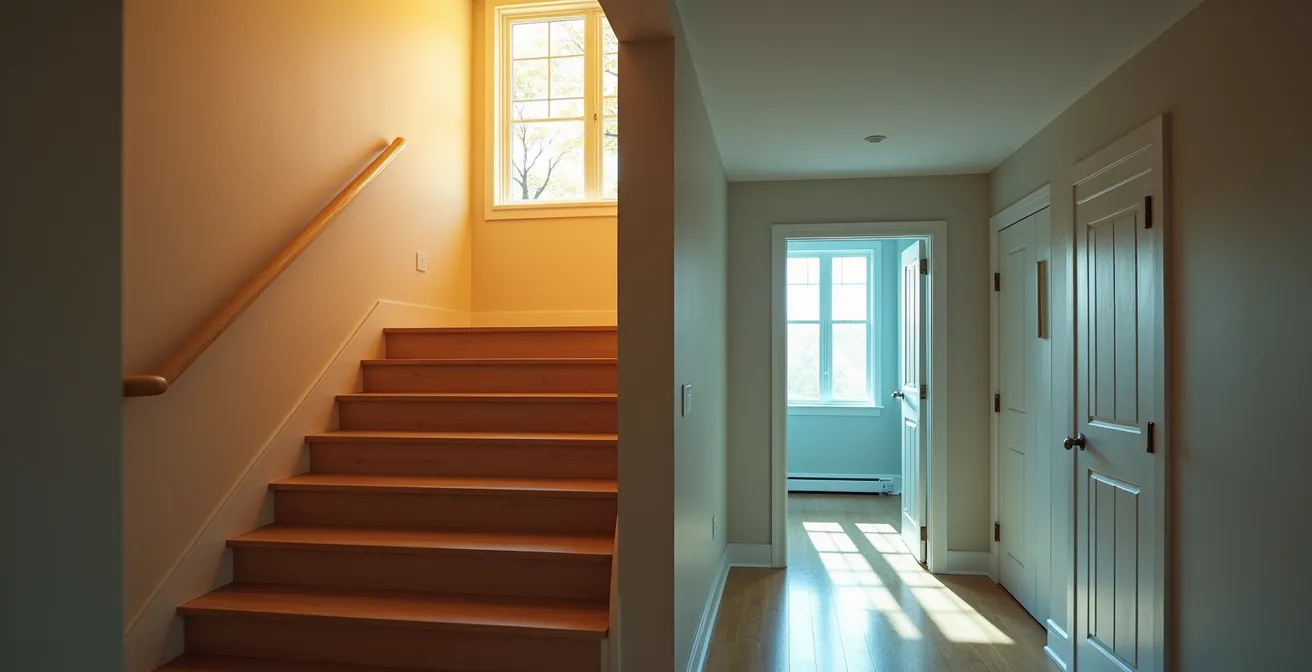
A real-world example from a Toronto two-storey home perfectly illustrates this. The homeowners suffered from a persistent 5-7°C temperature difference between floors. An assessment by a certified auditor revealed that after basic air sealing and insulation improvements, the crucial step was upgrading to a variable-speed HVAC system with proper zoning. This combination completely eliminated the temperature gap. Crucially, by pairing zoning with variable-speed equipment, they avoided the need for an inefficient bypass duct, allowing the system to precisely match airflow to the demands of each zone for maximum efficiency.
Are Mini-Splits the Ultimate Zoning Solution for Old Homes?
For many older Canadian homes, especially those built before forced-air heating became standard, traditional ductwork-based zoning isn’t feasible. These properties, often relying on radiators or baseboard heaters, lack the necessary infrastructure. This is where ductless mini-split heat pumps emerge as a powerful, efficient, and often ideal zoning solution. A mini-split system consists of an outdoor condenser unit connected to one or more indoor air-handling units, allowing each room or “zone” with an indoor unit to have its own independent temperature control.
This inherent zoning capability makes them perfect for creating comfortable micro-climates in additions, converted attics, or entire older homes. Furthermore, modern cold-climate heat pumps are incredibly efficient. According to Natural Resources Canada, for homeowners currently using more expensive heating sources, the savings can be dramatic. For instance, an analysis shows that switching from an oil furnace to an electric heat pump can save Canadians $1,500 to $4,700 per year.
The financial incentives extend beyond operational savings. The push for electrification in Canada has led to significant government rebates. Homeowners can leverage these programs to offset the initial installation cost. Programs vary by province, but they all aim to make this efficient technology more accessible:
- British Columbia: CleanBC offers combined rebates that can reach up to $21,000 for qualifying heat pump installations.
- Ontario: Various programs can provide up to $7,500 for installing cold-climate air-source heat pumps.
- Quebec: Through LogisVert and Hydro-Québec, incentives can total up to $6,720 for high-performance models.
- Atlantic Provinces: The Oil to Heat Pump Affordability Program offers substantial grants, from $15,000 to $16,000, for households making the switch from oil.
As the Ontario Clean Air Alliance notes, the economic argument is compelling even when compared to natural gas. Their analysis highlights that heat pumps are not just an environmental choice but a sound financial one for many Canadians.
Air source heat pumps can save as much as $1,000 per year in heating and cooling costs compared to buying a conventional gas furnace and standard AC units.
– Ontario Clean Air Alliance, Home Energy Retrofits Analysis 2025
How Much Can You Save by Keeping Guest Rooms at 15°C?
The concept of heating empty rooms is the cornerstone of energy waste in large homes. The savings from setting back the temperature in unused spaces like guest rooms, formal dining rooms, or basement rec rooms are substantial and can be maximized by leveraging smart zoning with your local utility’s rate structure. In provinces like Ontario with Time-of-Use (TOU) electricity rates, the financial benefit of zoning becomes even more pronounced. It’s not just about *if* you heat, but *when*.
With a zoned system, you can strategically pre-heat primary living areas during off-peak hours when electricity is cheapest and drastically reduce or eliminate heating to unused zones during expensive on-peak times. This “energy arbitrage” is impossible with a single-thermostat system. As the data shows, aligning your heating schedule with TOU rates creates a powerful savings multiplier.

The table below illustrates how a homeowner in Ontario can use zoning to their financial advantage by manipulating heating based on fluctuating electricity prices.
| Time Period | Ontario TOU Rate | Zoning Strategy | Potential Savings |
|---|---|---|---|
| Off-Peak (7pm-7am) | 8.7¢/kWh | Pre-heat main zones | 40% vs on-peak |
| Mid-Peak (11am-5pm) | 12.2¢/kWh | Reduce unused zones | 20% reduction |
| On-Peak (7-11am, 5-7pm) | 18.2¢/kWh | Minimal zone heating | Base comparison |
Furthermore, the most significant returns on investment often come from a holistic approach. A Canadian home energy retrofit analysis demonstrates this principle. A homeowner combined HVAC zoning with building envelope improvements like upgrading insulation and sealing air leaks. This dual strategy not only made the home more comfortable but also reduced the overall heating load so significantly that a smaller, less expensive heat pump system could be installed. The combined improvements resulted in a 30% total energy reduction and qualified the homeowner for substantial rebates, proving that zoning is a powerful component of a larger, more comprehensive energy strategy.
The Bypass Damper: How to Protect Your Furnace When Zones Close?
When you transition to a zoned HVAC system, a critical technical challenge arises: managing static pressure. Your furnace’s blower is designed to move a specific volume of air through the entire duct system. When multiple zone dampers close, restricting airflow, it’s like trying to exhale with your mouth partially covered. Pressure builds up inside the ducts. This excess static pressure can lead to noisy airflow, reduced efficiency, and, in severe cases, damage to the furnace’s heat exchanger or the air conditioner’s evaporator coil.
The traditional solution is to install a bypass damper. This is a duct that connects the main supply plenum to the return air plenum. When pressure gets too high, a barometric control on the damper opens, allowing excess air to “bypass” the zones and loop directly back into the return. While this protects the equipment, it’s an inefficient, brute-force solution. You end up wasting energy by re-heating or re-cooling air that never reached its destination—a problem known as “stolen air.”
However, modern HVAC technology offers a more elegant and efficient solution: variable-speed equipment. A case study comparing retrofit methods showed that while older, single-stage furnaces required bypass dampers with their inherent efficiency losses, upgrading to a variable-speed system eliminated the need for a bypass entirely. The “smart” blower in a variable-speed unit automatically senses the increased pressure when zones close and ramps down its speed to match the required airflow. This surgical approach not only protects the equipment but also leads to better dehumidification, quieter operation, and longer, more consistent heating and cooling cycles.
For homeowners committed to maximum efficiency, combining zoning with variable-speed technology is the definitive strategy. If that’s not feasible, several other methods can help manage static pressure:
- Install a modulating bypass with a pressure sensor for more precise control than a simple barometric damper.
- Use specialized dampers (e.g., Jackson Systems BZD) that have built-in pressure relief mechanisms.
- Ensure your smallest zone is sized correctly, typically to handle at least 30-35% of the system’s total airflow capacity.
- Add a discharge air temperature sensor that can shut the system down if it begins to overheat due to low airflow.
Why is Your Head Hot and Your Feet Cold in the Living Room?
The feeling of being simultaneously too hot and too cold in the same room is a hallmark of poor air distribution and thermal stratification. Your head feels warm because it’s surrounded by the less-dense, heated air that has risen to the ceiling, while your feet remain cold in the layer of denser, cooler air pooled near the floor. In rooms with high or vaulted ceilings, this effect is magnified, with a typical temperature variance in rooms with vaulted ceilings can reach 5-10°C between the floor and the ceiling.
A standard single-zone forced-air system often makes this problem worse. The furnace blasts hot air into the room until the thermostat (usually mounted 1.5 meters off the floor) is satisfied. The system then shuts off, and the natural process of stratification takes over again. The system isn’t designed to create a consistently mixed environment; it’s designed to hit a single temperature target at a single point in space. This is precisely the kind of comfort issue that a “broadcast” heating model cannot solve.
Zoning provides a direct solution by enabling longer, more consistent run times at lower fan speeds, particularly when paired with variable-speed equipment. Instead of short, powerful blasts of hot air that quickly stratify, a zoned system can provide a gentle, continuous flow of conditioned air to a specific area. This constant circulation helps to de-stratify the air, mixing the warmer and cooler layers to create a more uniform and comfortable temperature from floor to ceiling. As HVAC professionals at Service Experts point out, this is one of the primary problems zoning is designed to fix.
Home zoning systems relieve the most common troubles we see in homes—hot and cold rooms that are never the right temperature. This is especially true for homes with more than one story, where the top floor is usually too hot.
– Service Experts HVAC, Canadian HVAC Zoning Systems Guide
By treating different areas—or even different levels within a large open room—as distinct zones, the system can deliver a more intelligent and tailored response that directly counters the natural tendency for air to stratify, finally eliminating that hot-head, cold-feet feeling.
The Mistake of Heating Empty Rooms That Spikes Your Hydro Bill by 15%
The single biggest source of energy waste in a large Canadian home is paying to heat space that nobody is using. A single thermostat forces you into an all-or-nothing proposition, conditioning every square foot of your house to the same temperature, whether it’s the bustling kitchen or the guest bedroom that’s been empty for three months. This “broadcast” approach to heating is fundamentally inefficient and directly contributes to inflated hydro bills. The average savings from general home retrofits already point to the potential for efficiency gains, with data showing that Canadian households receiving Greener Homes Grants save an average of $386 per year on home energy bills. However, zoning offers a much more targeted and potent way to cut waste.
For homeowners with large or multi-generational homes, the list of “energy vampire” rooms is long and familiar. These are spaces that consume energy 24/7 but are only used a fraction of the time, directly inflating your costs by 15% or more. Smart zoning allows you to surgically remove these areas from your daily energy budget.
Common energy-wasting zones in Canadian homes include:
- The formal dining room: Perfectly heated 365 days a year for the handful of holidays it’s actually used.
- Guest bedrooms: Maintained at a comfortable 21°C in an empty-nester’s home, despite being vacant over 90% of the time.
- The basement rec room: Kept warm all week, even though the family only uses it on weekends.
- The home office: Heated throughout the night and weekends, long after the workday is over.
- Snowbird homes: Kept at full temperature for six months while the owners are wintering in a warmer climate, simply to protect the pipes.
Each of these represents a significant, correctable energy drain. By installing a zoned system, you can set these areas to a minimal, pipe-protecting temperature (e.g., 15°C) and only bring them up to a comfortable level on demand. This simple act of not heating empty space is the most direct path to significant savings and is the logical evolution from the obsolete, wasteful model of whole-house heating.
Key Takeaways
- Zoning represents a fundamental paradigm shift from inefficient “broadcast” heating to precise, “surgical” on-demand climate control.
- It is the most effective solution for correcting thermal stratification, the physical phenomenon responsible for hot upper floors and cold lower floors in multi-story homes.
- Properly implementing a zoned system requires careful management of static pressure, with modern variable-speed equipment offering a more efficient solution than traditional bypass dampers.
Do Smart Thermostats Actually Save Money or Is It Just Hype?
Smart thermostats are undeniably effective and have proven their ability to save homeowners money. By learning your schedule and using features like geofencing, they optimize *when* your HVAC system runs, typically saving 10-15% annually. However, their effectiveness is fundamentally capped by a major limitation: they still treat your entire house as a single zone. They are a smarter brain for an old, inefficient “broadcast” system. They can’t solve the problem of an overheated upstairs bedroom or a freezing basement, nor can they stop wasting energy on empty rooms. They make a blunt instrument slightly more efficient, but it remains a blunt instrument.
True efficiency and comfort require a more granular approach. This is where smart zoning enters the picture as the logical and necessary upgrade. While a smart thermostat controls the *timing* of your heating, zoning controls the *target*. Combining both technologies allows you to control not only *when* you heat but also *what* you heat, unlocking a new level of efficiency. The distinction is not trivial; it represents the difference between incremental improvement and transformative change.
| Technology | How It Saves | Typical Savings | Best For |
|---|---|---|---|
| Smart Thermostat Only | Optimizes WHEN you heat (scheduling) | 10-15% annually | Single zone homes |
| Smart Zoning | Controls WHAT areas you heat | Up to 30% reduction | Multi-level homes |
| Combined System | Both timing AND area control | 35%+ potential | Maximum efficiency |
The hype around smart thermostats is justified, but it’s crucial to understand their place in the hierarchy of home efficiency. They are an excellent starting point, especially for smaller, single-level homes. But for owners of larger, multi-story Canadian homes with unused rooms and persistent comfort issues, a smart thermostat alone is merely a bandage on a systemic problem. As experts at Nordics HVAC Solutions articulate, zoning is the next frontier for homeowners serious about efficiency.
Smart thermostats are a proven money-saver, but their effectiveness is capped by treating the house as one zone. True zoning is the logical upgrade for Canadians serious about maximizing comfort and energy savings.
– Nordics HVAC Solutions, Smart Thermostats and Zoning Guide 2025
Your home’s energy consumption doesn’t have to be a blunt, all-or-nothing expense. To transition from an obsolete broadcast model to a surgical, on-demand climate system, the next logical step is a professional assessment of your home’s unique layout and needs.