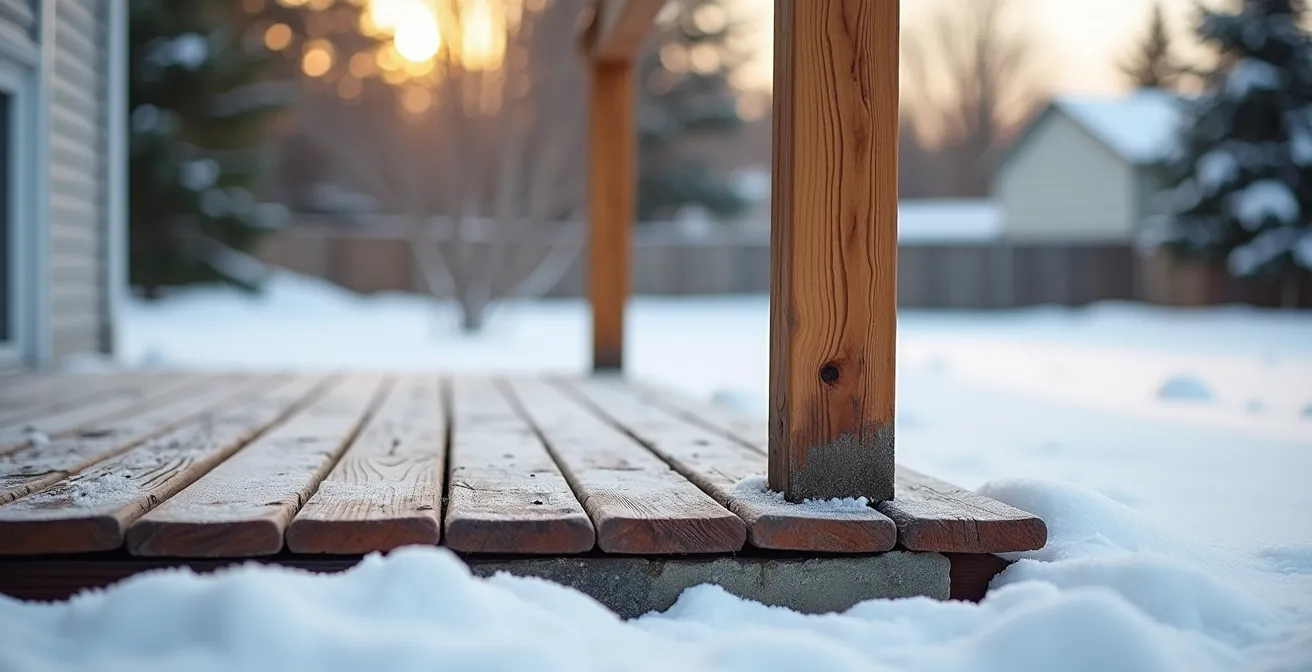
The 3-inch lift in your deck post is a symptom, not the disease. The root cause is a predictable failure in managing the trifecta of water, frost-susceptible soil, and freezing temperatures.
- Frost heave isn’t just water freezing; it’s the formation of “ice lenses” in fine-grained soils like clay, which can exert immense pressure.
- Simply digging deeper is often an incomplete solution; preventing the soil from gripping the post and managing water are the critical, often overlooked, steps.
Recommendation: Before attempting any fix, diagnose your specific soil type and water drainage patterns. The solution must match the problem, which could range from improved drainage to specialized shallow foundations.
That moment of discovery in spring is a familiar one for many Canadian homeowners. You step out onto your deck, and something feels… off. A railing is askew, a door sticks, and a quick look underneath reveals the problem: a deck post is sitting three inches higher than it was last fall. The common culprit is “frost heave,” a term often used but rarely understood. The typical advice is to simply dig your footings below the local frost line, a depth that varies across Canada. But what if you did that, and the post heaved anyway? This suggests the problem is more complex than just depth.
The issue isn’t a brute force attack from winter, but a subtle process rooted in soil mechanics and hydrology. The real cause of the lift is not the initial freezing of groundwater, but the gradual formation of powerful ice lenses within specific types of soil. Understanding this mechanism is the first step in moving from a temporary fix to a permanent, engineered solution. This isn’t just about fighting the frost; it’s about outsmarting it by controlling the two ingredients it needs to thrive: water and a specific type of soil structure.
This diagnostic guide will move beyond the platitudes. We will dissect the physics of frost heave, analyze why certain soils are more dangerous than others, and explore modern engineering solutions that can prevent this structural damage. We’ll examine the critical role of water management, the specific vulnerabilities of structures like garage slabs, and finally, provide a clear framework for when a professional consultation is no longer optional, but essential for the integrity of your home.
To navigate this complex issue, this article breaks down the problem into a series of diagnostic steps. The following summary outlines the key areas we will investigate to build a complete understanding of frost heave and its solutions.
Summary: Diagnosing and Curing Frost Heave
- Clay vs. Sand: Which Soil Type is Most Prone to Frost Heave?
- How Horizontal Wing Insulation Can Save You from Digging Deep Footings?
- Why Water Management is the First Line of Defense Against Heaving?
- The Cold Garage Problem: Why the Slab Cracks Near the Door?
- When to Call an Engineer: Can Heaved Footings Be Resettled?
- Flat vs. Steep Pitch: Which Roof Shape Survives Arctic Blizzards Best?
- How Deep Must Exterior Insulation Go to Prevent Frost Jacking?
- Can Your Roof Trusses Support the Weight of R-60 Blown-In Insulation?
Clay vs. Sand: Which Soil Type is Most Prone to Frost Heave?
The susceptibility of your property to frost heave is determined almost entirely by its soil composition. Not all soils are created equal when it comes to this phenomenon. The critical factor is hydraulic conductivity—the speed at which water can move through the soil. Coarse, granular soils like sand and gravel have high conductivity; water passes through them quickly, preventing the conditions necessary for destructive heaving. In contrast, fine-grained soils like silt and clay have low conductivity. They hold onto water through capillary action, creating the perfect environment for ice lens formation.
As the ground freezes, water in the soil turns to ice. But the real damage comes from what happens next. In clay or silt, the initial layer of ice acts like a wick, drawing up more water from the unfrozen soil below. This water freezes onto the bottom of the existing ice, forming a distinct layer, or “lens.” This process repeats, with each new lens adding to the last, incrementally lifting the soil and any structure embedded in it. The force generated is immense; according to the National Research Council of Canada, frost heave pressure can reach 213 psi (pounds per square inch), more than enough to lift a house, let alone a deck footing.

This mechanism also explains adhesion frosting, where wet soil freezes directly to the sides of a rough concrete footing. As the surrounding soil heaves, it grips the footing and pulls it upwards. This is why simply digging a deep, rough-sided hole can fail. Using a smooth-sided form tube, or Sonotube, creates a post that the frozen soil cannot easily grip, breaking the chain of upward force. The shape of the footing base is also critical; a bell-shaped bottom provides an anchor that actively resists uplift.
Action Plan: Canadian Homeowner’s Soil Assessment
- Perform a tactile test: Form a ball with moist soil from your property. Clay-rich soil will hold its shape and feel sticky, while sandy soil will crumble easily.
- Check local building codes: Verify the minimum footing depth for frost protection in your area. For example, many parts of Ontario require a minimum depth of 4 feet (1.2 metres).
- Ensure proper drainage material: When digging, plan to backfill around the footing with 3/4 inch clear stone drainage gravel, available from Canadian suppliers like RONA or Home Depot. This creates a barrier of non-frost-susceptible material.
- Use forming tubes: For new posts, use Sonotubes (costing approximately $6 per hole) to create smooth-sided piers that prevent soil adhesion and frost grip.
- Size your post holes correctly: Ensure post holes are at least 8 inches in diameter to allow for adequate concrete coverage around the post and proper backfill.
Therefore, diagnosing your soil is not an academic exercise; it is the most critical first step in designing a foundation that will remain stable through the harshest Canadian winters.
How Horizontal Wing Insulation Can Save You from Digging Deep Footings?
In many parts of Canada, particularly on the rocky Canadian Shield, digging to the prescribed frost depth of 5 or 6 feet is impractical or prohibitively expensive. This is where an engineered solution known as a Frost-Protected Shallow Foundation (FPSF) offers a superior alternative. This method doesn’t fight the frost by going deeper; it redirects the cold by using insulation horizontally. The principle is simple: if you can prevent the soil *around* the footing from freezing, the footing itself is protected from heaving forces.
The technique involves placing sheets of rigid, closed-cell foam insulation, typically extruded polystyrene (XPS), horizontally in the ground like “wings” extending outward from the footing. This insulation blanket keeps the geothermal heat from the earth trapped in the soil beneath it, effectively raising the frost line to a much shallower depth in the immediate vicinity of the foundation. The result is a footing that only needs to be 2 or 3 feet deep but performs as if it were at a 6-foot depth, saving significant time, labour, and concrete, especially in difficult terrain.
This is a recognized and approved method under the National Building Code of Canada (NBCC) when designed correctly. As a case study from Fine Homebuilding shows, FPSF installations are highly successful in regions like Muskoka, Ontario. By extending horizontal rigid foam insulation outwards from the deck footings a distance equal to the required vertical frost depth, an effective thermal barrier is created. This redirects frost away from the foundation while using minimal concrete and requiring far less excavation in rocky ground.
The following table provides a clear cost-benefit analysis for a typical Canadian installation, demonstrating the significant savings offered by the FPSF method.
| Method | Excavation Depth | Typical Cost (CAD) | Installation Time | NBCC Approved |
|---|---|---|---|---|
| Traditional Deep Footing | 5-6 feet | $800-1200 per post | 2-3 days | Yes |
| FPSF with XPS Wings | 2-3 feet | $400-600 per post | 1 day | Yes |
| Savings | 3 feet less | $400-600 | 1-2 days | – |
For homeowners facing the dual challenges of frost-susceptible soil and difficult digging conditions, the FPSF approach is not a compromise; it is a smarter, more efficient engineering solution.
Why Water Management is the First Line of Defense Against Heaving?
Frost heave cannot occur without its primary fuel: water. While soil type and freezing temperatures are critical components, controlling the presence of water in frost-susceptible soils is the most proactive and effective strategy a homeowner can employ. An otherwise stable foundation can be compromised simply by poor drainage that allows water to saturate the soil around it. Your water management system—gutters, downspouts, and surface grading—is, in effect, your foundation’s first line of defense.
A leaking gutter or a downspout that discharges too close to the foundation can create a concentrated zone of saturated clay or silt. When winter arrives, this localized “wet spot” becomes a powerful frost heave engine, capable of lifting a corner of your deck or garage slab while the rest of the structure remains stable. The goal is to keep the soil within at least 10 feet of your foundation as dry as possible before the ground freezes. This involves ensuring all surface water is directed far away from the structure.
Furthermore, snow cover plays a surprisingly important role. Snow is an excellent insulator. As research from the National Research Council of Canada demonstrates, each foot of undisturbed snow can reduce the soil freezing depth by approximately the same amount. Shoveling or blowing snow away from your foundation removes this insulating blanket, allowing frost to penetrate much deeper into the ground. While clearing paths is necessary, piling snow against the foundation can actually help protect it. This is a system of interconnected thermal dynamics that must be managed holistically.
Effective water management is a year-round task. Gutters must be cleared in the fall to handle heavy rain and spring melt. The ground around the foundation should be graded to slope away from the house by at least 6%, ensuring that water flows away naturally. For persistent issues, installing a French drain—a perforated pipe in a gravel-filled trench—can actively intercept and redirect subsurface water before it reaches the foundation footing zone.
Ultimately, a footing in dry soil, even if it’s frost-susceptible clay, cannot heave. By controlling the water, you remove the essential ingredient from the equation.
The Cold Garage Problem: Why the Slab Cracks Near the Door?
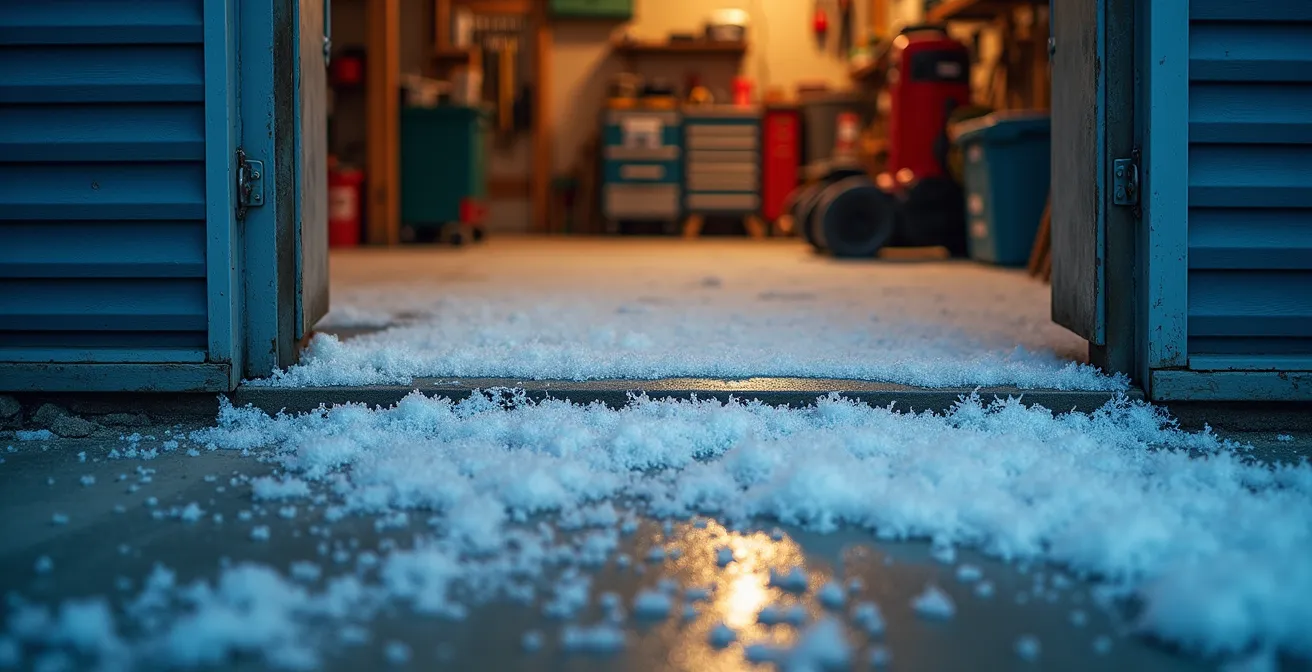
A common and telling sign of frost heave is cracking in a garage floor, specifically near the large overhead door. Homeowners often notice the slab lifting in winter, making the door difficult to close, only to see it settle back down in spring, leaving a new network of cracks. This occurs because the area just inside the garage door is the most vulnerable point in the structure, creating a perfect storm for frost action. The problem is a classic case of a thermal bridge.
The main part of a garage slab is protected by the relatively stable temperature of the ground beneath it and the structure above. However, the edge of the slab near the door is exposed to the full force of winter air. This creates a direct path—a thermal bridge—for cold to penetrate deep into the ground directly under the slab’s edge. This localized freezing is exacerbated by meltwater from vehicles, which runs towards the door and seeps down at the slab edge, saturating the subsoil right where the freezing is most intense. The result is a concentrated uplift force that targets the front of the garage.
The forces at play are not trivial. While a garage slab is a small structure, the physics are the same as those affecting massive buildings. The National Research Council of Canada documented an extreme case that illustrates this power:
A seven-story reinforced concrete frame building on a raft foundation was observed to heave more than 2 inches, with a force of 19 tons per square foot measured.
– National Research Council Canada, NRC Frost Action and Foundations Publication
To solve the cold garage problem, the thermal bridge must be broken. Modern construction practices for heated garages involve installing a continuous layer of rigid XPS insulation under the entire slab and, crucially, vertically along the inside edge of the foundation wall. This isolates the slab from the cold ground and prevents the cold from “wrapping around” the foundation edge. For existing uninsulated slabs, improving exterior drainage to keep water away from the door threshold is the most critical intervention.
Without addressing the thermal bridge and the associated water infiltration, any patch repairs to the concrete will inevitably fail during the next freeze-thaw cycle.
When to Call an Engineer: Can Heaved Footings Be Resettled?
After a winter of heaving, a common question is whether the lifted post or footing will “fix itself” and settle back into its original position. The answer is partially yes, but mostly no. As the ground thaws and the ice lenses melt, the structure will settle to some degree. However, it rarely returns to its precise original elevation. The soil particles are rearranged during the heaving process, and some of the uplifted material can fall into the void as the ice melts, propping the footing up. Over several years, this can lead to a “jacking” effect, where the footing gets progressively higher with each cycle.
Monitoring the movement is the first diagnostic step. If a deck is floating (not attached to the house), minor seasonal movement may be acceptable. However, if the deck is attached to the house via a ledger board, any vertical movement over 1 inch is a serious structural concern. This movement puts immense stress on the ledger connection, potentially pulling it away from the house and creating a risk of catastrophic collapse. In this situation, a consultation with a Professional Engineer (P.Eng.) is not just recommended; it is mandatory for safety.
Case Study: The Limits of Code-Compliant Footings
Structure Tech Home Inspections documented a deck in Maple Grove, Minnesota—a climate similar to many parts of Canada—with severe frost heave. The posts had lifted over 4 inches in some areas, despite being installed at the local code-required depth of 42 inches. The failure was attributed to highly adhesive clay soil. The repair was a complete rebuild, this time involving smooth-walled sonotubes to reduce grip, bell-shaped footings with rebar for anchoring, and significantly improved drainage—addressing the full heave-enabling system, not just depth.
An engineer will assess the specific cause and prescribe a permanent solution. For minor, stable heaving, mudjacking (injecting a slurry to lift and level the slab or footing) might be an option. For more severe or ongoing problems, the most common permanent fix is the installation of helical piles. These are large, screw-like steel piles that are drilled deep into the ground until they reach stable, non-frost-susceptible soil or bedrock, completely bypassing the problematic upper layers. The structure is then transferred onto these piles. While more expensive, helical piles offer a definitive, long-term solution.
A homeowner can diagnose the symptoms, but only a qualified engineer can safely prescribe the cure for a foundation ailment that threatens the primary structure.
Flat vs. Steep Pitch: Which Roof Shape Survives Arctic Blizzards Best?
While seemingly unrelated, your roof’s design has a direct and significant impact on the frost performance of your foundation. The connection is snow. As established, a thick blanket of snow acts as a powerful insulator, protecting the ground from deep frost penetration. The shape of your roof determines how effectively it holds onto this insulating blanket. This creates a paradoxical situation: a roof that is “good” at shedding snow can be “bad” for your foundation.
A steep-pitched roof is designed to shed snow quickly to prevent excessive structural load. However, this means the ground immediately surrounding the foundation becomes bare and exposed to the coldest air temperatures. Without the insulating snow cover, frost can drive much deeper into the soil in these areas, increasing the risk of frost heave, especially if the soil is susceptible and water management is poor. Conversely, a low-slope or flat roof retains snow for longer periods. This snow cover keeps the ground around the foundation warmer, reducing the depth of frost penetration and providing a natural defense against heaving.
This dynamic is why building codes in colder regions are so specific about footing depth. In places with heavy snowfall but consistent cold, the insulating effect of snow is a reliable factor. However, in areas with freeze-thaw cycles or high winds that scour snow away, the ground is more vulnerable. For example, Minnesota and Canadian building codes often require footings to be between 42 to 60 inches deep to account for worst-case scenarios with no insulating snow cover. The choice of roof design must be considered as part of this whole-house thermal system.
For a house with a steep roof, it becomes even more critical to ensure that other lines of defense are robust. This means meticulous water management to keep the exposed ground dry, potentially extending foundation insulation deeper, or using the FPSF wing insulation method to create an artificial thermal shield where the natural snow shield is absent.
Therefore, assessing your foundation’s risk profile must include an analysis of your roof’s typical snow load and its effect on the ground temperature below.
How Deep Must Exterior Insulation Go to Prevent Frost Jacking?
For foundations, the most effective way to prevent frost jacking is to use vertical rigid insulation on the exterior. This not only reduces energy loss from the basement but also keeps the surrounding soil warmer, preventing deep frost penetration. The crucial question is, how deep must this insulation go? The answer depends on your location within Canada, as frost penetration depths vary significantly by climate zone.
The insulation must extend from the top of the foundation wall down to at least the level of the local frost line. Simply stopping the insulation a foot or two below grade is a common mistake that creates a thermal bridge, allowing cold to get under the insulation and freeze the soil next to the footing. The National Research Council of Canada provides clear guidelines for these depths based on different climate zones across the country.
A critical engineering rule of thumb, backed by Canadian research, is the “10% Rule.” To provide a robust safety margin, the insulation should extend 10% deeper than the maximum calculated or prescribed frost depth. This accounts for unusually severe winters or areas with less-than-expected snow cover.
The effectiveness of this approach was proven in an Ontario railway embankment frost protection study. Research showed that in areas with high silt content, frost penetrated to 1.6 meters (over 5 feet). The study demonstrated that installing rigid insulation that extended 10% deeper than this calculated frost line was highly effective at preventing track heaving, even during extreme cold snaps. This principle is directly applicable to residential foundations.
| Zone | Region | Frost Depth | Min. Insulation Depth | 10% Rule Depth |
|---|---|---|---|---|
| Zone A | Maritimes/Southern ON | 42 inches | 42 inches | 46 inches |
| Zone B | Prairies/Quebec | 48-60 inches | 60 inches | 66 inches |
| Zone C | Northern Territories | 72+ inches | 72 inches | 79 inches |
Insulating to the correct, locally-appropriate depth is not just about energy efficiency; it is a fundamental component of structural preservation in a cold climate.
Key Takeaways
- Frost heave is caused by ice lenses in fine soils (clay/silt), not just frozen water.
- Controlling water through grading and drainage is the most effective preventative measure.
- Engineered solutions like FPSF (wing insulation) or helical piles are often superior to simply digging deeper, especially in difficult soil.
Can Your Roof Trusses Support the Weight of R-60 Blown-In Insulation?
The diagnosis of a home’s performance in a Canadian winter requires a systems-thinking approach. A decision made in one area can have unintended consequences elsewhere. A prime example is upgrading attic insulation. In an effort to improve energy efficiency, many homeowners are adding significant amounts of blown-in insulation to reach values of R-60 or higher. While this is excellent for reducing heat loss, it introduces two new factors that loop directly back to our foundation problem: structural load and water management.
First, a deep layer of R-60 insulation, especially if it’s dense-packed cellulose, adds significant weight to the attic floor. The roof trusses must be able to support this additional dead load. Before undertaking such an upgrade, a structural engineer should verify the load capacity of the existing trusses. Second, and more relevant to frost heave, a heavily insulated attic means less heat escapes through the roof. This keeps the roof surface colder, which can lead to larger, more persistent ice dams at the eaves and a greater volume of snowmelt during the spring freshet. This sudden, massive release of water puts extreme pressure on your gutter, downspout, and grading system.
If your water management system is not upgraded to handle this increased flow, the result will be a deluge of water saturating the ground directly against your foundation—precisely the condition you must avoid to prevent frost heave. Therefore, an R-60 insulation upgrade should be seen as part of a package. The project must include verifying truss capacity, ensuring proper attic ventilation is maintained with baffles, and, most importantly, upgrading gutters to a larger capacity (e.g., 6-inch K-style) and extending downspouts a minimum of 10 feet away from the foundation.
To truly solve the problem of a heaved deck post, you must stop looking at it as a single failed component and start diagnosing the entire interconnected system of your home’s structure, soil, and environment. A permanent fix requires an engineered solution, not just a simple repair.