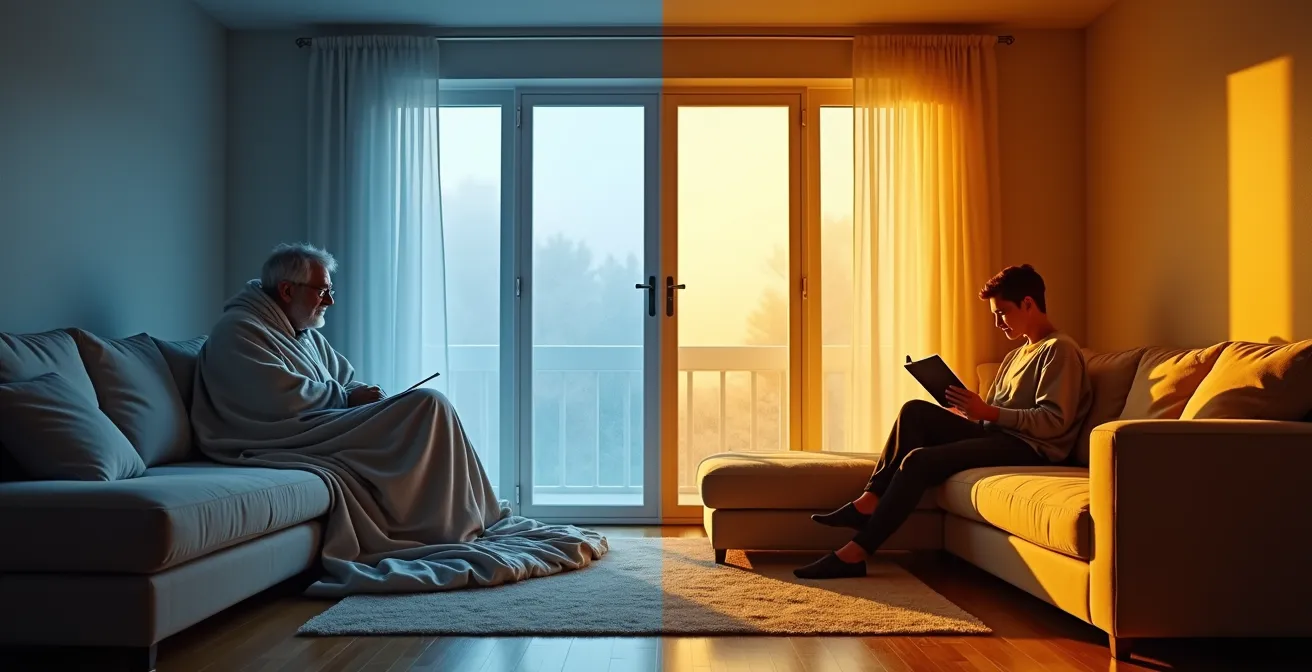
The number on your thermostat is lying to you; true comfort is about how your body loses heat to its surroundings, not the temperature of the air.
- Your body radiates heat to cold walls, floors, and windows, making you feel chilled even in a warm room.
- Tiny, imperceptible drafts and improper humidity levels can steal warmth far more effectively than cold air alone.
Recommendation: Shift your focus from simply heating the air to improving your home’s building envelope—its insulation and air-tightness—to control heat loss and achieve genuine thermal well-being.
It’s a frustratingly common scenario in many Canadian homes: the thermostat is set to a comfortable 22°C, yet you find yourself reaching for a sweater or a blanket. You feel a persistent chill, especially near windows or when sitting on the sofa. You might blame a faulty furnace or simply resign yourself to wearing layers indoors, but the real issue is often invisible. The discomfort you feel isn’t just in your head; it’s a physiological response to your home’s thermal environment, a battle your body is quietly losing against the laws of physics.
Conventional wisdom tells us to seal drafts and check the attic, which are valid starting points. However, these actions barely scratch the surface of a deeper science: the science of human thermal comfort. It’s a field that looks beyond the simple number on a digital display and asks a more important question: how does your body *actually experience* the space it’s in? The answer involves a complex interplay between air temperature, humidity, air movement, and, most critically, the temperature of the surfaces surrounding you.
But what if the key to finally feeling warm wasn’t just about producing more heat, but about losing less of it? This guide moves beyond the simplistic advice. As a thermal comfort physiologist, we will explore the hidden reasons your body feels cold. We’ll decode the “cold wall effect,” explain why your feet are freezing while your head is warm, and uncover how imperceptible drafts are constantly undermining your comfort. By understanding how your body interacts with your home’s envelope, you can move from endlessly adjusting the thermostat to creating a truly comfortable and efficient living space.
This article breaks down the core components of thermal comfort, explaining the science behind each phenomenon and offering concrete, Canadian-centric solutions. The following sections will guide you through understanding and conquering the hidden cold in your home.
Summary: Decoding the Science of True Home Comfort
- The Cold Wall Effect: Why Your Body Radiates Heat to Cold Surfaces?
- 30% vs. 50% Humidity: What is the Sweet Spot for Comfort and Health?
- Why is Your Head Hot and Your Feet Cold in the Living Room?
- The “Ankle Biter” Draft: How to Seal Baseboards to Stop Cold Air?
- How Insulation Improves the “Solid Feel” of a Home?
- Why Your Floors Are Cold Even With New Windows?
- Why Remote Sensors are Essential for Two-Story Homes?
- How to Eliminate the Drafts That Make Your Living Room Unusable?
The Cold Wall Effect: Why Your Body Radiates Heat to Cold Surfaces?
The single most significant reason you feel cold in a room with a “warm” air temperature is a phenomenon called radiant heat transfer. Your body, at approximately 37°C, is a constant source of heat. Like a tiny radiator, it continuously emits this heat outwards in all directions. When you’re in a well-insulated room, the surrounding walls, ceiling, and floor are close to the air temperature. Your body radiates heat, but those warm surfaces radiate heat back to you, creating a state of thermal equilibrium and comfort.
However, in a poorly insulated home, the interior surface of an exterior wall can be significantly colder—sometimes 5 to 10 degrees colder than the air. Your body doesn’t know the air temperature; it only knows it’s losing a tremendous amount of heat to that large, cold surface. You could be sitting in 22°C air, but if the wall next to you is 12°C, your body will relentlessly radiate its warmth towards it, creating a distinct and unshakable feeling of cold. This is the “cold wall effect,” and it’s why that seat by the window is always the last one taken.
This radiant loss is a major, often-overlooked, component of home energy inefficiency. It’s not just walls; cold, uninsulated foundation systems are a massive culprit. In fact, 25% of a home’s heat loss can occur through its foundation, creating cold floors and walls on the main level. Addressing this requires diagnosing where your home’s surfaces are coldest.
Your Action Plan: Diagnosing Cold Wall Syndrome
- Use an infrared thermometer to check wall surface temperatures, paying close attention to exterior and north-facing walls on a cold day.
- Schedule a professional blower door test with a certified energy advisor to pinpoint the exact locations of air infiltration.
- Evaluate existing insulation levels by safely checking behind electrical outlets (with the power turned off).
- For a deeper analysis, an energy advisor can calculate the room’s Mean Radiant Temperature (MRT) using the surface temperatures of all six surfaces (walls, floor, ceiling).
- Explore programs like the Canada Greener Homes Grant, which can help fund a professional energy audit and subsequent insulation upgrades.
30% vs. 50% Humidity: What is the Sweet Spot for Comfort and Health?
Air temperature is only one part of the comfort equation; relative humidity is its crucial partner. The amount of water vapour in the air dramatically affects how your body perceives temperature. In the dry Canadian winter, indoor humidity levels can easily plummet below 30%. This arid air acts like a sponge, drawing moisture from any available source—including your skin. This constant, low-level evaporation creates a cooling effect, making 20°C feel more like 18°C.
Conversely, in the summer, high humidity prevents your sweat from evaporating efficiently, which is your body’s primary cooling mechanism. This is why a humid 25°C can feel more oppressive than a dry 30°C. There is a “goldilocks zone” for your home’s humidity. For Canadian homes, Health Canada recommends maintaining a relative humidity between 35% and 45% during the heating season. This range is not only ideal for comfort but also helps protect your wooden furniture and floors and can reduce the survival of airborne viruses.
Achieving this balance requires a two-pronged approach: controlling moisture sources and ensuring your home’s building envelope can handle it. A humidifier can add moisture, but if your home is leaky and has cold surfaces, that added humidity will condense on cold windows and inside wall cavities, potentially leading to mould and rot. Proper insulation and air sealing create warmer interior surfaces, which is the first and most critical step before attempting to manage humidity.

As you can see, when warm, moist indoor air meets a cold window surface, condensation is inevitable. A well-insulated wall assembly and high-performance windows raise a surface’s temperature, reducing this risk and allowing you to maintain a healthier, more comfortable indoor humidity level.
Why is Your Head Hot and Your Feet Cold in the Living Room?
If you’ve ever felt the need to wear thick socks while the room feels stuffy, you’re experiencing thermal stratification. This is the natural tendency of air to form layers based on temperature, with warm, less-dense air rising to the ceiling and cool, denser air pooling at the floor. In a poorly insulated house, this effect is dramatically exaggerated. The ceiling is warmed by rising heat and its proximity to an uninsulated attic, while the floor is cooled by the unconditioned basement or crawlspace below.
This can create a temperature difference of 5°C or more between your head and your feet, a situation your body finds deeply uncomfortable. Your circulatory system has to work overtime to try and keep your extremities warm, while your head might feel flushed. No matter how high you crank the furnace, you’re mostly just super-heating the top half of the room, wasting energy and failing to address the core problem at floor level.
The solution is not more forced air, but a robust thermal barrier at the top and bottom of your house. Proper insulation in the attic prevents the heat from escaping upwards, keeping the ceiling surface cooler and reducing the “pull” on the warm air. For this reason, Canadian building codes often suggest a minimum of R-60 insulation for attics, creating a thick, effective barrier. Similarly, insulating the basement or crawlspace stops the cold from radiating upwards, allowing the floor to stay closer to the ambient room temperature. When top and bottom are sealed, the air in the room can mix more evenly, creating a uniform comfort from head to toe.
The “Ankle Biter” Draft: How to Seal Baseboards to Stop Cold Air?
While you might notice a draft from a window, some of the most uncomfortable air leaks are the slow, persistent ones that occur at floor level. Cold, dense air from the outside finds its way into the gap between your foundation and the main structure of your house, an area known as the rim joist (or band joist). This uninsulated wooden perimeter acts as a “thermal bridge,” allowing outdoor cold to seep in and chill the air in the joist cavities. This cold air then spills out from behind your baseboards, creating a constant, ankle-level river of cold that makes an entire section of your room feel unusable.
This “ankle-biter” draft is a prime example of convective heat loss, where moving air strips heat away from your body. Because this draft is low to the ground and low-velocity, you may not even “feel” it as a typical draft. You just feel consistently cold. Sealing and insulating this rim joist area is one of the single most effective, high-impact energy-saving upgrades a homeowner can make. It directly targets a major source of both heat loss and physical discomfort.
inse
There are several ways to insulate this critical junction, each with its own trade-offs in terms of performance, cost, and ease of installation. Closed-cell spray foam offers the highest R-value and an integrated air and vapour barrier, but requires professional installation. Rigid foam boards are a more DIY-friendly option that can also be very effective when sealed properly. The following table compares the most common options for Canadian homes.
| Insulation Type | R-Value per inch | Cost | DIY Friendly | Moisture Resistance |
|---|---|---|---|---|
| Spray Foam (Closed Cell) | R-6 to R-7 | High | No | Excellent |
| Rigid Foam (XPS) | R-5 | Medium | Yes | Very Good |
| Fiberglass Batts | R-3.5 | Low | Yes | Poor |
How Insulation Improves the “Solid Feel” of a Home?
The benefits of insulation extend beyond thermal comfort into the realm of acoustics and perceived quality. A house that feels “drafty” or “flimsy” often suffers from a lack of density in its wall cavities. When walls are empty or poorly insulated, they act like a drum, easily transmitting sound from outside and between rooms. This could be traffic noise, a neighbour’s lawnmower, or just conversations from the next room. This constant auditory intrusion contributes to a background level of stress and detracts from a sense of sanctuary and privacy.
This is where the choice of insulation material becomes critical for more than just its R-value. Dense-pack insulation, such as cellulose or mineral wool, does more than just trap air; it adds significant mass to the wall assembly. This added mass is highly effective at dampening sound vibrations. As Natural Resources Canada points out in its comprehensive guide, this is a well-documented benefit.
Dense-pack cellulose or mineral wool insulation adds mass to wall cavities, reducing the transmission of both airborne noise and structural vibrations.
– Natural Resources Canada, Keeping The Heat In Guide
The result is a home that doesn’t just feel warmer, but feels more solid and substantial. The doors close with a satisfying thud instead of a hollow echo. Exterior noises fade into the background. This enhanced acoustic separation has a profound, if subconscious, impact on your well-being, creating a calmer and more peaceful indoor environment.
Case Study: Acoustic Comfort in Urban Canadian Homes
A common scenario in dense urban areas of Canada is the challenge of noise pollution. A study of homes near busy roads found that upgrading to mineral wool insulation with R-values between R-15 and R-23 offered superior sound dampening. This simple upgrade was shown to reduce noise transmission by up to 75%, creating a significantly quieter interior. This demonstrates that the investment in quality insulation pays dividends in both thermal and acoustic comfort, directly enhancing occupant well-being.
Why Your Floors Are Cold Even With New Windows?
Many families invest thousands of dollars in new, energy-efficient windows, hoping to solve their comfort problems. While windows are a common source of heat loss, homeowners are often disappointed to find that their floors remain stubbornly cold. This is because they’ve addressed a symptom, but not one of the largest root causes: the uninsulated basement or slab foundation. Your basement is a massive, underground “heat sink,” constantly drawing warmth out of the floor above it.
Without a thermal break, the concrete foundation is in direct contact with the cold earth. This cold radiates upwards, through the concrete and your floor joists, a process known as thermal bridging. The wooden joists and the subfloor above become chilled, and they, in turn, cool the entire floor surface of your main living area. You can have the best windows in the world, but if your feet are standing on a surface that is actively losing heat to the ground, you will feel cold.
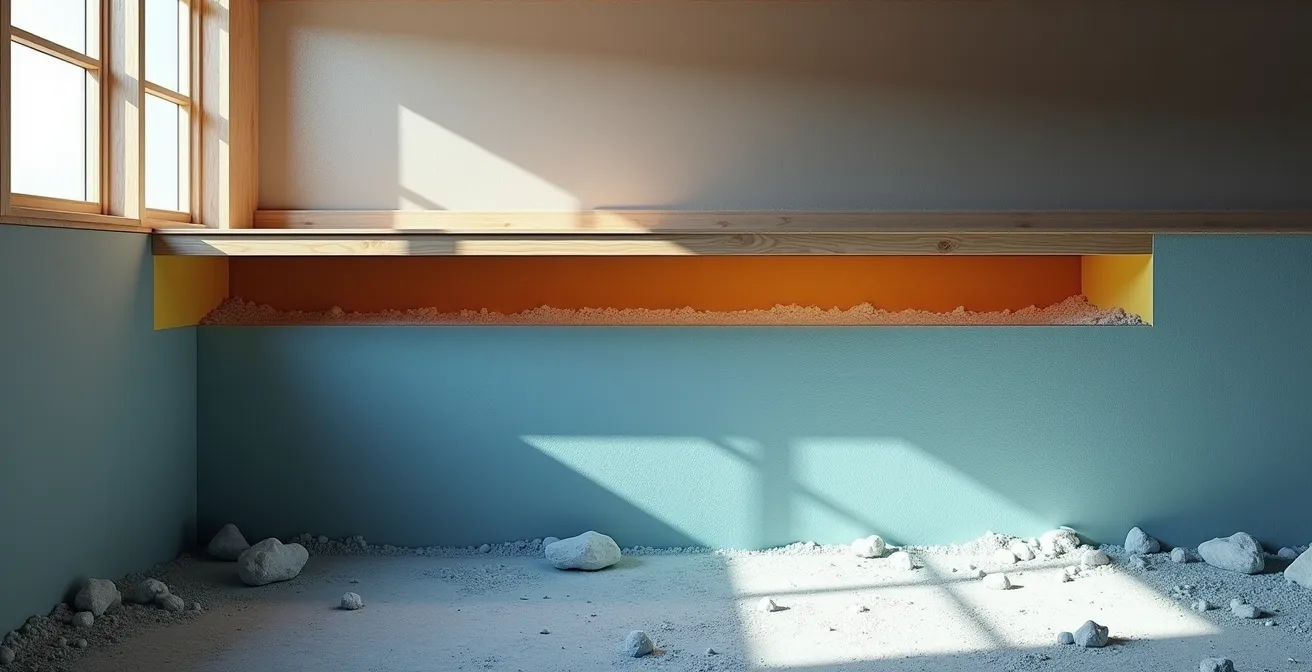
As the illustration shows, the main floor is fighting a losing battle against the massive, cold thermal mass below it. To win this fight, you must insulate the basement walls or the underside of the floor. In many parts of Canada, building codes now mandate this. For example, the Ontario Building Code requires a minimum of R-12 continuous insulation on the interior of basement walls. This layer of rigid foam or spray foam creates the crucial thermal break, decoupling your home’s living space from the cold ground and allowing your floors to finally warm up to the room’s air temperature.
Why Remote Sensors are Essential for Two-Story Homes?
A standard thermostat is fundamentally flawed in a multi-story home: it only measures the temperature in one single location, usually a central hallway on the main floor. Yet, as we’ve discussed, thermal stratification and varying levels of insulation can cause temperatures to differ wildly throughout the house. The bonus room over the cold garage might be 18°C, the master bedroom upstairs could be 23°C, and the main floor thermostat reads a “perfect” 21°C. Your heating system is making decisions based on incomplete and inaccurate data.
This is where smart thermostats with remote sensors become an essential tool for achieving true whole-home comfort. These small, wireless sensors are placed in different rooms and zones, providing your HVAC system with a complete thermal picture of the house. Instead of heating the home based on the hallway’s temperature, the system can be programmed to make decisions based on the temperature of the rooms you actually use.
For example, you can tell the system to ensure the nursery is 21°C at night, or that the living room is 22°C during the evening, regardless of what the main thermostat reads. The system will run until the *occupied* space reaches the target temperature. This not only resolves comfort complaints but also improves efficiency. Instead of overheating the main floor to try and warm up a cold bonus room, the system can average the temperatures or prioritize a specific zone. For any Canadian home with a second story, a finished basement, or a room over a garage, remote sensors are no longer a luxury; they are a fundamental component of a modern, intelligent, and comfortable heating strategy.
Key Takeaways
- True comfort is determined by Mean Radiant Temperature (MRT), not just air temperature. Your body loses heat to cold surfaces, making you feel chilled.
- Thermal stratification, where hot air rises and cold air pools, is exaggerated by poor attic and basement insulation, leading to hot heads and cold feet.
- A holistic approach of air sealing and proper insulation is the only way to permanently solve comfort issues and reduce energy waste.
How to Eliminate the Drafts That Make Your Living Room Unusable?
We’ve deconstructed the individual comfort thieves: radiant heat loss, stratification, and humidity. Eliminating the drafts that make your home uncomfortable requires bringing this knowledge together in a holistic strategy. The goal is to transform your house from a leaky, inefficient structure into a continuous, well-sealed building envelope. This means addressing all the small, seemingly insignificant air leaks that, when combined, add up to a major source of discomfort and energy loss.
While sealing baseboards and window frames is a good start, a truly comprehensive approach requires a professional diagnosis. A certified Canadian energy advisor can perform an EnerGuide home evaluation. A key part of this evaluation is the blower door test. This test depressurizes your home, making it easy to find every single air leak, from hidden gaps in the attic to unsealed electrical outlets. The advisor will often use a thermal imaging camera to visually show you where your home is “bleeding” heat. This provides a scientific, prioritized roadmap for upgrades, showing you which fixes will give you the most “bang for your buck.”
Undertaking these upgrades, such as air sealing and adding insulation, not only drastically improves comfort but also delivers significant financial returns. Through programs like the Canada Greener Homes Grant, homeowners who complete recommended retrofits are saving an average of $386 annually on their energy bills. By focusing on creating an airtight and well-insulated envelope, you stop fighting a constant battle with the outside elements. You create a stable, predictable, and truly comfortable indoor environment, reclaiming those unusable parts of your home and finally being able to trust the number on your thermostat.
The first step towards transforming your home’s comfort is to understand its unique challenges. For a precise and personalized roadmap, consider a professional EnerGuide home evaluation to pinpoint exactly where your home is losing heat and how to fix it most effectively.
Frequently Asked Questions About Home Comfort and Insulation
How many remote sensors do I need for a two-story Canadian home?
Typically, you will need 2-3 sensors for optimal coverage. A common setup includes one for the bonus room over the garage (a notorious cold spot), one for the master bedroom to ensure nighttime comfort, and optionally one for the basement if it is a finished, occupied space.
Can remote sensors work with heat pump systems common in Canada?
Yes, absolutely. Most modern smart thermostats equipped with remote sensors are fully compatible with the heat pump and dual-fuel systems that are increasingly popular across Canada. They can intelligently manage the switch between the heat pump and an auxiliary furnace.
What temperature variance justifies adding remote sensors?
A good rule of thumb is to consider remote sensors if you notice that certain occupied rooms consistently vary by more than 3°C from the location of your main thermostat. At this level of variance, sensors can provide a significant and noticeable improvement in both comfort and energy efficiency.