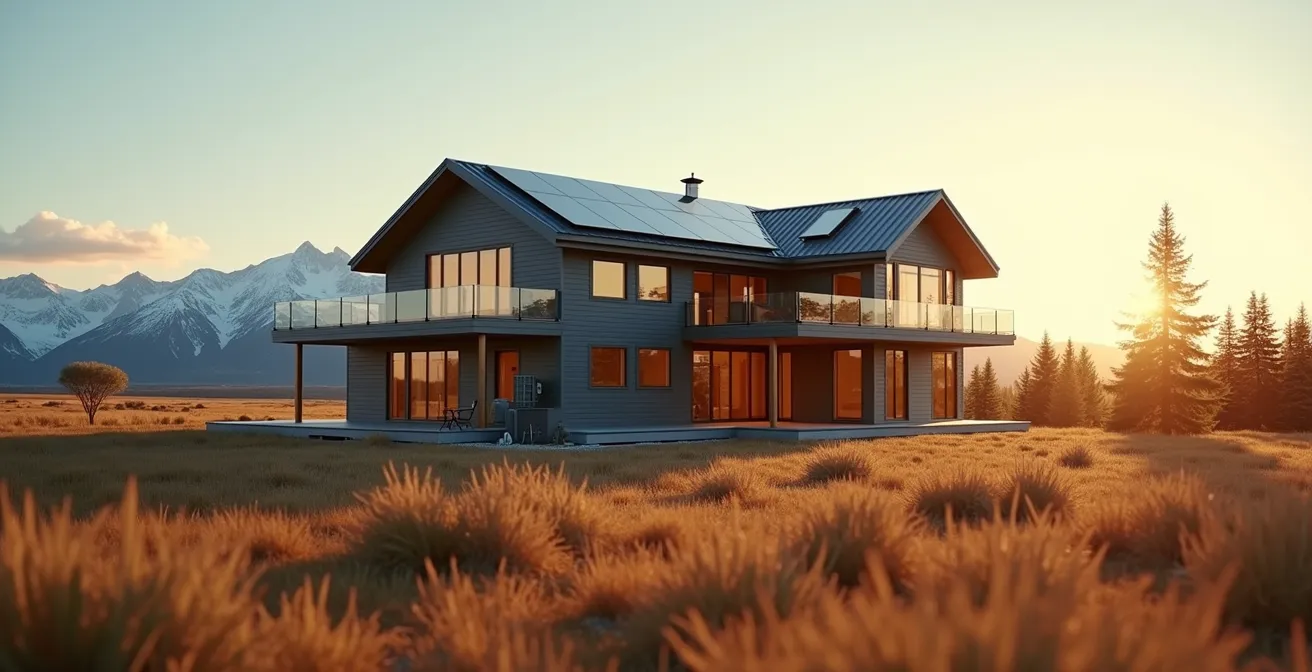
“Net-Zero Ready” is more than a marketing label; it’s a homebuyer’s entry ticket to becoming the active energy manager of their own home.
- It signifies a home built with a high-performance envelope and systems, but reaching actual net-zero status depends on future additions (like solar) and your operational habits.
- Evaluating a home’s true potential requires looking beyond operational savings to the embodied carbon of its construction materials, like insulation.
Recommendation: To navigate the market, trust official government-backed labels like EnerGuide and CHBA certifications over vague “eco-friendly” claims, and demand the data to prove performance.
As a Canadian home buyer, you’ve likely seen the term “Net-Zero Ready” appearing more frequently in real estate listings and new development brochures. It sounds impressive, suggesting a home at the pinnacle of environmental design and energy efficiency. The common understanding is that it’s a highly efficient house, pre-wired for solar panels, that will save you money and help the planet. While this isn’t entirely wrong, it misses the most critical point. This perspective treats “Net-Zero Ready” as a final, passive feature—a badge the house has earned.
The reality is far more dynamic. Viewing this label as a finished product is like buying a high-performance race car and never taking it out of first gear. The true value of a Net-Zero Ready home isn’t just in its components, but in the potential it unlocks for the homeowner. But what if the key wasn’t the label itself, but the change in mindset it demands? The real meaning of “Net-Zero Ready” is that you, the homeowner, are about to become an active energy manager. It’s the starting line of a journey, not the finish.
This article will deconstruct the “Net-Zero Ready” concept for the Canadian context. We will move beyond the surface-level benefits to explore the crucial decisions and systems that define these homes—from the hidden carbon footprint of your insulation to the data you need to truly optimize performance. We’ll examine the interplay between heat pumps and solar in a Canadian winter, the reality of going all-electric, and how to tell the difference between a genuine certification and clever marketing. Ultimately, you’ll learn how to transform a “ready” house into a truly performing asset.
To navigate this complex but crucial topic, this guide breaks down the essential components and considerations for any prospective buyer in Canada. Explore the sections below to gain a comprehensive understanding of what “Net-Zero Ready” truly entails.
Table of Contents: A Home Buyer’s Guide to Net-Zero Ready in Canada
- Insulation with Low Embodied Carbon: Cellulose vs. Spray Foam?
- How Many Solar Panels Do You Need to Power a Heat Pump in Winter?
- Cutting the Gas Line: Is It Possible to Heat a Canadian Home with Electricity Only?
- Dashboarding Your Energy: Why You Need Real-Time Data to Stay Net-Zero?
- LEED vs. Zero Carbon Building Standard: Which Badge Should You Chase?
- 15 kWh/m²: Why This Specific Number Defines a Passive House?
- EnerGuide Label vs. ‘Eco-Friendly’ Marketing: Which Can You Trust?
- Is Passive House Certification Worth the Premium in Canada?
Insulation with Low Embodied Carbon: Cellulose vs. Spray Foam?
The first step in understanding a Net-Zero Ready home is to look at its bones: the building envelope. Superior insulation is a given, but the conversation often stops at R-value (a measure of thermal resistance). An active energy manager thinks deeper, considering the embodied carbon—the total greenhouse gas emissions generated to produce and install the material. This is a critical part of the home’s total carbon equation, and the choice of insulation has a massive impact from day one, long before you pay your first energy bill.
Spray foam, for instance, offers a high R-value per inch, making it popular for achieving airtightness. However, it is a petroleum-based product with a significant carbon footprint during manufacturing. In contrast, cellulose insulation, typically made from recycled paper, presents a compelling alternative. Not only is its production less energy-intensive, but it also acts as a carbon sink. The wood fibres it’s made from have already absorbed CO2 from the atmosphere, and that carbon remains locked within your walls. A CIMA report suggests that using cellulose insulation can effectively store 7-9 tons of CO2 per single-family home, turning your house into a form of carbon storage.
This decision goes beyond simple energy savings. It’s about front-loading your environmental commitment by choosing materials that actively reduce atmospheric carbon. The following table provides a clear comparison of the carbon impact of common insulation types, highlighting why material choice is a foundational act of energy management.
| Insulation Type | Carbon Impact | R-Value Performance |
|---|---|---|
| Cellulose (SANCTUARY) | 210% carbon footprint reduction | R-3.59 per inch |
| Spray Foam | Petroleum-based, higher emissions | R-6 to R-7 per inch |
| Fiberglass | 2-3 tons CO2 emissions per home | R-2.2 to R-2.7 per inch |
Ultimately, a Net-Zero Ready home isn’t just about reducing future operational energy; it’s also about minimizing the environmental debt incurred during its construction. Choosing a low-embodied-carbon material like cellulose is a powerful first step in your role as an active energy manager.
How Many Solar Panels Do You Need to Power a Heat Pump in Winter?
A core component of many Net-Zero and Net-Zero Ready homes in Canada is the cold-climate air source heat pump. This technology is a cornerstone of electrification, as it doesn’t create heat but moves it, making it incredibly efficient. However, the key question for any Canadian homeowner is its performance during our harsh winters and how it pairs with a solar array, which itself produces less energy in winter. This is where system synergy becomes paramount.
First, it’s essential to dispel the myth that heat pumps don’t work in the cold. Modern cold-climate models are engineered for this exact purpose. According to Napoleon, modern cold climate heat pumps maintain over 200% efficiency at -18°C, meaning for every 1 kWh of electricity consumed, they produce 2 kWh of heat. This is a huge leap over traditional electric resistance heating, which is only 100% efficient. The Department of Energy’s Cold Climate Heat Pump Challenge further validated this, with test units operating successfully in Canadian provinces at temperatures as low as -26°C (-15°F).

Calculating the number of solar panels needed is therefore not a simple multiplication. It requires an energy model that considers: your home’s total heating demand (determined by its insulation and airtightness), the heat pump’s specific performance curve, your local climate’s average winter sunlight (insolation), and your overall household electricity consumption. A “Net-Zero Ready” home should come with this energy model, allowing you or a solar installer to accurately size a photovoltaic (PV) system that can offset the heat pump’s winter consumption on an annual basis. Without this data, you’re just guessing.
This highlights the active role of the homeowner: you must understand the relationship between your home’s biggest energy consumer (the heat pump in winter) and its potential producer (the solar array) to make an informed investment.
Cutting the Gas Line: Is It Possible to Heat a Canadian Home with Electricity Only?
For decades, natural gas has been the default for home heating in much of Canada, prized for its reliability and low cost. The idea of “cutting the gas line” and relying solely on electricity can therefore feel daunting, especially when imagining a power outage during a January cold snap. However, in a well-built Net-Zero Ready home, this is not only possible but is often the primary design goal. The key lies in a two-pronged approach: radically reducing the heating demand and using hyper-efficient technology to meet that smaller demand.
A Net-Zero Ready home achieves the first part with a superior building envelope—extreme airtightness, high-R-value insulation, and triple-pane windows. The home simply needs far less energy to stay warm. The second part is accomplished with a cold-climate heat pump. As we’ve seen, these systems are highly effective even in deep cold. This combination dramatically changes the economic and practical equation of all-electric heating. In fact, due to their efficiency, homeowners can expect significant operational savings.
While costs vary by province, switching from less efficient systems can lead to substantial reductions in annual heating bills. As an expert from an Alberta-based HVAC company points out, the performance is reliable even in the harshest climates. According to First Choice Plumbing and Heating in their article on “Heat Pumps in Cold Climates”:
With the right system and proper installation, a cold-climate heat pump can easily handle 80–90% of your home’s annual heating needs — even through Alberta’s brutal winters.
– First Choice Plumbing and Heating, Heat Pumps in Cold Climates
Most all-electric homes will still include a small supplementary electric resistance heater that kicks in on the absolute coldest days of the year (e.g., below -25°C or -30°C) or as a backup. In a well-designed home, this backup system may only run for a handful of hours per year. Therefore, going all-electric in Canada is not a futuristic dream; it’s a practical reality for any properly designed Net-Zero Ready home.
Dashboarding Your Energy: Why You Need Real-Time Data to Stay Net-Zero?
Here we arrive at the very heart of what it means to be an active energy manager. A Net-Zero Ready home is designed on paper (or in software) to be highly efficient. However, there is often a “performance gap” between the theoretical model and real-world operation. How you live in the home—when you run appliances, your thermostat settings, even how often you open windows—all affects energy consumption. Without data, you are flying blind.
This is why an energy monitoring system, or “energy dashboard,” is not a luxury but a necessity. It is the speedometer and fuel gauge for your house. These systems connect to your electrical panel and track both the electricity your home is consuming and, if you have solar panels, the electricity your system is producing in real time. This granular data empowers you to make intelligent decisions. For example, you can see the energy spike when your dryer turns on and decide to run it during the middle of the day when your solar panels are at peak production.
Modern Building Energy Management Systems (BEMS) use this data proactively, but the principles are just as important for a homeowner. By monitoring your consumption, you can identify “phantom loads” (devices using power when off) or detect when a system like your heat pump isn’t performing as efficiently as it should. This proactive approach allows you to address inefficiencies before they become costly problems. According to experts at MAG Solar, this type of monitoring can lead to significant savings. This capability puts you in the driver’s seat, allowing you to align your lifestyle with the home’s energy production and truly “balance the grid” within your own four walls.
A Net-Zero Ready home gives you the high-performance vehicle; an energy dashboard gives you the controls and feedback needed to drive it effectively. It transforms the passive state of “ready” into the active process of “performing.”
LEED vs. Zero Carbon Building Standard: Which Badge Should You Chase?
As you explore high-performance homes, you’ll encounter a confusing alphabet soup of certifications: LEED, ENERGY STAR®, R-2000, and various Net-Zero labels. Understanding the nuances is crucial because they don’t all measure the same thing. For a buyer focused on energy performance and carbon footprint, the most relevant programs in Canada are those managed by the Canadian Home Builders’ Association (CHBA) and the Canada Green Building Council (CaGBC).
LEED (Leadership in Energy and Environmental Design) is a holistic standard that covers everything from energy to water efficiency, site selection, and indoor air quality. While valuable, energy is only one piece of its puzzle. In contrast, the CHBA’s Net Zero Home Labelling Program is laser-focused on energy. It has two key tiers: Net Zero Ready and Net Zero. It’s critical to understand the distinction, which the CHBA makes very clear.
| Certification | Energy Performance | Requirements |
|---|---|---|
| Net Zero (CHBA) | Produce as much clean energy as consumed annually | On-site renewable energy systems required |
| Net Zero Ready | Same efficiency requirements as Net Zero | Solar-ready but systems not yet installed |
As the table sourced from the CHBA’s program overview shows, a “Net-Zero Ready” home is built to the exact same high-efficiency standard as a full Net-Zero home. The only difference is that the renewable energy system (i.e., solar panels) has not yet been installed. The CaGBC’s “Zero Carbon Building – Design” standard is similar, verifying that the design is sound and ready for net-zero operation. Chasing a “badge” is less important than understanding what it certifies. For a buyer, the CHBA Net Zero Ready label is a powerful assurance that the home’s fundamental performance—its envelope and mechanical systems—is top-tier and officially verified.

This label is your third-party guarantee that the foundation for exceptional performance is in place, ready for you to take the final step toward full Net-Zero when you choose.
15 kWh/m²: Why This Specific Number Defines a Passive House?
While exploring Net-Zero Ready homes, you might also encounter the term “Passive House” (or *Passivhaus*). This is another standard of high-performance building, but it approaches the goal from a different angle. Instead of focusing on producing as much energy as you consume (the “net” balance), Passive House focuses on radically minimizing consumption in the first place. Its targets are so stringent that a full Net-Zero goal becomes almost effortless to achieve on top of it.
The defining metric of a Passive House is its annual heating and cooling demand. To be certified, a building must not require more than 15 kilowatt-hours (kWh) of energy per square metre per year for heating and cooling. To put that in perspective, a typical new home built to code might use 100-120 kWh/m² per year. This incredible 85-90% reduction is achieved through a set of core principles: extreme levels of insulation, a completely airtight building envelope, high-performance windows (usually triple-glazed), elimination of thermal bridges, and a heat recovery ventilator (HRV) that provides constant fresh air while retaining the heat from the outgoing stale air.
The results of this obsessive focus on efficiency are staggering. The energy demand is so low that a traditional furnace is no longer needed. Many Passive Houses can be heated on the coldest winter day by a system the size of a hairdryer. This translates into near-zero heating bills. For example, a case study on GLA Windows notes that in a climate as cold as Ottawa’s, passive house owners can pay as little as $28 per year in heating costs. Another example, the “Maison des Sources” project in Quebec’s Eastern Townships, saw its total annual energy costs reduced to just $802—about 80% less than a comparable new code-built house.
Understanding this 15 kWh/m² target is important because it represents the gold standard of energy conservation. A Net-Zero Ready home is a fantastic step, but a home approaching Passive House levels of performance is in another league of efficiency altogether.
Key Takeaways
- A ‘Net-Zero Ready’ home is an optimized system where insulation, windows, and mechanicals work together; it’s not just a house with good insulation.
- The lowest carbon footprint comes from considering both operational energy (heating) and embodied carbon (materials like cellulose).
- True performance requires active monitoring with real-time data; without a dashboard, ‘Net-Zero Ready’ is just a promise.
EnerGuide Label vs. ‘Eco-Friendly’ Marketing: Which Can You Trust?
In a market where “green” and “eco-friendly” are used as vague marketing buzzwords, how does a buyer verify a builder’s claims about a Net-Zero Ready home? The answer lies in trusting official, government-backed programs and third-party verification, not glossy brochures. In Canada, the most important tool at your disposal is the EnerGuide label.
Every CHBA-certified Net Zero Ready home must have an EnerGuide rating, which is administered by Natural Resources Canada (NRCan). This label provides a standardized rating of your home’s energy performance, measured in gigajoules per year (GJ/year). A lower number means a more efficient home. This isn’t just a summary; it’s the result of a detailed energy model created using software like HOT2000 by a certified Energy Advisor. This process is the only way to get a true, unbiased assessment of a home’s planned performance.
The need for this verification is critical. According to a report by Efficiency Canada, there’s a long way to go in the Canadian building sector. It states, ” In Canada, less than 1% of buildings can be considered NZEr. We need to quickly scale up the number of NZEr buildings constructed each year.” With so few homes meeting this standard, the temptation for “greenwashing”—making unsubstantiated eco-claims—is high. As a buyer, you must demand the official documentation. The EnerGuide label is your proof that the home’s design meets a rigorous national standard, insulating you from misleading marketing.
Action Plan: How to Verify a ‘Net-Zero Ready’ Claim in Canada
- Request the Full Report: Ask for the official multi-page EnerGuide report for the home, not just the builder’s summary or the sticker on the electrical panel.
- Verify the Energy Advisor: Confirm that the report was completed by a Natural Resources Canada (NRCan) licensed Energy Advisor working with a CHBA Qualified Net Zero Service Organization.
- Check for the Label: A CHBA Qualified Net Zero or Net Zero Ready Home will have an additional label to accompany the EnerGuide rating. Demand to see it.
- Ask for the Model: Request a copy of the results from the HOT2000 energy simulation software. This is the raw data behind the EnerGuide rating.
- Consult the Network: The CHBA maintains a national network of builders, renovators, and Energy Advisors qualified in Net Zero construction. Use this network to verify credentials.
Is Passive House Certification Worth the Premium in Canada?
After exploring the rigorous standards of Passive House and the practical steps of Net-Zero Ready, the final question for many Canadian buyers is a financial one: is the upfront investment worth it? Building to these high-performance standards does cost more than conventional construction. The question is whether the long-term benefits justify the premium.
For Passive House, the cost increase can be modest if planned from the start. According to the Canadian Passive House Institute (CanPHI), building to this standard in Canada typically requires a 10% incremental cost compared to a standard code-built home. This premium covers the investment in higher-quality components: more insulation, superior triple-pane windows, and a high-efficiency heat recovery ventilation (HRV) system. While a 10% increase is not insignificant, it’s crucial to view it in the context of total cost of ownership.
The return on this investment comes from multiple avenues. The most direct return is from drastically reduced energy bills. As Passive House Canada explains, an 80-90% reduction in annual heating and cooling costs quickly begins to offset the higher mortgage payment. But the benefits go beyond finances. These homes offer superior indoor air quality thanks to the continuous filtered fresh air from the HRV. They are also incredibly quiet due to the thick insulation and airtight construction. Finally, they provide a level of thermal comfort that is unmatched; there are no drafts and the temperature is remarkably stable throughout the entire house, year-round.
For a Net-Zero Ready home, the premium is often lower, but the principle is the same. You are paying more upfront for a superior building envelope and mechanical systems that will deliver lower operating costs, greater comfort, and better air quality for the life of the home. This initial premium is not just an expense; it’s an investment in resilience, comfort, and long-term energy security.
Ultimately, whether you are considering a certified Passive House or a CHBA Net Zero Ready home, the higher initial investment is a strategic choice. To ensure this investment delivers on its promise, your next step should be to demand transparent energy modeling data and insist on official certification for any new home you consider, putting you firmly in control of your energy future.