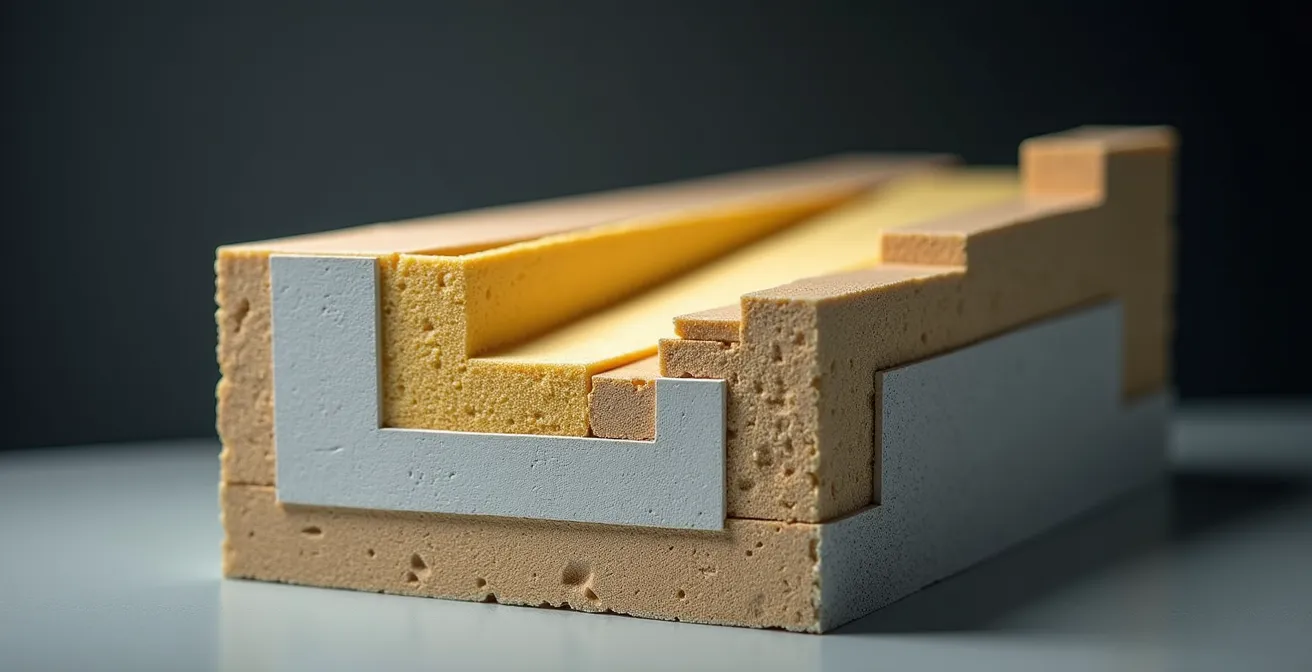
Successfully passing a basement framing inspection in Canada depends on understanding one critical concept: the code regulates the ‘effective R-value’ of the entire wall assembly, not the ‘nominal R-value’ printed on the insulation package.
- Thermal bridging through wood studs can drastically reduce your wall’s performance, meaning R-20 batts alone do not meet an R-20 code requirement.
- Compliance requires a carefully designed system, often involving continuous exterior insulation, to counteract heat loss through the framing.
Recommendation: Before purchasing materials, you must determine your home’s specific Climate Zone and design a wall assembly whose calculated effective R-value meets or exceeds the provincial requirement.
For many Canadian homeowners, a basement renovation begins with a straightforward plan: frame the walls, install insulation, and hang drywall. You purchase R-20 insulation, assuming it satisfies the local building code’s R-20 requirement. Then comes the framing inspection, and your project is halted. The inspector informs you that despite using R-20 batts, your wall does not meet the code. This frustrating and costly scenario stems from a widespread misunderstanding of Section 9.36 of the National Building Code (NBC) of Canada.
The common advice to “check your local R-value requirements” is incomplete. The code’s primary concern isn’t the rated value of a single product but the thermal performance of the complete system you build. This introduces crucial concepts like “effective R-value” versus “nominal R-value,” the role of thermal bridging, and the absolute necessity of a continuous air barrier. The building code is not simply a checklist of materials; it is a legal framework based on building science principles designed to ensure energy efficiency, structural integrity, and occupant health.
But what if the key to a successful permit was not just buying the right product, but understanding the legal and physical principles behind the requirements? This guide acts as a consultant, translating the dense language of NBC 9.36 into a practical framework for homeowners. We will dissect the distinction between the insulation you buy and the compliant wall you must build. This is not about memorizing code references; it is about grasping the “why” behind the rules to avoid common pitfalls and expensive rework.
This article will guide you through the essential considerations for code compliance, from identifying your climate zone to understanding the specific details an inspector will scrutinize. By following this structure, you can navigate the permit process with clarity and confidence, ensuring your renovation is both legal and high-performing.
Summary: Navigating Canadian Basement Code Requirements
- Which Climate Zone Are You In: 5, 6, or 7?
- Nominal vs. Effective R-Value: Why R-20 Batts Don’t Meet R-20 Code?
- The 5 Mandatory Air Barrier Details Inspectors Always Check
- When Does a Renovation Trigger a Full Code Upgrade for the Whole House?
- OBC vs. NBC: How Ontario’s Code Differs from the National Standard?
- How Code Requirements Differ Between Zone 1 (Victoria) and Zone 7 (Edmonton)?
- Engineer vs. Home Inspector: Who Can Sign Off on Structural Changes?
- Why Does the 2020 National Building Code Require Higher R-Values?
Which Climate Zone Are You In: 5, 6, or 7?
Before any other consideration, the first step in determining your basement insulation requirements is to identify your precise location within Canada’s climate zone map. The National Building Code divides the country into zones based on heating degree-days (HDD), a measure of how cold a location is and for how long. The higher the zone number, the colder the climate and the more stringent the insulation requirements. Major centres fall into distinct zones: for example, Toronto is in Zone 5, Ottawa and Calgary are in Zone 6, and Edmonton and Winnipeg are in Zone 7a. These classifications are not arbitrary; they are the legal foundation for all energy efficiency requirements under Section 9.36.
However, simply knowing the national code is insufficient. The NBC is a model code that each province and territory adopts and potentially modifies. This creates a complex regulatory landscape. For instance, the 2024 Ontario Building Code comes into effect on January 1, 2025, with its own specific tables and transition periods. Meanwhile, Alberta adopted its edition of the NBC 2023 on May 1, 2024, and British Columbia implemented its 2024 code in March 2024. Other provinces like Saskatchewan and Quebec are on their own distinct timelines. This hierarchy of authority means a homeowner must first consult their provincial building code, which legally supersedes the national model code for projects within that province.
Failure to identify the correct, currently enforced code for your specific municipality is a primary reason for failed permit applications. Your legal obligation is to the version of the code that your local building department is enforcing at the time your permit is submitted. A contractor’s outdated knowledge or information from a different province is not a valid defence during an inspection. Determining your climate zone and the applicable provincial code is the mandatory first step of due diligence.
Nominal vs. Effective R-Value: Why R-20 Batts Don’t Meet R-20 Code?
This is the single most misunderstood concept in basement renovations. Homeowners purchase insulation with an “R-20” label and assume their wall is now an R-20 wall. This is incorrect. The value on the packaging is the nominal R-value, which represents the material’s thermal resistance in a perfect, uninterrupted state. The building code, however, is concerned with the effective R-value, which measures the thermal performance of the entire wall assembly, including all its components.
The primary culprit for the discrepancy is thermal bridging. Every wood stud in your wall framing is a poor insulator compared to the insulation around it. Heat bypasses the insulation by travelling through the studs, creating a “bridge” for energy loss. This significantly lowers the overall performance of the wall. An assembly built with R-20 batts between wood studs may only achieve an effective R-value of R-15 or R-16, well below the code requirement. To comply, the assembly must be designed to counteract this. A common strategy is adding a continuous layer of rigid foam insulation on the interior or exterior of the studs, which breaks the thermal bridge.
The following illustration demonstrates how heat (represented by thermal flow) will always choose the path of least resistance, bypassing high-performance insulation by travelling through the conductive wood framing.

As you can see, the wood stud acts as a highway for heat loss. Provincial codes often prescribe specific combinations to achieve compliance. For example, in Ontario, the code might specify a minimum continuous insulation value in addition to batt insulation. Achieving a compliant wall is a matter of calculation and design, not just material selection.
This table, adapted from building science discussions, illustrates common insulation combinations designed to meet the effective R-value requirements in a cold climate province like Ontario.
| Configuration | Components | Effective R-Value | Code Compliant |
|---|---|---|---|
| Option 1 | 1.5″ rigid foam + R-14 batts | R-21.5 | Yes |
| Option 2 | 1″ rigid foam + R-20 batts | R-25 | Yes |
| Option 3 | 2-3″ closed cell spray foam | R-20 to R-30 | Yes |
The 5 Mandatory Air Barrier Details Inspectors Always Check
While thermal insulation (R-value) controls heat transfer via conduction, a separate and equally critical system is the air barrier. Its purpose is to control air leakage, which can carry huge amounts of moisture and heat, leading to condensation, mold, and significant energy loss. An inspector will pay extremely close attention to the continuity of the air barrier system. A small gap or unsealed penetration can result in an immediate inspection failure, regardless of how much insulation you have installed.
The principle is simple: there must be an unbroken, continuous seal from the foundation slab, up the wall, and connected to the air barrier of the floor above. This continuity must be maintained around every single interruption. Taping the seams of a polyethylene sheet is not enough; the system must be robust at all transitions and penetrations. Inspectors are trained to look for common failure points where builders often cut corners. These are not optional details; they are mandatory requirements for passing your framing and insulation inspection.
Even if work is done without a permit, these issues can be discovered later. For example, when unpermitted electrical work is found, the Electrical Safety Authority (ESA) in Ontario may conduct an ElecCheck inspection. While primarily focused on wiring safety, this process can reveal other non-compliant work.
Case Study: The ESA ElecCheck Inspection Process
In cases where Ontario basements are finished without permits, the ESA is often called in before a property sale. An inspector will verify the safety of receptacles, lighting, and panel connections. While they try to avoid major demolition, they have the authority to require small sections of drywall to be cut to verify connections. This process, while focused on electrical safety, frequently uncovers other code violations related to insulation and air barriers that were hidden behind the walls, leading to more extensive and costly repairs for the homeowner.
Your Action Plan: Critical Air Barrier Inspection Points
- Rim Joist Area: Verify that the space where the main floor joists rest on the foundation wall is completely sealed. This must be done with spray foam or a combination of rigid foam board and high-quality caulking.
- Electrical and Plumbing Penetrations: Check that every wire, pipe, and duct that passes through the air barrier is sealed. This typically requires specialized caulk or low-expansion spray foam.
- Foundation-to-Wall Connection: Ensure the air barrier membrane (e.g., polyethylene) is sealed to the concrete foundation wall and runs continuously up behind the framing.
- Window Perimeters: Confirm that the gap between the window frame and the rough opening is fully sealed with low-expansion foam, connecting the window frame to the wall’s air barrier.
- Main Floor Continuity: Verify that the basement’s air barrier is properly lapped and sealed to the air barrier system of the floor above it. There can be no gaps in this transition.
When Does a Renovation Trigger a Full Code Upgrade for the Whole House?
A common fear for homeowners is that a small renovation will trigger a requirement to upgrade the entire house to current code standards. This is governed by the concept of “substantial renovation.” While the exact definition can vary by municipality, it is generally tied to the scope and scale of the work. Finishing a small portion of a basement might only require that finished area to meet the new code. However, a project that involves a significant portion of the building’s area or alters its structural components or building envelope can trigger much broader upgrade requirements.
Municipalities often set clear thresholds. For example, according to the City of Calgary’s building department, developing a basement area that exceeds 10 square metres (108 square feet) typically requires a building permit, which automatically subjects the new work to the current Alberta Building Code. While this doesn’t automatically mean you must re-insulate your upstairs walls, if the renovation significantly impacts the home’s overall energy performance or ventilation, an inspector or plans examiner may require compensatory upgrades elsewhere to ensure the house functions as a complete system.
The code-triggering threshold is a critical legal boundary. Any project involving the creation of a new bedroom requires adherence to egress window size and location rules. Any modification to load-bearing walls, beams, or columns mandates structural drawings sealed by an engineer. If your renovation plan includes adding a suite or apartment, it will trigger a cascade of additional requirements for fire separation, soundproofing, and independent ventilation systems. The key is that as the scope of your renovation grows, so does the level of regulatory scrutiny. Understanding where these thresholds lie before you begin design is essential to accurately budget for your project and avoid unforeseen orders to upgrade unrelated parts of your home.
OBC vs. NBC: How Ontario’s Code Differs from the National Standard?
While the National Building Code of Canada (NBC) provides the foundational model, it is not law until adopted by a province. Ontario, with its large population and specific climate considerations, maintains the Ontario Building Code (OBC), which introduces significant amendments to the NBC. For any renovation in Ontario, the OBC is the sole legal document that governs construction. A contractor citing the NBC without referencing the current OBC is operating with incomplete information.
The upcoming OBC 2024, set to take effect January 1, 2025, provides a clear example of this divergence. It introduces new, often more stringent, requirements for energy efficiency that go beyond the 2020 NBC. This includes specific R-values for continuous insulation and enhanced standards for air barrier systems. Homeowners and contractors must be aware of not only the new rules but also the transition periods. For the OBC 2024, there is a three-month transition where builders can operate under the old or new code, but after March 31, 2025, compliance with the new standard is mandatory for all new permit applications. According to experts at Sprayfoam Solutions Toronto in their guide on Ontario codes, properly insulated basements can have a tangible financial benefit.
Homes with proper basement insulation save up to 15% on heating bills.
– Sprayfoam Solutions Toronto, Basement Insulation Codes for Ontario Homes Guide
This table highlights some key differences between the national model code and the specific requirements being implemented in Ontario.
| Requirement | NBC 2020 | OBC 2024 |
|---|---|---|
| Minimum Wall R-Value | Varies by zone | R-20 continuous |
| Implementation Date | Province-dependent | January 1, 2025 |
| Transition Period | Varies | 3 months (until March 31, 2025) |
| Air Barrier Requirements | Standard 9.25.3 | Enhanced sealing standards |
This provincial specificity means that advice from a friend in Alberta or a guide based on the national code may be dangerously inaccurate for a project in Ontario. Your only source of truth is the version of the OBC currently in force in your municipality.
How Code Requirements Differ Between Zone 1 (Victoria) and Zone 7 (Edmonton)?
The vast climatic differences across Canada are precisely why the NBC uses a climate zone system. The construction methods and insulation levels required in a temperate coastal city like Victoria (part of BC’s Climate Zone 4) are fundamentally different from those in a cold prairie city like Edmonton (Zone 7a). The code’s objective is to achieve a similar level of energy performance, which demands vastly different inputs depending on the external environment.
In a milder climate like Victoria, the primary challenge is often moisture management rather than extreme cold. The building science must account for high humidity and frequent freeze-thaw cycles near the freezing point. The BC Building Code reflects this with specific guidance for its coastal zones.
Case Study: BC Climate Zone 4 (Victoria) Requirements
In BC’s Climate Zone 4, Section 9.36 is applied with a focus on preventing moisture issues. The code guide emphasizes achieving “continuous insulation” to minimize thermal bridging, but clarifies this doesn’t strictly require a single, unbroken material; it’s about the calculated performance of the assembly. Critically, the installation of a Heat Recovery Ventilator (HRV) is strongly recommended. An efficient HRV system can improve air quality and, in some cases, allow for a relaxation of certain prescriptive R-value requirements, as the home’s mechanical systems are helping to manage energy and moisture loads. The Canadian Wood Council provides online calculators to help determine the effective thermal resistance for wall assemblies in these specific coastal conditions.
In stark contrast, a project in Edmonton (Zone 7a) faces long, severe winters where pure heat loss is the dominant issue. Here, the code will demand much higher effective R-values for basement walls, under-slab insulation becomes a serious consideration, and the integrity of the air and vapour barriers is even more critical. A small breach in a Zone 7 home’s building envelope can lead to massive heat loss and severe interstitial condensation, where moisture freezes inside the wall cavity, causing structural damage when it thaws. Consequently, the prescriptive requirements will be higher, and inspectors will be even more rigorous in checking for thermal bridging and air barrier continuity.
Engineer vs. Home Inspector: Who Can Sign Off on Structural Changes?
In the hierarchy of a renovation project, roles and legal authorities are clearly defined, and misunderstanding them can be a costly error. A home inspector and a professional engineer serve entirely different functions. A home inspector’s role is primarily diagnostic; they assess the current condition of a property, typically for a real estate transaction. They can identify potential issues, but they have no legal authority to approve or design structural work. They cannot provide the sealed drawings required for a building permit application involving structural changes.
That authority rests exclusively with a Professional Engineer (P.Eng) licensed to practice in your province. Any plan that involves altering a load-bearing wall, modifying a beam or column, or changing the structure of the foundation requires drawings and a report prepared and sealed by a P.Eng. This is a non-negotiable legal requirement. The engineer performs calculations to ensure the proposed change is safe and compliant with Part 4 or Part 9 of the building code. Their seal on a drawing is a legal certification to the municipality that the design is sound. Attempting to proceed with structural work without engineered plans will result in an immediate stop-work order and may require you to reverse the changes at your own expense. The high costs associated with legalizing a non-compliant basement, which BCR Basements reports can range from $80,000 to $150,000 in Ontario, often stem from having to retroactively hire an engineer and rebuild improperly executed structural work.
The building inspector employed by your municipality then acts as the enforcement agent. They do not design your project; their job is to verify on-site that the construction conforms exactly to the approved, engineered plans and meets all other code requirements discussed in your permit. They are the final authority on whether the work passes or fails at each stage of construction.
Key Takeaways
- Compliance is measured by ‘effective R-value’ (the whole wall’s performance), not the ‘nominal R-value’ on insulation packaging.
- A continuous, sealed air barrier is as critical as insulation for passing inspection and preventing moisture damage.
- Provincial codes (like the OBC) legally supersede the National Building Code (NBC) and have their own specific requirements and implementation dates.
Why Does the 2020 National Building Code Require Higher R-Values?
The steady increase in R-value requirements in successive versions of the National Building Code is not an arbitrary decision. It is a direct response to two primary drivers: national energy efficiency policy and the prevention of building envelope failures. The code is evolving to mandate the construction of more resilient, durable, and less wasteful homes. This push for higher performance is a cornerstone of Canada’s long-term strategy for reducing greenhouse gas emissions from the building sector.
This policy objective is clearly stated by the code’s authors. As Natural Resources Canada explains, the code is designed to move the entire industry forward.
The NBC’s tiered energy requirements are a key part of Canada’s Pan-Canadian Framework on Clean Growth and Climate Change, aiming for Net-Zero Energy Ready buildings.
– Natural Resources Canada, Keeping The Heat In – Basement Insulation Guide
Secondly, higher R-values, when installed correctly as part of a complete system, help prevent costly building failures. Inadequate insulation leads to cold interior surfaces, which can cause condensation to form when warm, moist indoor air comes into contact with them. This moisture is the primary ingredient for mold growth, which is not only a serious health hazard but also an expensive problem to fix. According to industry data, mold repairs in Canadian basements can cost anywhere from $500 to over $5,000, and that figure does not include the cost of rebuilding the affected area. By requiring better insulation and robust air barrier systems, the code aims to keep wall cavities warm and dry, protecting the building’s structure and the occupants’ health.
Ensuring your renovation meets these standards is not just about passing an inspection; it’s about safeguarding the long-term health, safety, and financial value of your home. The next logical step is to consult a qualified designer or Professional Engineer to develop code-compliant plans before any demolition or construction begins.
Frequently Asked Questions About Legal Basement Renovations
Can a home inspector approve structural work for permits?
No, home inspectors cannot approve structural work. Their role is to assess existing conditions. For any changes to load-bearing structures, you are legally required to obtain sealed drawings from a licensed Professional Engineer (P.Eng) in your province.
Do I need ESA approval for basement electrical work?
Yes. In provinces like Ontario, all legal basement renovations involving electrical work must be approved by the Electrical Safety Authority (ESA). This involves filing a notification of work and having it inspected to ensure it is safe and compliant with the electrical code.
What professionals are involved in a legal basement renovation?
A fully compliant project typically involves a team of professionals: a Designer or Architect to create the initial plans, a Professional Engineer (P.Eng) for any structural approvals, a Municipal Permit Officer who reviews the plans, a Municipal Building Inspector for on-site verification at key stages, and licensed contractors (electrical, plumbing, HVAC) for specialized work.