
Hiring an insulation contractor in Canada isn’t about the cheapest quote; it’s about verifying their legitimacy to avoid costly disasters.
- True professionals provide a “paper trail of legitimacy,” including verifiable CCMC-certified materials and specific insurance riders for spray foam.
- “Cowboy” operators often rely on vague contracts, unverifiable reviews, and may even swap premium materials for cheap filler to cut their costs.
Recommendation: Demand to see WSIB/WCB clearance certificates, specific insurance policies, and CCMC evaluation numbers for all products before you even consider signing a contract.
The dread is familiar to any Canadian homeowner about to undertake a major project. You’ve solicited quotes for new insulation, and now you’re staring at a few different numbers, trying to decipher who is offering genuine value and who is a predator in work boots. The fear of being ripped off, of paying for premium spray foam only to get cheap, ineffective filler, or worse, finding out the work has voided your home insurance, is very real. It’s a high-stakes decision that can impact your home’s comfort, energy bills, and structural integrity for decades.
Most online advice will offer generic platitudes: “get multiple quotes,” “check reviews,” “get a contract.” This is dangerously insufficient. A slick “cowboy” contractor knows how to play this superficial game. They have fake reviews, a template contract full of loopholes, and a price that’s just low enough to be tempting. They prey on the homeowner’s lack of specialized knowledge about things like pollution liability insurance or Canadian Construction Materials Centre (CCMC) certifications.
But what if the key wasn’t just to follow a checklist, but to conduct a forensic investigation? This guide is designed to transform you from a hopeful client into a sharp investigator. We will move beyond the surface-level questions and arm you with a series of deep, probing checks focused specifically on the Canadian market. This isn’t just about avoiding a bad deal; it’s about taking control and ensuring the contractor you hire has a verifiable paper trail of legitimacy that proves their professionalism.
This article will walk you through the critical checkpoints of this investigation. You’ll learn exactly what documents to demand, which contractual traps to watch for, and how to verify a contractor’s claims. Follow these steps, and you’ll be able to confidently distinguish a true professional from a “cowboy” looking for their next victim.
Table of Contents : Your Vetting Guide to Canadian Insulation Contractors
- Why General Liability Insurance is Non-Negotiable for Insulation Pros?
- What Exclusion Clauses in Insulation Contracts Should Raise Red Flags?
- References vs. Reviews: Which One Reveals the True Quality of a Contractor?
- Manufacturer vs. Labor Warranty: Who Pays if the Foam Shrinks?
- When to Release the Final Payment: The Post-Insulation Checklist?
- The Scam Where Contractors Swap Premium Foam for Cheap Filler
- The Paperwork You Need to Save 15% on Your Commercial Property Insurance
- Why Using Non-CCMC Certified Insulation Voids Your Home Insurance?
Why General Liability Insurance is Non-Negotiable for Insulation Pros?
Let’s be perfectly clear: if a contractor cannot immediately provide proof of comprehensive insurance, the conversation is over. This is the first and most important gate in your forensic vetting process. A lack of proper insurance is the brightest red flag, signaling that they are either cutting corners to lower their price or are simply not a legitimate business. In the world of insulation, especially with chemical products like spray foam, “general liability” is not enough. You are looking for a specific paper trail of protection that shields you from catastrophic financial risk.
An accident on your property can be devastating. A worker could be injured, or an overspray incident could damage your neighbour’s property. Without proper insurance, you could be held personally liable. In many provinces, the requirements are strict. For example, 100% of construction businesses in Ontario must have WSIB coverage for their workers. A contractor operating without this is not only breaking the law but is also passing all the risk directly onto you. You must insist on seeing a current WSIB or other provincial WCB clearance certificate.
Furthermore, spray foam insulation involves chemical mixing on-site. This introduces a risk of pollution. A standard general liability policy often excludes pollution-related damages. A true professional will carry a separate pollution liability rider. Asking for this specific document is a powerful test; a “cowboy” won’t have it and will likely try to dismiss its importance. Don’t fall for it. Your home and your financial security depend on this level of professional diligence.
Your Essential Insurance Verification Checklist
- Ask for a Certificate of Insurance that names you as an ‘additional insured’ for the project’s duration.
- Verify their active WSIB/WCB registration by checking the provincial online registry yourself.
- Confirm they have a pollution liability rider, specifically for spray foam applications.
- Request proof of a minimum of $2 million in general liability coverage.
- Call the insurer directly using the number on the certificate (not one provided by the contractor) to verify the policy is active and in good standing.
This isn’t about trust; it’s about verification. A professional contractor will have this documentation ready and will respect you for asking. Anyone who hesitates or makes excuses has just failed the first, most crucial test.
What Exclusion Clauses in Insulation Contracts Should Raise Red Flags?
After verifying insurance, the contract is your next line of defence. A “cowboy” contractor’s most dangerous weapon is a poorly written or intentionally vague agreement. They rely on you not reading the fine print. This is where you must put on your investigator’s hat and scrutinize every line for contractual traps designed to limit their liability and transfer risk to you. A professional’s contract is a document of clarity and mutual protection; a scammer’s contract is a document of evasion.
Be extremely wary of clauses that use vague language like “work to be performed to industry standard” without defining what that standard is (it should reference the National Building Code of Canada and manufacturer specifications). Look for exclusion clauses that absolve the contractor of responsibility for “unforeseen circumstances” without detailing what those might be. One of the most dangerous traps is a clause that disclaims responsibility for damage to property, such as overspray on windows, siding, or mechanical systems. A professional crew takes extensive measures to protect your property and will stand behind their work if an accident happens.

Your contract should explicitly detail the scope of work, the exact materials to be used (including brand names and CCMC numbers), the payment schedule, the warranty details, and the cleanup process. Any verbal promise made by the salesperson must be written into the contract. If they promise a specific R-value, it should be in the contract. If they promise to handle all rebate paperwork, that must be a listed deliverable. A refusal to put a verbal promise in writing is a clear sign that they have no intention of honoring it.
Never sign a contract on the spot, especially if you feel pressured. Take it home, read it carefully, and if anything seems unclear or unfair, demand it be amended. A legitimate contractor wants you to be comfortable and confident. A “cowboy” wants your signature before you have second thoughts.
References vs. Reviews: Which One Reveals the True Quality of a Contractor?
In the digital age, we’re trained to trust online reviews. But for vetting a contractor, this is a dangerous trap. It is trivially easy for a dishonest company to generate dozens of fake 5-star reviews. They look generic, lack specific detail, and are often posted in a short timeframe. A true professional’s online presence will have a more natural pattern, including detailed positive reviews and even some negative ones, to which they should respond professionally. However, reviews are marketing; references are evidence.
Instead of just asking for a list of happy clients (which every contractor has), you need to interrogate these references. You’re not calling to ask “Were you happy?”; you’re calling to conduct a mini-investigation into the contractor’s process, professionalism, and integrity. Ask pointed questions that a casual acquaintance couldn’t answer. Did the final invoice match the original quote? How did they protect furniture and floors? Were there any unexpected delays, and how were they communicated?
Case Study: The Great Northern Insulation Transparency Model
Great Northern Insulation (GNI), one of Canada’s largest insulation contractors with over 45 years of experience, provides a masterclass in transparency. They actively warn against contractor fraud and demonstrate legitimacy through multiple channels. Their website features real jobsite photos (no stock images), lists multiple publicly verifiable business addresses across Ontario, and showcases customer testimonials that include specific details about the work performed. Crucially, they also respond professionally to negative reviews, showing accountability. This multi-pronged approach is a hallmark of a contractor who has nothing to hide and provides a clear model of what a homeowner’s “forensic vetting” should be looking for.
The most powerful questions you can ask a reference are about the paperwork. Ask them if the contractor provided all the necessary documentation to successfully claim government energy rebates. Ask if they received the CCMC fact sheets for the products used. A “cowboy” often fails at the administrative level, leaving homeowners unable to claim thousands of dollars in rebates. A reference who can confirm a smooth, successful rebate process is an invaluable piece of evidence pointing to a truly professional operation.
Here are the questions you must ask a contractor’s provided references:
- Did the final invoice match the original quote exactly? If not, why?
- How did the crew protect your property from damage and dust during the installation?
- Were you able to successfully claim government rebates with the paperwork they provided?
- Was the work completed within the promised timeframe, and was communication clear?
- Did they provide you with the proper CCMC documentation for all materials used?
Don’t be shy about this part of the process. You are making a significant investment. A contractor who is proud of their work will be eager for you to speak with their past clients and will have nothing to fear from pointed questions.
Manufacturer vs. Labor Warranty: Who Pays if the Foam Shrinks?
A warranty sounds like a great safety net, but it’s often a source of confusion and finger-pointing when things go wrong. In the insulation business, there are typically two distinct warranties, and “cowboy” contractors love to blur the lines between them. You must get absolute clarity on this, in writing, or you risk being left with a costly problem that nobody will claim responsibility for. This is a critical part of your investigation into a contractor’s long-term accountability.
The first is the manufacturer’s warranty. This covers the insulation product itself. For example, if the chemical composition of the spray foam is defective, causing it to shrink, off-gas, or fail to achieve its stated R-value, the manufacturer is responsible. These warranties are often for 20 years or even the lifetime of the home, and they sound very impressive. However, they almost never cover faulty installation.
The second, and arguably more important, is the contractor’s labor warranty. This covers the quality of the installation. Most insulation failures are not due to a bad product but to bad application. If the foam is applied at the wrong temperature, with an improper mix ratio, or too quickly, it can shrink, pull away from the studs, and create thermal bridges that defeat the purpose of insulating. This is an installation error, and the manufacturer’s warranty will not cover it. You are entirely reliant on your contractor’s labor warranty. A “cowboy” may only offer a one-year warranty or be extremely vague about what it covers. A reputable contractor will typically offer a multi-year labor warranty (e.g., 5-10 years) and will clearly state in the contract that it covers issues like shrinkage or poor adhesion.
Your question to the contractor should be direct: “If the foam shrinks away from the studs in two years, who pays to fix it, and where is that specified in my contract?” The answer will tell you everything you need to know about their professionalism and accountability.
When to Release the Final Payment: The Post-Insulation Checklist?
The moment you release the final payment is the moment you lose most of your leverage. A “cowboy” contractor knows this and will often pressure you for the final cheque the second the truck is packed. Do not give in. The final payment is not a reward for finishing; it is your acceptance of a completed, correct job. You must conduct a thorough post-installation inspection and paperwork audit before you sign that cheque.
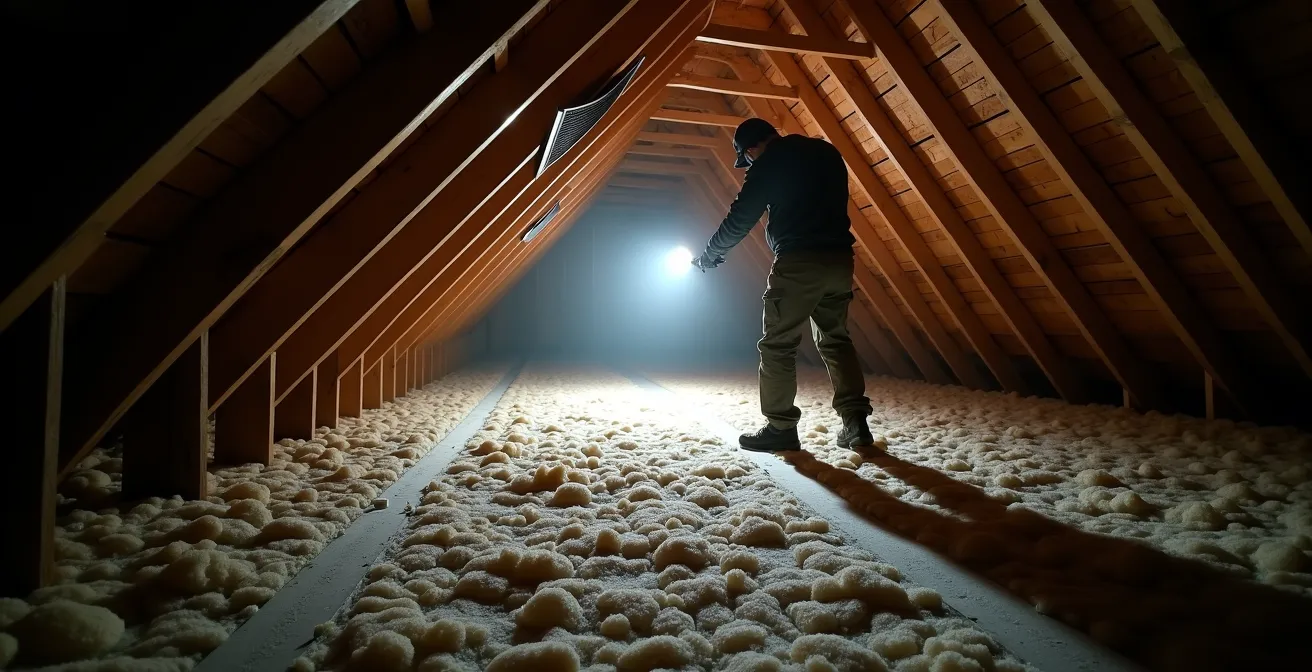
Your inspection starts with the work itself. Bring a powerful flashlight and look for any signs of overspray on windows, wall studs, or mechanical systems. Check for consistent depth and colour. In an attic, look for even coverage. The foam should adhere tightly to all surfaces with no gaps or shrinkage. If your contract included a post-insulation blower door test to measure air tightness, you must have those results in hand and verify they meet the target.
Just as important as the physical work is the final paper trail. The crew must remove all chemical drums and debris from your property in accordance with environmental regulations. Most importantly, you must have the complete, finalized paperwork package in your possession. This includes the final invoice, all warranty documents, and the crucial CCMC product fact sheets. Without this complete package, you may be unable to claim valuable government rebates. Do not accept a promise to “mail it later.” You need the documents in hand before the payment is released.
Your Final Payment Release Checklist
- Verify you have received the complete Canadian Rebate Paperwork Package.
- Confirm all CCMC-numbered product fact sheets have been provided for the materials used.
- Check that all chemical drums and project debris have been removed from your property.
- Review the post-insulation blower door test results, if applicable.
- Inspect the entire work area for overspray on windows, studs, and mechanical systems.
- Verify that thermal barriers have been applied correctly as per the National Building Code.
A professional contractor will expect this final review and will often perform a walkthrough with you to ensure your satisfaction. They are confident in their work and their process. A contractor who pressures you for payment before you’ve had a chance to verify everything is telling you they are afraid of what you might find.
The Scam Where Contractors Swap Premium Foam for Cheap Filler
One of the most insidious scams in the insulation industry is the “bait-and-switch” on materials. It’s almost impossible for a homeowner to detect without knowing exactly what to look for. The contractor quotes a high-quality, premium product—often a 2 lb closed-cell spray foam known for its high R-value and structural rigidity—but then uses a cheaper, inferior product, like a 0.5 lb open-cell foam or a different material entirely. They pocket the difference, and you are left with an underperforming and potentially problematic installation.
This is where your forensic vetting skills become critical. The verification of material integrity must happen *before* and *during* the installation, not after. Before the work begins, you must demand to see the foam drums that will be used on your job. Take a photograph of the labels. The label will contain the product name and, most importantly, the CCMC Evaluation Number. You must verify that this number matches what is specified in your signed contract. Any discrepancy is a massive red flag.
Case Study: The Cellulose Bait-and-Switch
A Canadian homeowner engaged an insulation company to install a blown-in fiberglass product. Just days before the job was scheduled, the contractor called, claiming their supplier was out of fiberglass. They offered to substitute blown-in cellulose for the same price, framing it as an equivalent. However, this is a known tactic. Insulation contractors often have a much higher profit margin on cellulose than on fiberglass. The last-minute swap, presented as a solution to a “supply problem,” is often a premeditated move to increase their profit at the client’s expense, who may not receive a product with the same performance characteristics they were sold on.
Also, be aware of seasonal blends. Professional-grade spray foam comes in different formulations for summer and winter application. Using a summer blend in cold weather can result in poor curing and shrinkage. A professional contractor will use the correct seasonal blend, and it will be stated on the drum. During the job, be observant. Watch to ensure the hoses are connected directly to the sealed, branded drums you photographed. If they are using unmarked barrels or transferring chemicals, stop the work immediately and demand an explanation.
You have the right to know exactly what is being installed in your home. A contractor who is transparent about their materials from start to finish is demonstrating a key professional fingerprint. One who is evasive or makes last-minute substitutions without a clear, logical reason and a price adjustment is likely not working in your best interest.
Key Takeaways
- General liability insurance is not enough; demand proof of a pollution liability rider for spray foam and verify the contractor’s WSIB/WCB status online yourself.
- A contractor’s true quality is revealed by asking their references specific, tough questions about paperwork and rebate success, not by skimming generic online reviews.
- Always verify the CCMC number on the material drums on-site matches the number specified in your contract to prevent bait-and-switch scams.
The Paperwork You Need to Save 15% on Your Commercial Property Insurance
While this article is focused on homeowners, looking at what’s required in the commercial sector provides a powerful lesson. The level of documentation required for a commercial project is the gold standard of professionalism. A contractor who can operate at this level has their processes dialed in, and this expertise inevitably benefits their residential clients as well. Seeing if a contractor has experience with this level of paperwork is an advanced vetting technique that can separate the true pros from the rest.
For commercial properties, a properly documented insulation upgrade can often lead to a reduction in insurance premiums, sometimes by as much as 15%. Insurance companies offer this because certified, properly installed insulation reduces risks (like fire) and liabilities. But to grant this discount, they require an airtight “paper trail of legitimacy.” This goes far beyond a simple invoice. It’s a comprehensive portfolio that proves the work was done to the highest standards with certified materials.
This portfolio typically includes pre- and post-work EnerGuide evaluation reports, the contractor’s signed contract with an itemized invoice, manufacturer and labor warranty documents, before and after photos, and—most critically—the CCMC evaluation sheets for every material used and the contractor’s certifications (like CUFCA for spray foam). A contractor who is accustomed to assembling these packages for their commercial clients understands the importance of meticulous record-keeping. They won’t be flustered when you, as a homeowner, ask for CCMC numbers or detailed warranty certificates.
Ask a potential contractor if they have ever helped a commercial client get an insurance reduction. Their answer, and their ability to describe the process, will tell you volumes about their level of expertise and administrative competence. This is the kind of deep operational knowledge that “cowboy” operators simply do not possess.
Why Using Non-CCMC Certified Insulation Voids Your Home Insurance?
Here is a terrifying fact that most “cowboy” contractors will never tell you: if you install a non-certified building product in your home, and that product contributes to a future loss (like a fire), your insurance company may have grounds to deny your claim. The Canadian Construction Materials Centre (CCMC) is the national evaluation service that provides an opinion on whether a product complies with Canadian building codes. It is the professional’s ultimate fingerprint of legitimacy.
The CCMC is part of the National Research Council Canada, and its evaluations are the bedrock of regulatory acceptance across the country. In fact, over 6,000 Canadian regulators trust CCMC product assessments when approving building materials. When a product is CCMC-certified, it has been rigorously tested for performance, health, and safety against the standards of the National Building Code of Canada. Using a non-certified product is like installing a car part that hasn’t passed any safety tests. It might seem fine, but it carries a massive hidden risk.
A professional contractor will only use CCMC-certified products and will proudly feature the CCMC numbers in their quotes and contracts. They will provide you with the evaluation sheet for the product upon request. A “cowboy” will often use cheaper, imported, or uncertified materials to undercut the competition. They might dismiss the CCMC as unimportant “red tape.” This is a lie, and it’s one that could cost you your home. The official position is clear, as stated by the National Research Council Canada itself:
It is the opinion of the Canadian Construction Materials Centre that the evaluated product, when used as thermal insulation in accordance with the conditions and limitations stated in this evaluation, complies with the following codes. In most jurisdictions this document is sufficient evidence for approval by Canadian authorities.
– National Research Council Canada, CCMC Canadian Code Compliance Evaluation Documentation
Your home is your biggest investment. Don’t leave its protection to chance by using unproven materials. Demanding a CCMC evaluation number for any insulation product being installed is not just smart; it’s an essential act of self-preservation. A contractor who can’t or won’t provide it is telling you that they are willing to gamble with your future.