Insulation techniques
Insulating a home in Canada’s demanding climate isn’t simply about stuffing material into wall cavities and hoping for the best. The difference between a drafty, energy-draining house and a comfortable, efficient sanctuary lies in understanding how different insulation techniques work together as an integrated system. Think of your home’s thermal envelope like a winter coat—the quality of the fabric matters, but so does the fit, the zipper, and whether there are gaps at the wrists.
Across Canadian provinces, from humid coastal climates to bone-dry prairie winters, homeowners and builders face unique challenges that demand specific technical approaches. The right insulation technique considers not just R-value and material type, but also air movement, moisture dynamics, thermal bridging, and acoustic performance. This comprehensive overview connects the fundamental concepts that separate merely adequate insulation from truly superior building performance, giving you the knowledge to make informed decisions for new construction or retrofit projects.
Understanding Core Insulation Materials
The foundation of any insulation strategy begins with selecting materials suited to your specific application. In Canadian construction, three primary material families dominate the landscape, each with distinct physical properties and ideal use cases.
Fibrous Batts: Mineral Wool and Fiberglass
Mineral wool (including rock wool) has earned particular respect in Canadian building science for its exceptional performance in extreme conditions. Unlike fiberglass, mineral wool maintains its insulating properties even when subjected to compression, making it ideal for areas where settling might occur. Its superior fire resistance—with melting points exceeding 1,000°C—provides an additional safety layer that many building codes recognize. The material’s density also contributes to excellent acoustic dampening, addressing both thermal and sound isolation in a single solution.
Fiberglass batts, while lighter and often more economical, require meticulous installation to achieve rated performance. The key difference lies in how these materials handle compression: fiberglass loses significant R-value when compressed, while mineral wool retains much of its effectiveness. For Canadian applications where heavy snow loads or settling over decades is a concern, this distinction becomes particularly relevant.
Spray Foam: Open-Cell vs. Closed-Cell Structures
Chemical foams offer unique advantages through their ability to seal and insulate simultaneously. Closed-cell spray foam provides both exceptional R-value per inch (approximately R-6 to R-7) and structural rigidity that can enhance wall racking resistance. Its vapor-impermeable nature makes it particularly valuable in below-grade applications or as an exterior sheathing layer in cold climates.
Open-cell foam, with its lower density and R-value (around R-3.5 per inch), excels at air sealing while remaining vapor-permeable—a critical characteristic for walls that need to dry to the interior. The choice between these foam types fundamentally alters your wall assembly’s moisture management strategy, making it essential to understand the drying mechanisms your building envelope requires.
Mastering Air Sealing Fundamentals
Canadians lose more energy to air leakage than to conductive heat loss in many homes, yet air sealing remains the most commonly overlooked aspect of insulation work. Creating a monolithic air barrier—a continuous plane that separates conditioned from unconditioned space—is non-negotiable for high-performance homes.
The practical challenge lies in maintaining this continuity through complex geometries. Every electrical box, plumbing penetration, and framing transition represents a potential failure point. Professional-grade air sealing requires a systematic approach:
- Identifying the air barrier plane early in design (interior polyethylene, exterior sheathing, or spray foam)
- Using compatible sealants that remain flexible across temperature extremes (-40°C to +40°C in many Canadian regions)
- Addressing “impossible gaps” like the rim joist-to-foundation connection with appropriate materials
- Blower door testing to verify performance, targeting 2.5 ACH50 or better for modern construction
The distinction between air barriers and vapor barriers confuses many DIY installers. An air barrier stops air movement (the primary driver of moisture problems), while a vapor barrier slows diffusion of water molecules through materials. Many modern assemblies use “smart” vapor retarders that adapt their permeability based on humidity conditions, allowing walls to dry when needed while protecting against winter condensation risks.
Eliminating Thermal Bridges
Even with perfect cavity insulation, your building envelope’s effective performance plummets if heat has easy pathways through conductive materials. Thermal bridging through wood or steel framing can reduce whole-wall R-values by 20-40% compared to center-of-cavity measurements.
The Rim Joist Challenge
The rim joist area—where floor systems meet exterior walls—represents one of the most severe thermal bridges in conventional construction. This junction combines multiple materials (concrete, wood, and often metal fasteners) with complex geometry that makes traditional batt installation nearly impossible to execute well. High-performance approaches typically involve cutting rigid foam to fit precisely between joists, sealing all edges with compatible foam sealant, or using spray foam to create a seamless thermal and air barrier in a single application.
Window and Roof Connections
Window “bucks” (the rough opening framing) create similar challenges, particularly in thick wall assemblies. The key is extending the insulation plane continuously past the structural opening, then carefully detailing the connection between window frame and air barrier. At roof connections, the transition from vertical wall to sloped roof assembly demands careful attention to maintain both insulation depth and ventilation requirements—a particularly critical balance in Canadian snow country where ice damming poses real risks.
Building a Continuous Thermal Envelope
Advanced building science increasingly favors continuous exterior insulation over relying solely on cavity insulation. By wrapping the entire structure with a continuous layer of rigid or semi-rigid insulation, you eliminate the thermal bridging inherent in framed walls while raising the temperature of structural elements—reducing condensation risk.
This approach, often called “exterior sheathing enhancement,” typically involves layering rigid mineral wool, XPS, or polyisocyanurate boards over wall sheathing before applying cladding. The technique offers several advantages for Canadian builders:
- Keeps framing warm and dry, extending building lifespan
- Allows cavity insulation to be less dense and more vapor-open
- Creates opportunities to install service runs without penetrating the air barrier
- Permits thicker overall assemblies without sacrificing interior floor space
Double stud wall construction takes a different approach to the same goal, creating a thick cavity (often 10-12 inches) that accommodates substantial insulation while breaking thermal bridges between inner and outer studs. This assembly achieves the “Perfect Wall” concept—a theoretical ideal where the structure remains warm, dry, and durable indefinitely—by positioning the vapor control layer appropriately for the climate and ensuring the wall can dry in at least one direction.
Managing Moisture and Vapor Control
Canadian building codes have evolved considerably in their approach to vapor management, moving away from the universal interior polyethylene vapor barrier toward more nuanced strategies. The reality is that vapor drive direction changes with seasons: outward in winter when interior humidity exceeds exterior levels, inward during summer in air-conditioned spaces or when solar-heated cladding drives moisture inward.
Bathrooms present particular challenges, generating intense, localized humidity that can overwhelm standard vapor control strategies. The traditional solution—6-mil polyethylene with sealed seams—works when installed meticulously but becomes problematic if any interior water intrusion occurs (a leaking fixture or ice dam), as it prevents drying inward. Modern alternatives include variable-permeability membranes that tighten up in winter humidity but open during drier seasons, or careful use of vapor-permeable insulation materials that allow drying while still controlling air movement.
The critical principle is ensuring your wall assembly can dry. Whether that drying happens primarily to the interior, exterior, or both depends on your climate, cladding choice, and interior finish materials. Assemblies that trap moisture between two impermeable layers—a common error when combining exterior foam with interior polyethylene incorrectly—risk long-term durability problems regardless of initial R-value.
Insulating Critical Building Zones
While wall assemblies receive the most attention, several specific building zones demand specialized insulation techniques due to their unique exposure or functional requirements.
Basement and Slab Edges
Below-grade spaces lose substantial heat through foundation walls and slab edges, with the thermal penalty extending several feet beyond the visible foundation. Slab edge insulation—rigid foam placed vertically along the perimeter before pouring—addresses this often-neglected detail. Similarly, full-height interior or exterior foundation insulation dramatically improves basement comfort while reducing the risk of summer condensation on cold concrete surfaces. Building codes across Canadian provinces increasingly mandate these measures, recognizing their significant impact on whole-house energy consumption.
Attic and Cathedral Ceiling Assemblies
Heat rises, making attic insulation your highest-return investment in cold climates. The challenge lies in maintaining proper ventilation—critical for managing moisture and preventing ice dams—while achieving target R-values that now often exceed R-50 in Canadian climate zones. Blown cellulose or fiberglass allows achieving these depths economically, but installers must carefully detail the perimeter to prevent wind washing, maintain clearance at eave vents, and ensure the attic hatch (often forgotten) receives equal attention.
Cathedral ceilings and dormer windows complicate this picture by eliminating the ventilated attic. These assemblies require either thick rafter bays to accommodate both ventilation channels and adequate insulation, or transition to unvented “hot roof” designs that use spray foam or substantial exterior rigid insulation to keep sheathing warm enough to prevent condensation.
Specialized Applications
Garage ceilings separating conditioned living space from unheated garages demand attention to both thermal and fire-rated assemblies. Insulation “skirts” around foundation perimeters minimize frost penetration in crawl spaces or around frost-protected shallow foundations. For those installing radiant floor heating, insulation beneath tubing ensures heat flows upward into living space rather than being lost to the ground—a simple detail that can improve system efficiency by 30% or more.
Addressing Acoustic Performance
While thermal performance drives most insulation decisions, sound isolation increasingly influences material selection and installation techniques, particularly in multi-family construction or home theaters. Flanking noise paths—sound that bypasses insulated assemblies by traveling through structural connections—often undermine even well-insulated walls.
Effective acoustic design requires understanding that sound travels through both airborne and structure-borne paths. Dense insulation materials like mineral wool excel at absorbing sound energy within cavities, while decoupling techniques (resilient channels, staggered or double-stud walls) prevent vibration transmission through framing. Specialized acoustic sealants remain flexible to maintain their seal even as buildings shift seasonally—a critical consideration in Canadian climates where thermal expansion and contraction cycles are pronounced.
The most effective acoustic assemblies combine multiple strategies: decoupled framing, dense cavity fill, multiple layers of drywall with staggered seams, and meticulous sealing of every penetration. For demanding applications, achieving STC ratings of 55 or higher requires this systems-based approach rather than relying on any single “soundproof” product.
Optimizing Installation Sequencing and Details
Even premium materials fail when installed improperly. The sequencing of insulation work relative to other trades determines whether you achieve theoretical performance or suffer from gaps, compression, and air leakage that undermines your investment.
Professional installations follow a logical progression: air sealing penetrations first, then installing insulation materials, followed by verification before closing walls. Batts must completely fill cavities without gaps at edges or compression that reduces R-value. Splitting batts around wiring rather than compressing them behind cables, supporting insulation at the bottom plate to prevent settling, and ensuring full contact with sheathing all separate adequate from excellent installations.
For multi-layer strategies—increasingly common when retrofitting to higher standards—the sequence matters tremendously. Interior cavity insulation, then exterior continuous insulation, then careful detailing of the transitions at windows, corners, and penetrations. Each layer’s air barrier must connect to the next to maintain continuity, and vapor permeability must decrease appropriately moving from warm to cold sides of the assembly.
Understanding insulation techniques as interconnected systems rather than isolated product choices transforms building performance. Whether you’re constructing a new energy-efficient home or retrofitting an older property to modern standards, these fundamental principles—proper material selection, continuous air barriers, thermal bridge elimination, moisture management, and meticulous installation—

Acoustic Sealant vs. Regular Caulk: Why the Black Stuff Matters in Soundproofing
Contrary to common belief, acoustic sealant isn’t just a flexible caulk; it’s a permanent viscoelastic damper designed to preserve structural decoupling, the true secret to effective soundproofing. It absorbs vibrational energy by converting it to heat, instead of just blocking…
Read more
Why Placing All Insulation on the Outside is the Definitive Strategy for Canadian Homes
Contrary to common belief, the primary benefit of exterior insulation isn’t just energy savings; it’s the strategic control of physics to create a wall assembly that is inherently resilient and durable. It keeps the entire wooden structure warm and dry…
Read more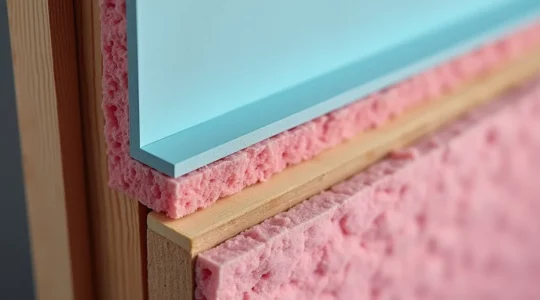
The Perfect Wall Assembly: Why Layering Insulation Outperforms Monolithic Systems in Canada
Achieving a high-performance wall in Canada is not about maximizing R-value, but about mastering hygrothermal control to prevent moisture damage. The placement and ratio of foam-to-batt insulation are dictated by your Canadian climate zone to keep the wall’s condensing surface…
Read more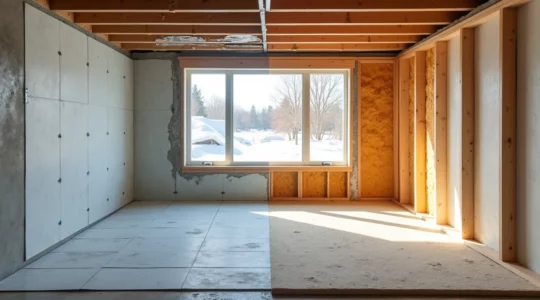
Should You Insulate Your Basement Walls from the Inside or Outside?
The choice isn’t just about interior vs. exterior; it’s about mastering Canadian building science to prevent costly structural and health failures. Exterior insulation is the only method that effectively controls soil moisture and frost forces, protecting the foundation itself. Interior…
Read more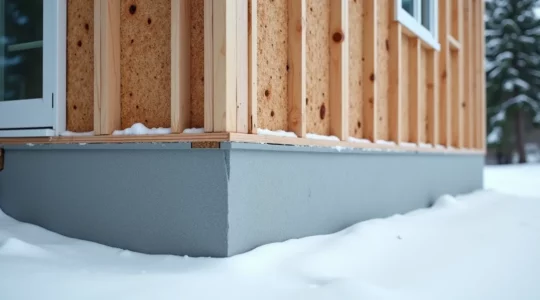
How Rigid Foam Insulation Stops the Cold Transmitted by Wall Studs
Adding exterior rigid foam during a siding replacement is the single most effective upgrade for eliminating thermal bridges and transforming your home’s building envelope performance. It creates a continuous thermal blanket, keeping your structural wall sheathing warm, dry, and protected…
Read more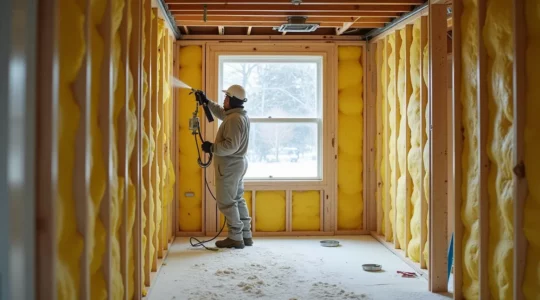
How Polyurethane Foam Engineers Structural Rigidity into Weakened Walls
Closed-cell polyurethane foam doesn’t just insulate; it engineers a monolithic composite structure, increasing wall racking strength by up to 300%. Success depends on controlling substrate thermodynamics, not just ambient temperature, a critical factor in Canadian climates. Proper surface preparation and…
Read more
Why Spray Foam Is the Only Solution for Irregular Joist Spaces
For older Canadian homes, eliminating drafts isn’t about R-value—it’s about creating a perfect, monolithic air seal that corrects structural inconsistencies, a task only closed-cell spray foam can achieve. Traditional insulation like fiberglass fails in irregular joist spaces, allowing air leakage…
Read more
Why Mineral Wool Is the Preferred Choice for Damp Canadian Basements?
Choosing mineral wool for your Canadian basement is an investment in your home’s long-term structural health, not just a thermal upgrade. Unlike fiberglass which acts like a sponge, mineral wool is hydrophobic, actively repelling bulk water and allowing the wall…
Read more