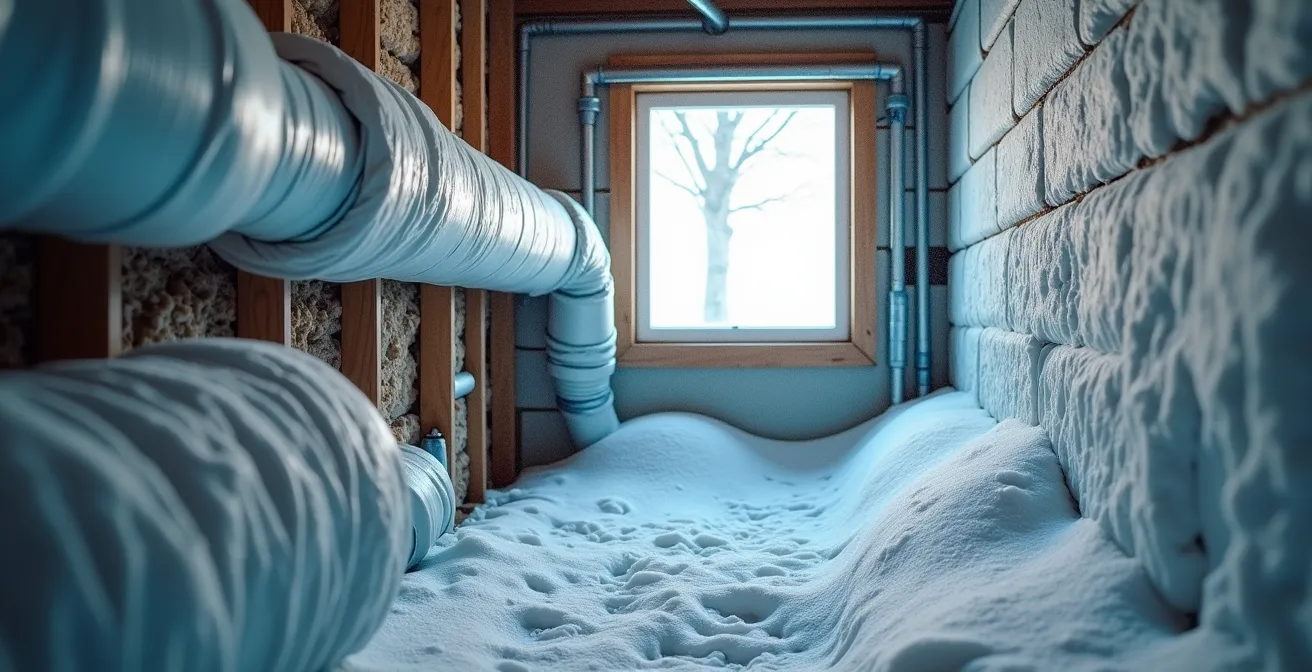
Surviving extreme cold isn’t about adding more insulation; it’s about eliminating the thermal bridge weak points that cause catastrophic failures at -50°C.
- Standard building methods fail because materials become brittle and thermal conductivity turns structural elements like steel studs into ice conduits.
- Airtightness is critical, but it creates a moisture war inside the home that must be managed with a perfectly serviced Heat Recovery Ventilator (HRV).
Recommendation: Shift your focus from generic insulation R-values to creating a continuous, unbroken exterior insulation envelope and installing components (windows, seals) certified for Arctic Zone 8 performance.
Living and building in Canada’s North is a different game. When the mercury plunges to -40°C or -50°C, the advice that works in the south isn’t just wrong—it’s dangerous. You’re told to insulate pipes, let faucets drip, and seal leaks. But I’ve seen homes built to “code” with ice forming on the *inside* of their walls and windows so frosted you can’t see out from November to March. The hard truth is that extreme cold doesn’t just make things colder; it changes the rules of physics for building materials.
The standard stick-built home with insulation stuffed between studs becomes a recipe for disaster. This isn’t a problem you can solve by just adding another layer of pink insulation or cranking up the furnace. The real challenge lies in the unseen enemies: thermal bridging that bypasses your insulation completely, air leaks that carry immense amounts of moisture, and materials that simply give up and crack in the brutal cold. It’s a constant battle against heat loss and moisture physics.
But what if the key wasn’t just fighting the cold, but designing a system that anticipates its every move? This guide is built on hard-won experience from construction sites across the Territories. We’re not going to rehash the basics. Instead, we’re going to dissect the specific points of failure in northern housing and give you the robust, field-tested strategies to build and maintain a home that doesn’t just survive the winter, but thrives in it. We’ll explore why modular building is taking over, how to stop steel studs from creating ice lines, and what to do when the worst happens and your furnace gives out at -30°C.
This article breaks down the critical systems and components you must master to win the war against the cold. The following sections provide a roadmap based on real-world challenges faced by builders and residents in Canada’s most extreme climates.
Summary: A Builder’s Manual for Arctic-Proofing Your Home
- Why Modular Panels Are Replacing Stick Framing in Fly-In Communities?
- Which Window Seals Don’t Crack When Temperatures Drop Below -40°C?
- Flat vs. Steep Pitch: Which Roof Shape Survives Arctic Blizzards Best?
- The Steel Stud Mistake That Creates Ice Lines Inside Northern Homes
- When to Service Heat Recovery Ventilators to Prevent Core Freezing?
- Why Windows Ice Up in January and How to Stop It?
- Which Climate Zone Are You In: 5, 6, or 7?
- What to Do If Your Furnace Fails at -30°C?
Why Modular Panels Are Replacing Stick Framing in Fly-In Communities?
In the North, the construction season is brutally short—sometimes only two or three months. Building a house stick by stick on-site is a race against time that you often lose. This logistical reality is the primary driver behind the shift to modular and panelized construction. When you’re dealing with a fly-in community, every nail, every 2×4, and every hour of skilled labour has a massively inflated cost. In fact, research shows that building costs are on average 150 percent higher in the North than in the rest of Canada, and that’s a conservative estimate for the most remote locations.
Stick framing is inefficient in this environment. It requires a large crew working in unpredictable weather, and any missing material can mean a delay of weeks or months until the next barge or winter road opens. Modular construction flips the script. The complex work of building the walls and roof panels is done in a climate-controlled factory down south. These complete, pre-engineered components are then shipped to the site, ready for rapid assembly. This dramatically reduces on-site construction time and exposure to the elements.
This approach offers superior quality control. It’s far easier to achieve a truly airtight building envelope in a factory setting than in a windy, sub-zero building site. As a research project by the National Research Council of Canada in the Yukon is demonstrating, this strategy is key to delivering speedy deep-energy retrofits and building more resilient new homes. By optimizing the logistics, we build better, faster, and more cost-effectively, which is essential for addressing the housing challenges across the North.
Which Window Seals Don’t Crack When Temperatures Drop Below -40°C?
A window is only as good as its weakest part, and in the Arctic, that’s almost always the seal. At temperatures below -40°C, many common materials reach their brittleness point. A standard EPDM (ethylene propylene diene monomer) rubber seal, which is perfectly fine in Toronto or Vancouver, will become hard, shrink, and crack. This failure opens up microscopic air leaks that completely undermine the performance of your expensive triple-pane windows, leading to drafts, condensation, and ice buildup.
This isn’t a matter of quality; it’s a matter of material science. You are fighting a war against physics, and you need to choose your weapon accordingly. For the extreme cold of the Yukon, NWT, or Nunavut, there is really only one reliable choice: silicone-based seals. Unlike EPDM or other vinyl compounds, high-quality silicone maintains its flexibility and sealing properties at temperatures down to -70°C, well below anything you’ll encounter.
When specifying windows for a northern project, you must look beyond the R-value and frame material. Demand to know the specific compound used for the weatherstripping and ensure it’s rated for your climate. A multi-chambered frame with compression seals can also work, but only if the seal material itself is a cold-rated compound. Choosing the wrong seal is like buying a top-of-the-line parka with a broken zipper—the main feature is rendered useless by a single point of failure.
Your Checklist for Arctic Window Installation
- Verify window certification: Ensure windows meet or exceed CSA A440 certification for Climate Zone D (or Zone 8 under the National Building Code).
- Seal the frame: Use fluid-applied membranes or specialized cold-weather tapes like Siga Fentrim to seal the window frame to the wall’s air barrier. This connection is critical.
- Ensure barrier continuity: Double-check that the window installation is perfectly integrated with the wall’s air and vapour barrier system. There can be no gaps.
- Demand quality control: Rigorous inspection of all sealing and insulation work around the window opening is non-negotiable. No shortcuts.
- Test for leakage: A final blower door test is essential to confirm the home’s airtightness is below 0.6 Air Changes per Hour (ACH). This verifies the performance of your windows and the entire envelope.
Flat vs. Steep Pitch: Which Roof Shape Survives Arctic Blizzards Best?
In the North, a roof has to do more than just keep the rain out. It has to manage massive snow loads and withstand hurricane-force winds during blizzards. The conventional wisdom often favours steep-pitched roofs for shedding snow, but in the wide-open tundra, the wind changes the equation entirely. A steep-pitched roof can act like a wing, creating immense uplift forces. More importantly, it creates a large area on the leeward side where snow can accumulate into massive, unbalanced drifts that can exceed the structural capacity of the roof.
This is why you see a surprising number of low-slope or flat roofs on modern northern buildings. A low-slope roof interacts with the wind differently. In a phenomenon known as wind scouring, the high-velocity winds that sweep across the landscape actually blow the roof clear of most snow, preventing dangerous accumulation. This turns the wind from an enemy into an ally, using its power to reduce the structural load on the building. The key is in the details: proper parapet height and robust membrane roofing are essential.

This building science is especially critical given the age of much of the housing stock. As the 2016 census showed, 22% of the Yukon’s dwellings date back to the 1970s, built long before our modern understanding of these forces. These older structures are often the most vulnerable. Furthermore, with permafrost thaw causing foundations to shift, as seen in many homes in Iqaluit, minimizing any additional stress on the building frame is paramount. Choosing the right roof shape is a critical piece of designing a resilient, long-lasting structure.
The Steel Stud Mistake That Creates Ice Lines Inside Northern Homes
Here is one of the most common and catastrophic mistakes I see in northern construction: using steel studs for exterior walls without a proper thermal break. On paper, it seems like a good idea. Steel is strong, straight, and non-combustible. But it has one fatal flaw in a cold climate: it’s an exceptional conductor of heat. In fact, steel studs are 300-400 times more thermally conductive than wood. This creates a “thermal bridge”—a superhighway for heat to escape your home.
Imagine a row of metal spoons reaching from the inside of your wall to the -50°C air outside. That’s what steel studs do. No matter how much high-R-value insulation you pack between them, the studs themselves will get incredibly cold. When warm, moist indoor air touches the section of drywall cooled by the stud, the moisture instantly condenses and freezes. This leads to tell-tale vertical stripes of frost or even ice on the inside of your walls, a phenomenon I call a “thermal bridge catastrophe.” This moisture can lead to mould, drywall degradation, and disastrous heat loss.
The only way to use steel studs safely in an exterior wall is to completely break the thermal bridge. This is not optional. The solution is to install a continuous layer of rigid exterior insulation over the outside of the studs, before the cladding is attached. This blanket of insulation (a minimum of R-10 in Zone 8) keeps the entire steel structure on the “warm” side of the wall assembly. Here are the key practices to prevent this mistake:
- Use specialized thermal clips (like Cascadia Clips) to attach cladding through the exterior insulation without creating new thermal bridges.
- For high-performance homes, consider a double-stud wall, where an inner and outer wall are framed separately with a large, continuous gap for insulation, completely eliminating thermal bridging.
- Under no circumstances should water pipes ever be run through an exterior wall framed with steel studs. It is a guaranteed frozen pipe.
- During construction or a retrofit, use thermal imaging on a cold day to verify the integrity of the building envelope and ensure there are no hidden thermal bridges.
When to Service Heat Recovery Ventilators to Prevent Core Freezing?
In the North, we build our homes as airtight as possible to stop heat loss. But a sealed box creates another problem: poor air quality and moisture buildup. Every breath you take, every shower, every pot of boiling water releases moisture into the air. In a super-insulated home, that moisture has nowhere to go. This is where a Heat Recovery Ventilator (HRV) becomes the lungs of the house. It constantly exchanges stale, moist indoor air with fresh outdoor air while recovering up to 80% of the heat from the outgoing air. It’s not a luxury; it’s an essential life-support system.
But at -40°C, the HRV itself can become a point of failure. As the warm, humid exhaust air passes through the HRV’s core, it meets the frigid incoming air. If not managed properly, the moisture in the exhaust air will freeze solid inside the core, blocking airflow completely. This can happen surprisingly fast. A frozen HRV core not only stops ventilation but can also force the unit into a constant, energy-wasting defrost cycle or cause it to shut down entirely.

The key is preventative maintenance, and it must be done before the deep cold sets in. Your pre-winter HRV service is one of the most important maintenance tasks for a northern home. This must be done every year, ideally in September or October. Service includes cleaning or replacing the filters, and most importantly, removing and thoroughly cleaning the core itself to remove any dust or film that can accelerate ice formation. You must also check that the condensate drain line is clear and properly insulated so it doesn’t freeze. The National Research Council’s work on indoor air quality in retrofitted homes continually highlights that managing ventilation is critical to a home’s overall health. An HRV that isn’t working is worse than no HRV at all.
Why Windows Ice Up in January and How to Stop It?
Waking up to a thick layer of frost on the inside of your brand-new triple-pane windows is a classic northern problem. It’s a clear sign that you are losing the moisture physics war inside your home. The ice isn’t forming because the window is “cold”; it’s forming because the surface temperature of the glass has dropped below the dew point of your indoor air. In simpler terms: your indoor air is too humid for the outdoor temperature.
The colder it gets outside, the less moisture the air inside your home can hold before it condenses on the coldest surface it can find—your windows. This isn’t a defect in the window; it’s a law of physics. At 0°C outside, your home might comfortably handle 40% relative humidity (RH). But when the temperature plummets, that moisture-holding capacity drops dramatically. To prevent condensation at -40°C, your indoor humidity must be kept below 15% RH, which is incredibly dry. Running a humidifier in a northern winter is almost always a mistake.
The solution is a two-pronged attack: reduce moisture sources and ventilate. You need to run bathroom and kitchen fans religiously. Most importantly, you need a properly functioning and balanced HRV to constantly exhaust moist air. The following table gives you a clear guide for managing your indoor humidity levels as the temperature outside drops.
This table, based on guidelines from municipal sources like the City of Toronto, provides a crucial framework for Canadian homeowners. While Toronto’s climate is milder, the physics are the same, and these targets are a good starting point for preventing condensation.
| Outdoor Temperature | Maximum Indoor RH | Risk Level |
|---|---|---|
| 0°C to -10°C | 40% | Low |
| -10°C to -20°C | 30% | Moderate |
| -20°C to -30°C | 25% | High |
| Below -30°C | 15% | Critical |
Which Climate Zone Are You In: 5, 6, or 7?
If you’re living in the Yukon, NWT, or Nunavut, the answer to this question is: none of the above. You’re likely in Climate Zone 8, the most demanding zone in the National Building Code of Canada (NBCC). The building code isn’t just a set of suggestions; it’s the minimum legal requirement for construction. These zones dictate everything from insulation levels to window performance, and the jump to Zone 8 is significant. While a city like Ottawa (Zone 5) might identify approximately 2,000 homes as vulnerable to freezing due to older infrastructure, in Zone 8, every single home is vulnerable by default if not built far beyond southern standards.
Building to Zone 8 requirements means a systemic upgrade of the entire building envelope. It’s not about just adding a bit more insulation in the attic. The requirements are a leap in performance:
- Wall Insulation: Requires an effective R-value of R-38, a significant jump from R-29 in Zone 7. This almost always requires continuous exterior insulation to achieve.
- Attic Insulation: A minimum of R-60 is the starting point. Many high-performance northern homes go for R-80 or even R-100.
- Foundation Insulation: R-20 insulation is required for the full height of the foundation wall to combat frost penetration.
- Windows: Triple-pane windows are mandatory, with a maximum U-value of 0.25 (which corresponds to a high R-value).
These aren’t just numbers; they represent a fundamentally different approach to construction. As the National Building Code of Canada makes clear, it’s about the performance of the entire system.
Climate zones dictate not just insulation, but performance requirements for all components including windows, doors, and ventilation systems.
– National Building Code of Canada, 2020 National Building Code Updates
Key Takeaways
- Extreme cold performance is about systems, not just components. A failure in one area (like a window seal) compromises the entire building envelope.
- Thermal bridging is the primary enemy in northern construction. Steel studs and other conductive materials must be isolated with continuous exterior insulation.
- Airtight homes require mechanical ventilation (HRV) to control moisture, and this system must be meticulously maintained to prevent its own failure from freezing.
What to Do If Your Furnace Fails at -30°C?
This is the scenario that keeps northerners up at night. A furnace failure at -30°C is not an inconvenience; it’s an emergency that can lead to catastrophic damage and pose a serious risk to life. In a remote community, help could be hours or days away. This is where the concept of systemic redundancy becomes a matter of survival. You must have a pre-planned, multi-layered emergency heat plan.
Your primary goal is to prevent your pipes from freezing. The first line of defense, if the furnace quits but you still have power, is to keep water moving. Go to the faucet furthest from where the water enters your home and turn it on to a slow trickle. This moving water is much harder to freeze. If you have electric heat tapes on vulnerable pipes, ensure they are functioning. However, you cannot rely on the grid alone.
A reliable secondary heat source is non-negotiable. For most, this means a CSA-approved wood stove with a well-stocked supply of dry, seasoned wood. A portable generator properly sized to run your furnace blower (even if the heat element isn’t working) can also help circulate air from the wood stove throughout the house. Portable space heaters can be used as a last resort, but they must never be left unattended, especially while you sleep, due to the high fire risk. If you are forced to leave the house for an extended period, you must have a plan and the tools ready to completely shut off your main water supply and drain the entire plumbing system to prevent burst pipes.
Frequently Asked Questions About Surviving Extreme Cold
How long does it take to thaw frozen pipes?
Depending on the outside temperature and how extensively the pipe is frozen, the thawing process could take anywhere from one to six hours. Patience is key to avoid damaging the pipes.
What heat sources are safe for thawing?
Safe methods include using an electric heating pad wrapped around the pipe, a hair dryer, a small space heater aimed at the area (from a safe distance), or wrapping the pipe in warm towels. You must never use an open flame, such as a propane torch, or a kerosene or charcoal heater, as this is an extreme fire hazard.
When should I shut off water completely?
If you are leaving your home for more than 24 to 48 hours during a deep freeze, especially in places like Alberta or the Territories, it is a wise precaution to shut off the main water supply and drain all the pipes to prevent any chance of them freezing and bursting while you are away.