
The era of slow, disruptive building retrofits is over. Prefabricated insulated panels enable an “Agile Retrofit” that transforms a building’s envelope in as little as two weeks, minimizing tenant disruption and accelerating ROI.
- Off-site manufacturing ensures precision and speed, moving 90% of the work away from the property.
- Exterior-only installation means tenants remain in place, eliminating lost revenue from vacancies.
Recommendation: For Canadian building owners, this method isn’t just a facelift; it’s a strategic upgrade to asset performance, delivering immediate energy savings and long-term value.
For owners of multi-unit residential buildings in Canada, the words “exterior renovation” often evoke a sense of dread. The process is notoriously slow, a marathon of scaffolding, noise, and constant disruption that can span months. This traditional approach not only frustrates tenants but also represents a significant operational and financial drag. While everyone acknowledges the need for better energy efficiency and modern aesthetics, the conventional methods make the cure feel worse than the disease. The standard advice involves lengthy on-site construction, juggling trades, and accepting tenant turnover as an unavoidable cost of upgrading.
But what if this entire paradigm is outdated? What if the key to a successful building retrofit isn’t just about the final materials, but about revolutionizing the process itself? This is the core of the Agile Retrofit methodology. Instead of a chaotic, months-long project, imagine a precision-engineered, high-performance building skin, manufactured off-site and installed in a matter of weeks. This approach focuses on a strategic advantage that traditional methods ignore: speed and minimal disruption. It transforms the renovation from a liability into a swift, predictable upgrade that enhances asset value almost overnight.
This guide delves into how this two-week transformation is not only possible but is becoming the new standard for savvy Canadian building owners. We’ll explore the technology behind these panels, the structural considerations, the critical science of moisture management, and the tangible financial returns. By focusing on an occupant-in-place strategy, we will demonstrate how you can achieve top-tier energy performance and a complete aesthetic overhaul without sacrificing months of rental income or tenant satisfaction. It’s time to move from the slow marathon to the high-performance sprint.
To help you navigate this innovative approach, this article breaks down every critical aspect of a prefabricated panel retrofit. Below is a summary of the key topics we will cover, from initial value assessment to final material selection for the Canadian climate.
Summary: The Agile Retrofit with Prefabricated Panels
- How Modern Insulated Panels Boost Property Value by 15%?
- Can Your Old Brick Walls Support New Heavy Insulated Panels?
- Why a Rainscreen Gap is Non-Negotiable Behind Continuous Panels?
- Passive House Retrofits: How Continuous Panels Achieve EnerPHit Standards?
- When to Remove Old Cladding vs. Over-Cladding with Panels?
- Exterior vs. Interior Retrofit: Which is Better if You Live in the House?
- CanExel vs. Hardie Board: Which Stands Up Better to Canadian Winters?
- Vinyl, Wood, or Fiber Cement: Which Siding Offers the Best ROI in Canada?
How Modern Insulated Panels Boost Property Value by 15%?
The primary driver for any capital improvement is return on investment, and prefabricated panel retrofits deliver on multiple fronts. The value increase isn’t just theoretical; it’s a direct result of tangible performance gains and enhanced curb appeal. By wrapping a building in a new, high-performance envelope, you’re fundamentally upgrading its core asset value. This is achieved through a combination of drastically reduced operating costs and increased market desirability.
First, the energy savings are immediate and substantial. A continuous layer of exterior insulation virtually eliminates thermal bridging, a major source of heat loss in older buildings. Studies and real-world projects confirm that prefabricated overcladding systems can deliver 15-25% energy savings. For a multi-unit residential building, this translates into thousands of dollars in reduced heating and cooling costs annually, a powerful selling point for both attracting new tenants and justifying higher rental rates. This improved energy rating becomes a durable financial asset.
Beyond operational savings, the aesthetic transformation modernizes the property, making it more competitive in the rental or sales market. A fresh, contemporary facade directly influences a potential tenant’s or buyer’s first impression. This “curb appeal” is not just cosmetic; it signals a well-maintained, modern, and comfortable building. The combination of lower utility bills for occupants and a superior living environment allows owners to command premium pricing, directly boosting net operating income and, consequently, the building’s capital valuation. The financial velocity of this process—achieving these gains in weeks, not years—is what sets it apart.
Can Your Old Brick Walls Support New Heavy Insulated Panels?
A common and valid concern for owners of older, often brick-clad, buildings is whether the existing structure can handle the additional weight of a new facade system. The image of heavy, cumbersome panels being attached to aging masonry is a source of anxiety. However, this concern is largely based on outdated perceptions of precast materials. Modern prefabricated panels are engineered specifically for retrofit applications, prioritizing lightweight construction without sacrificing performance.
Many advanced panel systems are surprisingly light. For instance, some architectural cladding solutions are designed to be significantly lighter than traditional options. As the team at SlenderWall points out, their system is engineered to be lightweight, which can reduce foundation and superstructure requirements. This is a crucial advantage in retrofits, where modifying the existing foundation is often prohibitively expensive. The use of lightweight composite materials and efficient structural design means these panels impose a minimal additional load, making them suitable for a wide range of existing building types.
SlenderWall is designed to be lightweight (66% less than traditional architectural precast), reducing foundation and superstructure requirements.
– SlenderWall, Architectural Cladding Panel Specifications
Of course, this doesn’t eliminate the need for due diligence. A thorough structural assessment by a qualified engineer is a mandatory first step. This assessment will verify the condition of the existing substrate, check for any degradation or damage to the brickwork or sheathing, and confirm the load-bearing capacity of the wall assembly. But in most cases, the conversation is not *if* the building can support the panels, but *how* to best attach the lightweight system to ensure a secure and durable high-performance envelope for decades to come.
Why a Rainscreen Gap is Non-Negotiable Behind Continuous Panels?
While speed and insulation are key benefits of prefabricated panels, their long-term durability hinges on a critical, often-overlooked detail: the rainscreen gap. Installing a highly insulated, airtight panel system directly against an old wall without a proper air gap is a recipe for disaster. This space, typically between 10mm and 25mm, is the building’s first line of defense against moisture, a lesson learned the hard way during events like British Columbia’s “leaky condo crisis.”
This engineered gap serves two primary functions: drainage and ventilation. No matter how well a cladding system is sealed, some bulk water will inevitably find its way behind it. The rainscreen gap creates a clear, unobstructed drainage plane, allowing this water to travel down the weather-resistive barrier (WRB) and exit safely at the bottom. Without this gap, water gets trapped, leading to rot, mold, and catastrophic failure of the wall assembly. This is especially true with non-permeable insulation types like foam panels, which can trap condensation if not managed.
This paragraph introduces the complex concept of a rainscreen. To truly understand its function, it’s helpful to visualize its components. The illustration below breaks down this critical moisture management system.

As the image highlights, the second function, ventilation, is equally important, particularly in Canada’s varied climates. The gap allows air to circulate behind the cladding, which helps to dry out any residual moisture that doesn’t drain away. This constant air movement is essential for the longevity of all wall components, from the sheathing to the panel attachments. The choice between a simple drained system and a more robust ventilated system often depends on the local climate.
This table, based on building science principles, provides a clear comparison to guide the decision between drained and ventilated systems for different Canadian regions.
| Feature | Drained Rainscreen | Ventilated Rainscreen | Best Canadian Climate |
|---|---|---|---|
| Air Gap Size | 6-10mm minimum | 19-25mm recommended | – |
| Moisture Management | Water drainage only | Drainage + evaporation | – |
| Installation Cost | Lower | Higher | – |
| Performance | Good | Excellent | – |
| Recommended Region | Prairie provinces | Coastal BC, Great Lakes | Based on humidity |
Passive House Retrofits: How Continuous Panels Achieve EnerPHit Standards?
For building owners aiming for the pinnacle of energy performance, prefabricated panels are the most efficient pathway to achieving the rigorous EnerPHit standard. EnerPHit is the Passive House certification specifically for retrofits, representing a gold standard in energy efficiency, comfort, and building durability. Reaching this level of performance with traditional, on-site methods is exceptionally difficult, disruptive, and costly. Prefabricated systems, however, are almost tailor-made for the challenge.
The core principles of Passive House design—a super-insulated envelope, extreme airtightness, and elimination of thermal bridges—are inherently addressed by panelized retrofits. The off-site manufacturing process allows for a level of quality control and precision that is nearly impossible to replicate in the field. Seams, window interfaces, and other complex details can be perfectly executed in a factory setting, creating a truly continuous and unbroken thermal barrier. When these large-format panels are installed on-site, they drastically reduce the number of joints and potential points of air leakage, which is the primary challenge in any deep energy retrofit.
This approach is not just a European concept; it’s being actively developed and validated for the Canadian market, demonstrating its viability for our specific housing stock and climate challenges.
Case Study: The Canadian PEER Project
Natural Resources Canada’s (NRCan) 5-year Prefabricated Exterior Energy Retrofit (PEER) initiative was launched to validate a process for upgrading Canadian housing with panels. The R&D program involved building science investigations to ensure durability in Canadian climates and testing panel concepts. To date, five distinct panel prototypes have been developed, with several pilot projects underway, proving the technical and practical feasibility of achieving deep energy savings with this streamlined, factory-first approach.
Ultimately, for building owners, this means that achieving an elite standard like EnerPHit is no longer a theoretical ambition but a practical and efficient process. It’s the fastest way to transform an aging, inefficient building into a high-performance asset that is future-proofed against rising energy costs and stricter emissions regulations.
When to Remove Old Cladding vs. Over-Cladding with Panels?
Once the decision to use prefabricated panels is made, a critical question arises: should you remove the existing cladding or install the new system directly over it? The answer has significant implications for the project’s cost, timeline, and complexity. While over-cladding is often faster and creates less waste, it’s not always the right or even a possible choice. The decision hinges on three key factors: hazardous materials, substrate condition, and local building codes.
The first and most critical check is for asbestos. If the building was constructed before 1990, there’s a high probability that asbestos-containing materials are present in the siding, caulking, or underlying layers. In Canada, provincial regulations are strict; if asbestos is found, complete and professional abatement is almost always mandatory before any work can proceed. Attempting to over-clad in this situation is dangerous and illegal.
Secondly, the structural integrity of the existing wall is paramount. A preliminary inspection might reveal signs of widespread rot, mold, or water damage hidden beneath the old siding. Covering up these problems is not a solution; it’s a guarantee of much larger, more expensive failures down the road. If significant degradation is found, the old cladding must be removed to allow for full remediation of the wall structure before the new panels are installed. On the other hand, if the existing cladding is in good condition, over-cladding can be a major time and cost saver, as it eliminates demolition and disposal fees.
Action Plan: Decision Checklist for Canadian Retrofits
- Test for asbestos if the home was built before 1990, as testing is mandatory in most provinces before renovation.
- Inspect for water damage, staining, and rot that may require structural repairs before installing new control layers.
- Calculate disposal costs, including transportation and tipping fees at local landfills, if removal is necessary.
- Verify local building code requirements regarding over-cladding weight limits and attachment methods.
- Confirm eligibility for programs like the Canada Greener Homes Grant based on the chosen approach, as some grants have specific requirements.
Exterior vs. Interior Retrofit: Which is Better if You Live in the House?
For any occupied building, the choice between an exterior and an interior retrofit has a clear winner: exterior is unequivocally better. The fundamental advantage is the ability to perform a complete “occupant-in-place” upgrade. An interior-first approach, which often requires a full “gut” renovation, is massively disruptive. It means relocating tenants, dealing with dust, noise, and fumes inside their living spaces, and a significant loss of rental income for the duration of the project.
An exterior retrofit using prefabricated panels avoids all of this. The work happens entirely on the outside of the building. Imagine scaffolding going up and a new, insulated skin being installed, but your tenants’ daily lives are barely touched. They can continue to live comfortably in their homes without the chaos and stress of a typical construction zone. This is arguably the single greatest benefit for owners of multi-unit residential properties. With an estimated 85-90% of the housing stock that will exist in 2030 already standing today, finding low-disruption solutions is a critical economic and social priority.
This interior view of a family relaxing while work happens outside perfectly captures the core value of an exterior-first approach: life goes on, undisturbed.
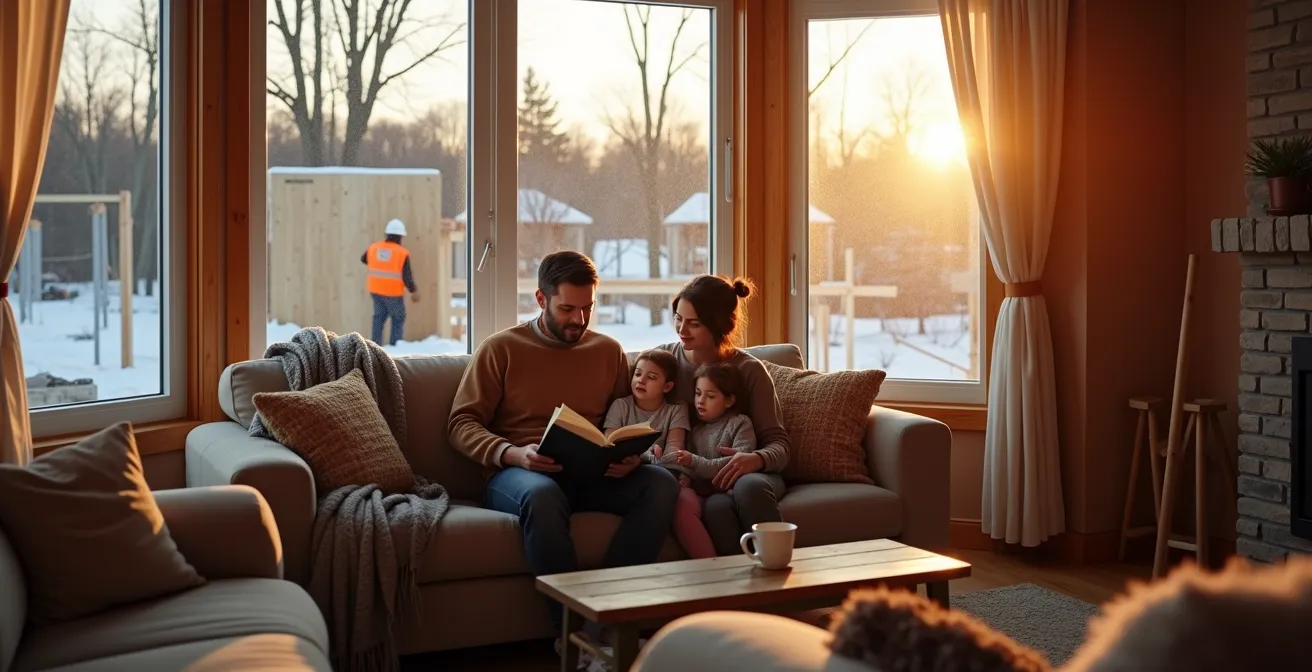
This low-disruption method is not just about convenience; it’s a powerful financial strategy. It eliminates the cost of tenant relocation and, most importantly, ensures that rental income continues to flow without interruption. This commitment to minimizing disruption is a core tenet of the Agile Retrofit philosophy.
Deep energy retrofits have been undertaken from the interior requiring a full gut renovation, a major barrier given the disruption to occupants’ lives. Exterior retrofits can dramatically lessen this disruption.
– Passive House Accelerator, Prefabricated Exterior Energy Retrofits Study
CanExel vs. Hardie Board: Which Stands Up Better to Canadian Winters?
Once the core panel system is chosen, the final exterior finish—the siding—is the next decision. This layer is the building’s face to the world and its first defense against the elements. In Canada, that means it must withstand a brutal range of conditions, from the freeze-thaw cycles of Ontario and Quebec to the hail of Alberta and the intense UV exposure on the Prairies. Two popular premium options are CanExel (an engineered wood product) and Hardie Board (a fiber cement product).
Hardie Board (Fiber Cement) is renowned for its sheer durability and stability. Composed of cement, sand, and cellulose fibers, it is exceptionally resistant to impact from hail, impervious to rot and insects, and non-combustible. Its greatest strength in a Canadian context is its minimal expansion and contraction with temperature swings. It remains stable whether it’s -30°C in Winnipeg or +30°C in Toronto, which means tighter joints and a longer-lasting finish. However, it is heavier, which needs to be factored into the panel’s structural design, and requires painting on-site or periodic repainting.
CanExel (Engineered Wood) offers the aesthetic appeal of wood without the high maintenance. It’s lighter than fiber cement, which can simplify installation on the panel system. Its prefinished surface is baked on for durability and comes in a wide variety of colours and patterns. While it performs well in freeze-thaw conditions, as an engineered wood product, it has a higher rate of expansion and contraction than fiber cement and is more susceptible to damage from severe impact. The factory finish is durable but may experience some fading over many years under intense sun.
The best choice often comes down to regional climate and project priorities. This table breaks down their performance characteristics against key Canadian weather challenges.
| Performance Factor | CanExel | Hardie Board | Canadian Climate Impact |
|---|---|---|---|
| Freeze-Thaw Resistance | Good – engineered wood | Excellent – fiber cement | Critical in Ontario/Quebec |
| Hail Resistance | Moderate | Superior | Important for Alberta |
| UV Resistance | Factory finish may fade | Paint required but durable | Prairie sun exposure |
| Weight on Panels | Lighter – easier install | Heavier – needs stronger support | Snow load considerations |
| Expansion/Contraction | More movement | Minimal movement | Temperature swings -40°C to +30°C |
Key takeaways
- The “Agile Retrofit” model prioritizes speed and minimal disruption, using off-site panel manufacturing to compress project timelines from months to weeks.
- Exterior-only installation is the cornerstone of this approach, allowing tenants to remain in place and ensuring continuous rental income for building owners.
- Success hinges on sound building science, particularly the non-negotiable inclusion of a rainscreen gap for moisture management to ensure long-term durability.
Vinyl, Wood, or Fiber Cement: Which Siding Offers the Best ROI in Canada?
The final calculation of Return on Investment (ROI) for a recladding project must account not just for the initial cost but also for long-term performance, maintenance, and energy savings. While the insulated panel core provides the thermal performance, the choice of exterior siding—be it vinyl, wood, or fiber cement—significantly impacts the total cost of ownership and eventual resale value. In Canada, durability against the climate is a major factor in this calculation.
Vinyl siding is the undisputed leader in low initial cost and minimal maintenance. It never needs painting and is easy to clean. However, it offers the lowest durability against impact (especially in cold weather, when it becomes brittle) and can be perceived as a lower-quality finish, potentially limiting the uplift in property value compared to premium materials. Its ROI is strong in the short term due to low upfront investment.
Natural wood siding provides a premium, high-end aesthetic that is highly desirable. It can significantly boost curb appeal and property value. However, its long-term ROI is heavily impacted by its high maintenance requirements. In the Canadian climate, wood requires regular staining or sealing every 3-5 years to prevent rot, warping, and fading. These ongoing costs must be factored into the lifetime ROI calculation.
Fiber cement siding (like Hardie Board) strikes a balance between the two. Its initial cost is higher than vinyl but often lower than premium wood. Its key advantage is exceptional durability and low maintenance, requiring repainting only every 15-25 years. It convincingly mimics the look of wood while resisting rot, fire, and pests. For the Canadian market, its resistance to harsh weather makes it a very strong contender for the best long-term ROI, as it delivers premium aesthetics with minimal upkeep costs, maximizing the financial benefit of the entire retrofit project over its 30+ year lifespan.
By embracing an Agile Retrofit strategy with prefabricated panels, you are not just upgrading a facade; you are executing a swift, strategic enhancement of your asset’s performance, value, and resilience. To take the next step, evaluate your property’s specific needs and explore the panel and finishing options best suited to your region and investment goals.