
Treating your building’s insulation as a strategic capital asset, not just a maintenance cost, is the key to unlocking significant operational savings and maximizing ROI.
- Effective insulation goes beyond saving on heating; it directly impacts staff productivity, reduces operational downtime during retrofits, and protects valuable inventory.
- Timing your insulation upgrades strategically allows you to maximize Capital Cost Allowance (CCA) tax deductions in Canada, drastically reducing the net cost of the project.
Recommendation: Conduct a comprehensive thermal envelope audit to identify vulnerabilities and plan insulation upgrades that align with your fiscal calendar and operational schedule for maximum financial benefit.
As a facility manager for a large Canadian warehouse, the winter heating bill is a familiar and formidable challenge. You see the energy consumption reports, feel the cold spots near loading docks, and know that a significant portion of your operational budget is literally disappearing through the roof. The common reaction is to crank up the thermostat or apply temporary fixes, but these are merely short-term palliatives for a deep-seated structural issue. While most discussions about insulation focus narrowly on R-values and material types, they often miss the bigger picture.
The real leverage isn’t just in choosing the right foam or board; it’s in reframing the entire project. What if insulating your facility wasn’t just a defensive move against the cold, but a proactive, strategic investment in your company’s bottom line? This perspective shifts the conversation from a simple maintenance task to a calculated business decision involving operational downtime, insurance premiums, employee efficiency, and crucially for Canadian businesses, tax optimization through the Capital Cost Allowance (CCA) program. The true art lies in understanding how these elements interact.
This article moves beyond the basics of thermal resistance. We will deconstruct the process of insulating a large-scale facility from a business and operational standpoint. We will explore how to resolve persistent issues like loading dock drafts and internal condensation, compare materials based on their impact on business continuity, and detail the strategic timing required to turn a capital upgrade into a significant tax advantage. It’s time to stop thinking about plugging leaks and start architecting a high-performance thermal envelope that pays for itself.
This comprehensive guide is structured to address the critical questions a facility manager faces when considering a major insulation project. Each section provides targeted insights and actionable strategies to help you make informed, cost-effective decisions.
Summary: A Facility Manager’s Guide to Strategic Insulation Investment
- Why Cold Drafts in the Loading Dock Are Costing You Staff Efficiency?
- How to Select Insulation for Steel Framing in High-Rise Offices?
- Spray Foam or Rigid Board: Which Minimizes Downtime for Offices?
- The “Raining Inside” Phenomenon: How to Stop Condensation in Metal Barns?
- When to execute Capital Upgrades to Maximize CCA Tax Deductions?
- High-Volume Low-Speed Fans: Do They Really Save 20% on Heating?
- The Paperwork You Need to Save 15% on Your Commercial Property Insurance
- How to Stop Stratification in a 40-Foot High Warehouse?
Why Cold Drafts in the Loading Dock Are Costing You Staff Efficiency?
The loading dock is the heart of any warehouse, but it’s also a major source of energy loss and operational inefficiency. Persistent cold drafts don’t just drive up heating bills; they directly impact the well-being and productivity of your staff. When employees are forced to work in uncomfortable, cold conditions, their focus shifts from the task at hand to staying warm. This can lead to slower work, increased errors, and lower morale, creating hidden costs that far exceed the wasted energy. Improving the building envelope is a key factor in boosting overall performance, with transportation and warehousing facilities in Canada having already reduced energy intensity by 15% between 1990 and 2013 through such measures.
A poorly sealed loading dock allows a constant influx of cold air, forcing your HVAC system to work overtime to maintain a stable temperature in the rest of the facility. This battle is often lost, resulting in inconsistent temperatures that can also affect temperature-sensitive goods stored nearby. The solution lies in creating a robust thermal barrier that isolates the dock area and prevents air infiltration into the main warehouse space.
Case Study: Edmonton Warehouse Draft Elimination
An insulation retrofit in an Edmonton warehouse provides a clear example of the benefits. By applying spray foam insulation to create a complete, airtight seal around the loading dock area, the facility saw immediate results. The project not only cut heating costs but also led to a noticeable improvement in employee comfort and productivity. The stable indoor temperatures, even during harsh -20°C winter days, protected stored goods and eliminated the pervasive drafts that had plagued the loading bay, demonstrating a direct link between a well-insulated envelope and operational efficiency.
Tackling this problem requires a multi-pronged approach that addresses both the openings and the surrounding structure. By creating controlled zones and a continuous insulation layer, you can transform the loading dock from an energy drain into a controlled, efficient workspace.
How to Select Insulation for Steel Framing in High-Rise Offices?
Steel framing is a cornerstone of modern high-rise construction, but it presents a unique thermal challenge: thermal bridging. Steel is an excellent conductor of heat, meaning that every steel stud or beam that runs from the interior to the exterior of a building acts as a highway for heat to escape in the winter and enter in the summer. Simply filling the stud cavities with insulation (like fiberglass batts) is insufficient, as the steel frame itself undermines the R-value of the assembly. The most effective strategy is installing a layer of continuous exterior insulation.
This approach involves applying an unbroken layer of insulation, typically rigid board, over the exterior sheathing. This physically separates the steel framing from the outside elements, creating a thermal break that dramatically improves the building envelope’s overall performance. The choice of material is critical and depends on factors like required R-value, fire resistance, and moisture management.
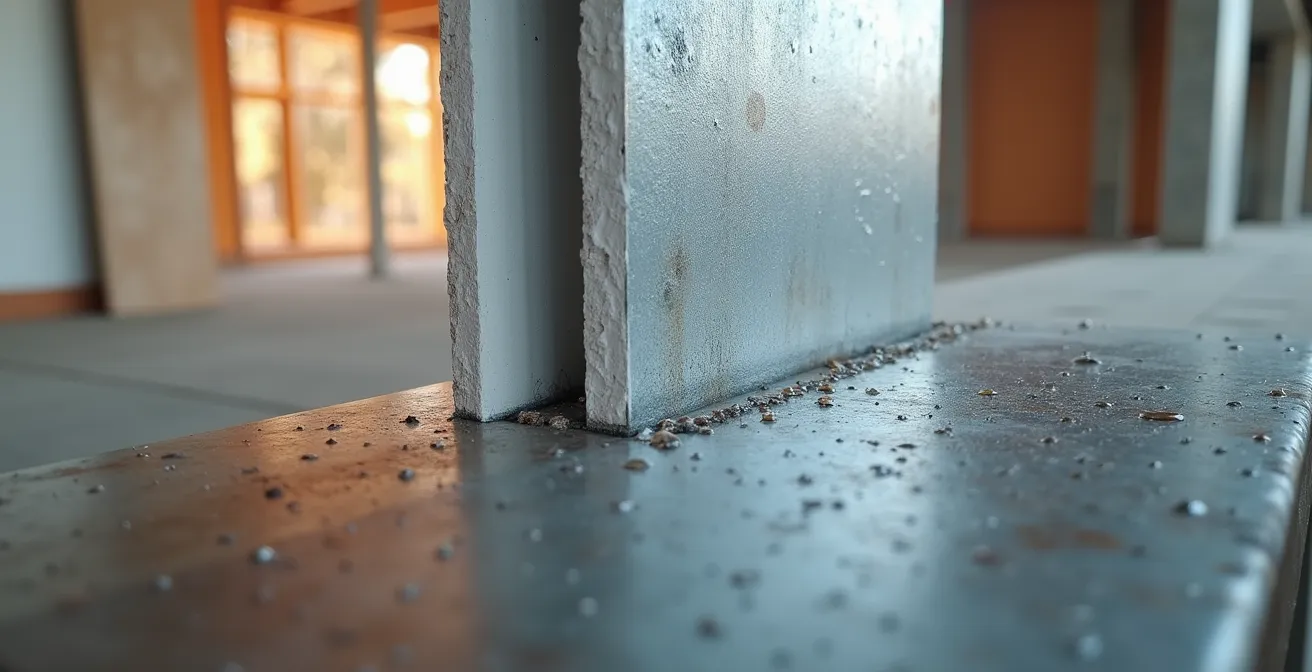
The decision between materials like mineral wool, spray foam, and polyisocyanurate (polyiso) rigid board involves trade-offs in performance, cost, and installation logistics. As a facility manager, understanding these differences is key to specifying a solution that meets both budget and long-term energy goals.
The table below compares common insulation types used in steel-framed commercial buildings, highlighting key decision-making factors for a facility manager. As you review it, consider not just the R-value but also how each material interacts with other building systems and trades during installation.
| Insulation Type | R-Value per inch | Fire Rating | Moisture Resistance | Installation Impact |
|---|---|---|---|---|
| Mineral Wool | 3.0-3.3 | Non-combustible | Good | Labor-intensive but allows parallel trades |
| Spray Foam (Closed-Cell) | 6.0-7.0 | Requires fire barrier | Excellent | Fast but requires area clearance |
| Polyiso Rigid Board | 5.6-6.5 | Class A when faced | Good with facers | Moderate speed, minimal disruption |
| Fiberglass Batts | 2.9-4.3 | Non-combustible | Poor when wet | Low cost but performance degrades |
Ultimately, the insulation is just one part of a larger system. As experts from Rmax Building Insulation note in their guide to warehouse insulation:
Proper sizing and efficient operation of the HVAC system contribute to a synergistic relationship with the insulation, ensuring that the entire climate control system operates optimally.
– Rmax Building Insulation, Warehouse Insulation: Complete How-to Guide
This highlights the need for a holistic approach, where the insulation choice supports and enhances the performance of the building’s mechanical systems.
Spray Foam or Rigid Board: Which Minimizes Downtime for Offices?
When retrofitting an occupied office or commercial space, the primary concern beyond cost and performance is operational downtime. Every hour a space is unusable is an hour of lost productivity or revenue. The choice between spray foam and rigid board insulation often hinges on which method causes the least disruption to your business. Both are excellent insulators, but their installation processes are fundamentally different and have distinct impacts on workflow and re-occupancy schedules.
Spray polyurethane foam (SPF) offers rapid application and creates a monolithic, airtight seal that conforms perfectly to any surface irregularities. This is its greatest strength. However, its installation requires the work area to be completely cleared of personnel and sensitive equipment. More importantly, it involves a curing period of 24-48 hours before the space is safe to re-enter due to the off-gassing of volatile organic compounds (VOCs). This mandatory waiting period can represent a significant operational delay.
Rigid foam boards (like polyiso or XPS), on the other hand, can be installed in a more phased, zone-by-zone manner. Since the boards are inert and produce no fumes, work can often proceed in one area while adjacent spaces remain occupied. There is no chemical curing time, meaning the area is immediately ready for the next trade or for re-occupancy once the mechanical fastening is complete. While the installation may be slower piece-by-piece, the ability to maintain partial operations can result in significantly less overall business disruption. This makes rigid board a compelling choice for retrofits in active environments where a complete shutdown is not feasible.
Your Action Plan: Minimizing Retrofit Downtime
- Assess Your Operational Flexibility: Evaluate if a complete, short-term shutdown (favoring spray foam) is more cost-effective than a longer, phased renovation with partial occupancy (favoring rigid board).
- Schedule Around Business Lulls: Plan the installation for off-peak hours, weekends, or seasonal slowdowns to mitigate the impact on core business activities.
- Factor in Re-entry Timelines: Build the 24-48 hour re-entry requirement for spray foam directly into your project schedule. For rigid board, plan for a seamless handover to the next trade.
- Verify Environmental Dependencies: Confirm with your contractor that weather conditions are suitable. Spray foam application is sensitive to temperature and humidity, which can cause delays, whereas rigid board installation is less affected by climate.
- Coordinate with All Trades: Develop a clear schedule that accounts for the specific requirements of each insulation type, including area clearance for spray foam or material staging for rigid boards.
The decision is not just technical; it’s logistical. The “best” material is the one that aligns with your facility’s unique operational constraints and financial tolerance for downtime.
The “Raining Inside” Phenomenon: How to Stop Condensation in Metal Barns?
One of the most destructive and perplexing issues in uninsulated metal agricultural buildings is condensation, often described as “raining inside.” This occurs when warm, moist air produced within the building (e.g., from livestock respiration) rises and comes into contact with the cold surface of the metal roof or walls. The metal, chilled by the outside air, cools the interior air to its dew point, causing water vapor to condense into liquid droplets. These droplets accumulate and eventually drip down, damaging stored goods, corroding metal structures, and creating an unhealthy environment for animals and workers. This is not just a nuisance; it’s a symptom of massive thermal inefficiency.
The key to stopping this phenomenon is to prevent the warm, moist interior air from ever touching the cold metal surface. This is achieved by creating a continuous insulation layer with a vapor barrier on the interior side of the metal sheathing. By keeping the interior surface of the insulation above the dew point temperature, condensation simply cannot form. The potential savings are immense; research shows that insulating warehouses and similar structures can achieve up to $9.5 billion in annual energy cost savings across the commercial sector.
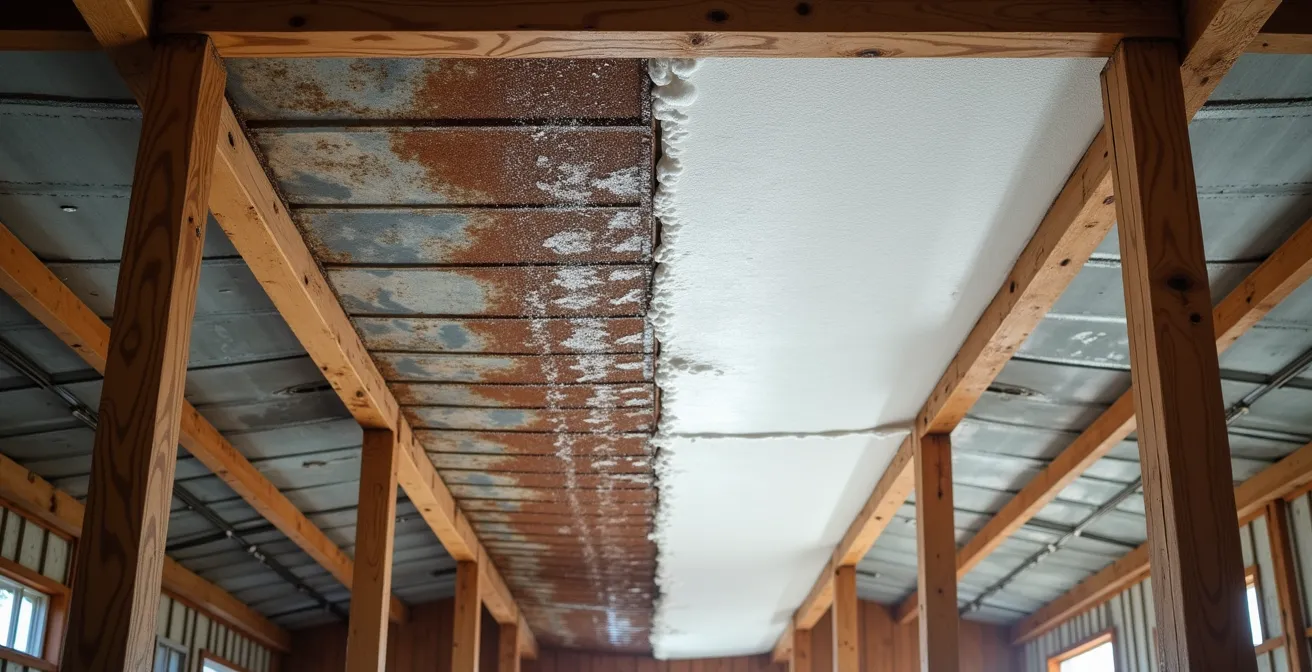
The right solution depends on the specific use of the building. A high-moisture environment like a livestock barn requires a different approach than a drier grain storage facility. Understanding these nuances is critical for an effective and long-lasting solution.
The following table outlines recommended solutions based on building type and the primary source of moisture, providing a clear framework for addressing condensation in various agricultural settings.
| Building Type | Primary Issue | Recommended Solution | Key Benefit |
|---|---|---|---|
| Livestock Barns (High Moisture) | Interior condensation from animal respiration | Closed-cell spray foam directly on metal deck | Creates vapor barrier and insulation in one application |
| Grain Storage (Dry) | Temperature differential causing condensation | Radiant barrier foil + ventilation | Reflects 97% radiant heat while allowing moisture escape |
| Mixed-Use Agricultural | Variable moisture levels | BlueTex foil/foam combination | Interior surface stays above dew point year-round |
By correctly identifying the source of the moisture and applying the appropriate insulation and vapor control layer, you can permanently eliminate indoor raining and create a stable, protected environment for your assets.
When to execute Capital Upgrades to Maximize CCA Tax Deductions?
For a Canadian business, a major insulation upgrade is more than an operational expense; it’s a capital investment that can be strategically managed for significant tax advantages. The key mechanism is the Capital Cost Allowance (CCA), which allows businesses to deduct a portion of the cost of their capital assets over time. Certain energy-efficient assets fall into specific CCA classes (like Class 43.1 and 43.2) that offer accelerated depreciation rates, allowing you to write off the investment much faster and reduce your taxable income sooner. The financial impact of these upgrades is substantial, as Natural Resources Canada reports that a 32% energy efficiency improvement in Canadian buildings has already saved $8.5 billion in energy costs.
The “when” of executing your upgrade is just as important as the “what.” Timing the project correctly can maximize your deductions in a given fiscal year. For instance, the “half-year rule” generally applies, meaning you can only claim half of the usual CCA deduction in the year you acquire the asset. Therefore, completing a project earlier in your fiscal year doesn’t provide an advantage over completing it later, as long as it’s “available for use” before your fiscal year-end. This allows for strategic planning to align the project completion with your company’s financial reporting.
Furthermore, savvy facility managers coordinate insulation projects with other capital work. For example, the ideal time to upgrade roof insulation is during a full roof replacement. This consolidates disruption and allows you to capitalize on multiple accelerated depreciation opportunities at once. It transforms a necessary repair into a comprehensive energy and tax optimization strategy.
Your Action Plan: Strategic Timing for Maximum Tax Benefits
- Align with Major Retrofits: Schedule major insulation upgrades to coincide with other capital projects, such as a roof replacement, to bundle costs and maximize accelerated CCA claims.
- Meticulous Documentation: Maintain a complete paper trail for all energy efficiency improvements, including spec sheets, engineer reports, and installation certificates, to justify CCA classification to the CRA.
- Target Q4 Completion: Plan for project completion late in your fiscal year (e.g., Q3 or early Q4) to ensure the asset is “available for use” and eligible for the current year’s CCA deduction, without rushing the work.
- Stack Incentives and Rebates: Actively seek out and apply for federal and provincial energy efficiency programs. These grants reduce your net capital cost *before* you calculate your CCA, increasing the overall ROI of the project.
- Consult Your Accountant: Work closely with your financial team to model the tax implications of different project timings and CCA classes to make the most informed investment decision.
By viewing insulation through the lens of tax strategy, you can build a powerful business case that demonstrates a clear and rapid return on investment, making the project far more appealing to executive stakeholders.
High-Volume Low-Speed Fans: Do They Really Save 20% on Heating?
The claim that High-Volume Low-Speed (HVLS) fans can save up to 20% on heating costs is a powerful one, but it requires critical context. The savings don’t come from the fan itself generating heat; they come from the fan’s ability to solve the problem of thermal stratification in high-ceilinged spaces. An HVLS fan alone in a poorly insulated building will have a limited effect. The real savings are unlocked when HVLS fans work in synergy with a well-insulated building envelope.
In a tall warehouse, warm air produced by the heating system naturally rises and pools at the ceiling. This can create a temperature difference of 10°C or more between the floor and the roof. Your thermostat, located at ground level, registers the cold, forcing the HVAC system to run continuously to try and heat a space that is losing warmth to the uninsulated roof as fast as it’s supplied. This is the essence of stratification and the primary driver of high heating bills.
An HVLS fan works by slowly and gently pushing this massive pocket of trapped warm air from the ceiling back down to the floor level where your employees and inventory are. This process, known as destratification, equalizes the temperature throughout the space. The thermostat is satisfied sooner, and the HVAC system runs significantly less. However, this is only half the equation. If the roof is not insulated, you are simply circulating air within a space that is constantly losing heat to the outdoors. The fan will help, but your heater will still work hard to replace the lost energy.
The 20% savings figure becomes realistic when destratification is combined with proper ceiling insulation. The insulation stops the heat from escaping through the roof, and the HVLS fan ensures the heat you are paying for is efficiently distributed to the occupied zone. As highlighted in guides from industry experts like Quality Material Handling, the combination is key: preventing heat loss at the source (the roof) and then effectively managing its distribution is the most effective way to achieve stable temperatures and maximize energy savings. One without the other is an incomplete solution.
The Paperwork You Need to Save 15% on Your Commercial Property Insurance
Upgrading your facility’s insulation is a proven way to reduce energy costs, but it can also lead to a reduction in your commercial property insurance premiums. Insurers calculate risk, and a well-insulated, professionally retrofitted building presents a lower risk profile. For example, proper insulation reduces the risk of ice dams forming on the roof, which can cause significant water damage. Using fire-rated insulation materials can lower the risk of fire spread. Eliminating condensation prevents moisture damage and mold growth. However, your insurer won’t automatically grant you a discount; you need to proactively build the case and provide the right documentation.
To successfully negotiate a premium reduction, you must translate your technical upgrades into the language of risk mitigation. This means providing clear, certified proof that the work was done to a high standard and has demonstrably improved the building’s safety and resilience. Vague claims of “new insulation” are insufficient. You need a comprehensive dossier that proves the quality and performance of the installation, leaving no room for ambiguity.
Your Action Plan: Insurance Documentation Checklist for Insulation Upgrades
- Compile Complete Material Specifications: Gather all spec sheets for the insulation materials used, paying special attention to fire ratings (e.g., compliance with CAN/ULC-S102 for Canadian standards) and the final installed R-value.
- Obtain Certified Installer Documentation: Secure a certificate from the installer confirming that the work was completed in compliance with all local building codes, manufacturer specifications, and industry best practices.
- Document Performance with Thermal Imaging: Commission a “before and after” thermal imaging report. This provides irrefutable visual evidence of the improved building envelope performance and elimination of thermal bridges.
- Prepare an Executive Risk Summary: Write a one-page summary that translates the technical benefits into risk reduction terms. For example: “The Class A fire-rated insulation reduces flame spread risk,” or “The new vapor barrier eliminates condensation, mitigating risk of mold and structural corrosion.”
- Include Photographic Evidence: Take high-quality photos during and after installation, showcasing the quality of work, the integrity of the vapor barrier, and any fire-stopping measures implemented.
Furthermore, as experts from Estimate Florida Consulting point out, these direct savings can be supplemented by other financial programs:
Many regions offer financial support to businesses adopting sustainable and energy-saving practices. Thorough research and leveraging these opportunities can substantially offset the initial investment.
– Estimate Florida Consulting, Metal Warehouse Insulation Cost Analysis
By presenting a professional and well-documented case to your insurance broker, you can turn your insulation upgrade into an asset that delivers returns not only through energy savings but also through reduced fixed costs.
Key Takeaways
- Insulation is a strategic capital investment with a clear ROI, not just a maintenance cost. It impacts energy bills, productivity, and asset protection.
- The best insulation material depends on operational constraints. The choice between spray foam and rigid board should be driven by your tolerance for operational downtime.
- In Canada, strategically timing your insulation upgrades can unlock accelerated Capital Cost Allowance (CCA) tax deductions, significantly improving the project’s business case.
How to Stop Stratification in a 40-Foot High Warehouse?
In a warehouse with a 40-foot ceiling, thermal stratification is not a minor issue; it’s the single largest driver of heating inefficiency. The fundamental principle is simple: heat rises. The warm air you pay to pump into the space immediately ascends to the ceiling, leaving the floor-level occupied zone cold. This creates a vast, useless reservoir of heat at the roofline while your HVAC system works relentlessly to try and warm the ground level. To effectively combat this, a two-part strategy is non-negotiable: contain the heat, then control it.
First, you must contain the heat by properly insulating the roof and upper walls. The ceiling is the largest, most exposed surface and represents the primary path for heat loss. Without a robust thermal barrier at the roof deck, any effort to manage the air below is futile. Insulating the ceiling essentially puts a “lid” on the building, trapping the warm air inside. This is the single most critical step in reducing the energy required to heat the space.
Second, once the heat is contained, you must control its distribution. This is where mechanical destratification comes into play. Using High-Volume Low-Speed (HVLS) fans or other air circulation systems, you can actively push the warm air that is trapped at the ceiling back down to the floor. This breaks up the stratified layers, equalizing the temperature from floor to ceiling. This ensures the heat is delivered where it’s needed—in the occupied zone—making the space more comfortable for employees and satisfying the thermostat more quickly, which in turn reduces HVAC runtime.
Case Study: High-Bay Warehouse Holistic Retrofit
A comprehensive retrofit of a high-bay warehouse demonstrated the power of this combined approach. The project involved installing insulated metal panels on the walls and applying spray foam insulation to the ceiling, creating a complete thermal envelope (containment). Simultaneously, a system of destratification fans was installed to manage air distribution (control). The results were significant and measurable: lower utility bills, more consistent temperatures for product storage, and a marked improvement in staff comfort. The project proved that tackling both insulation and air circulation in tandem is the most effective way to conquer stratification in a high-ceiling environment.
Simply installing fans in an uninsulated building or insulating without addressing air circulation are incomplete solutions that will yield disappointing results. A truly effective strategy integrates both containment and control to create a high-performance thermal system.
The next logical step for any facility manager is to move from theory to practice. A comprehensive thermal audit of your building will provide the specific data needed to build a business case, identify the most critical areas for upgrades, and accurately forecast the return on investment for a strategic insulation project.