
An EnerGuide rating is a quantifiable financial asset that, when properly documented and marketed, can directly increase your home’s appraisal and sale price.
- The old “0-100” scale is obsolete; value is now measured in Gigajoules per year (GJ/year), where a lower score signifies a lower “cost of operation.”
- Documenting certified upgrades in an “appraiser’s toolkit” is non-negotiable to translate renovation spending into recognized home value.
Recommendation: Prioritize a pre-retrofit energy audit to create a strategic blueprint for upgrades that maximizes both your EnerGuide score and your return on investment.
As a seller in a competitive Canadian market, your objective is singular: maximize your property’s sale price. You may have heard that an “EnerGuide rating of 80” is a golden ticket, but let’s address that misconception immediately. That 0-100 scale is a relic of the past. Today, the conversation is about Gigajoules per year (GJ/year)—a direct measure of your home’s energy consumption. From an appraiser’s perspective, this isn’t an environmental badge; it’s a hard financial metric defining your property’s “cost of operation.” A lower GJ/year score is a powerful selling feature that signals a well-maintained, cost-effective, and future-proofed asset to potential buyers.
The common advice is to simply mention your home is “energy-efficient.” This is a strategic error. Vague claims are dismissed as marketing fluff. To truly leverage your home’s performance, you must treat your EnerGuide rating not as a feature, but as a quantifiable asset. This requires a calculated approach: strategically choosing upgrades, meticulously documenting every investment, and translating technical data into a compelling financial narrative for buyers and, most importantly, for the appraiser who will determine its value. This article will provide the strategic blueprint to do precisely that, turning your energy efficiency investments into a measurable increase in your home’s market value.
This guide provides a comprehensive framework for sellers. We will break down how to convert your EnerGuide score into a dollar value, identify the most impactful upgrades, and build the documentation necessary to ensure your investment is reflected in your final appraisal.
Summary: Does an EnerGuide Rating of 80 Increase Your Home’s Resale Value?
- Gigajoules per Year: How to Translate Your EnerGuide Score into Dollars?
- The Top 3 Upgrades That Boost Your EnerGuide Score the Fastest
- How to Explain EnerGuide to Buyers Who Don’t Care About R-Values?
- Can an Old House Achieve the Same EnerGuide Score as a New Build?
- EnerGuide Label vs. “Eco-Friendly” Marketing: Which Can You Trust?
- Why You Must Do a Pre-Retrofit Audit Before Buying a Single Roll of Insulation?
- How Documenting Certified Upgrades Adds $5,000 to Your Home Appraisal?
- How to Get the Maximum $5,000 Grant for Insulation in Canada?
Gigajoules per Year: How to Translate Your EnerGuide Score into Dollars?
From a financial standpoint, a home’s EnerGuide rating in GJ/year is its annual operating cost. A lower number means the asset is cheaper to run, a powerful value proposition. But “cheaper” is not a number an appraiser can work with. You must translate this into a concrete dollar figure. While recent data reveals that 60% to 70% of Canadian homes have adequate insulation, achieving a score significantly better than the neighbourhood average creates a clear competitive advantage that can be monetized. A home that is objectively proven to be in the top tier of energy performance is a rarer, more valuable asset.
The most direct way to translate GJ/year into dollars is by calculating the annual savings against a baseline. The cost of one gigajoule varies dramatically across Canada due to provincial energy pricing and carbon taxes. For example, an improvement of 10 GJ/year could save a homeowner in British Columbia significantly more than one in Quebec, where hydroelectric power is less expensive. Your energy advisor’s report will provide a precise local calculation, but you can use provincial averages to frame the value for potential buyers.
The following table, based on general data from sources like Natural Resources Canada, illustrates how a modest improvement can translate into tangible annual savings across different provinces. This is the kind of data you should present to buyers. It shifts the conversation from abstract energy units to real, recurring financial benefits.
| Province | 10 GJ/Year Improvement Savings | Key Factors |
|---|---|---|
| British Columbia | $280-$350/year | High carbon tax + hydro rates |
| Quebec | $150-$200/year | Low hydro rates |
| Alberta | $220-$300/year | Deregulated market |
By presenting this data, you are not just selling a house; you are selling a home with a lower, more predictable cost of ownership. This is a powerful form of risk mitigation for a buyer, which adds quantifiable value.
The Top 3 Upgrades That Boost Your EnerGuide Score the Fastest
Maximizing your return on investment means focusing on upgrades that deliver the largest reduction in GJ/year for the lowest cost. An energy advisor will provide a customized roadmap, but certain upgrades consistently deliver the most significant impact. The “big three” are almost always related to the building envelope and mechanical systems: comprehensive air sealing, attic insulation, and high-efficiency heating/ventilation. Wasting money on cosmetic upgrades or new windows before addressing these fundamentals is a common and costly mistake.
This macro shot highlights the critical process of air sealing, where expanding foam fills every gap and crack in the building’s structure. This single action can be one of the most effective ways to lower a home’s GJ/year rating by preventing heat loss.
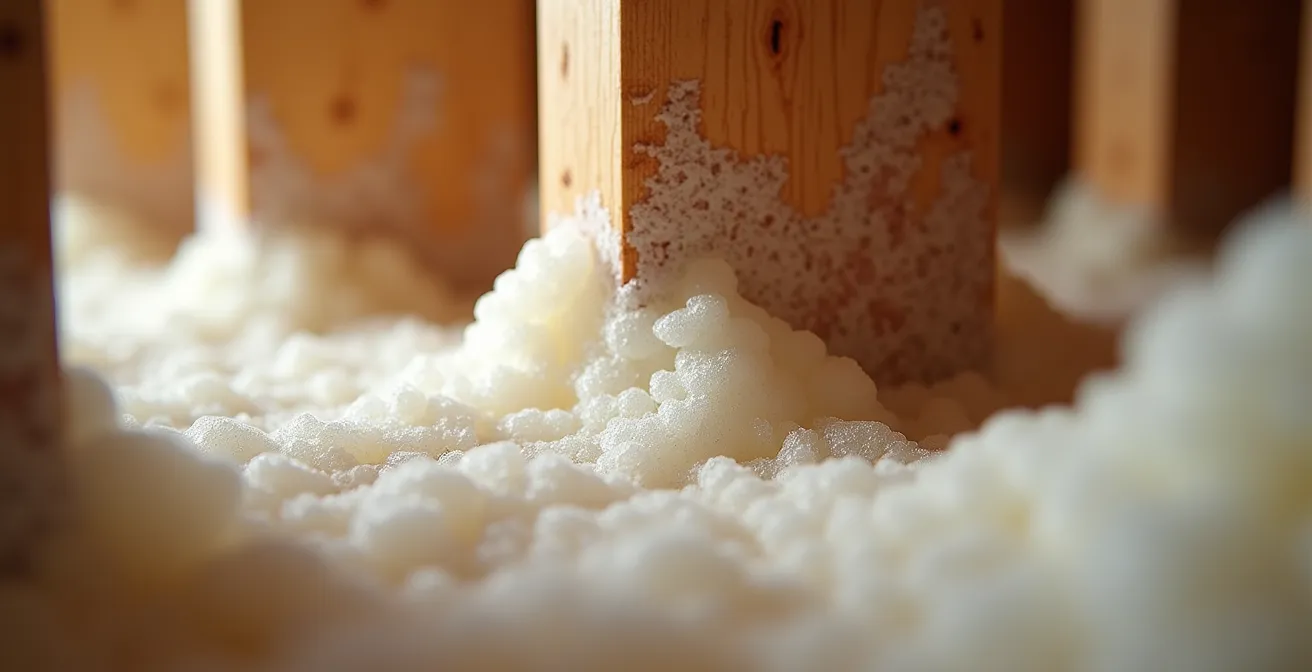
As you can see, stopping uncontrolled air leakage is fundamental to energy performance. However, the optimal strategy varies based on your specific location within Canada. Different climate zones present unique challenges, demanding tailored solutions to achieve the best results. Below are the top upgrades prioritized by their effectiveness in distinct Canadian climate zones.
- Coastal BC: The priority here is managing moisture alongside heating. Installing heat pumps with integrated moisture management systems is highly effective, often achieving a 20-30% energy reduction by providing efficient heating and cooling.
- The Prairies: In a region defined by extreme cold, the focus is on retaining heat. A combination of comprehensive air sealing and high-R insulation (R-40+) in attics and walls is paramount, capable of reducing heating costs by 15-25%.
- Ontario/Quebec: With cold winters and humid summers, a balanced approach is key. Adding a balanced Heat Recovery Ventilator (HRV) to a high-efficiency furnace improves air quality significantly while saving 10-20% on energy by pre-conditioning incoming fresh air.
How to Explain EnerGuide to Buyers Who Don’t Care About R-Values?
The average homebuyer does not understand technical specifications like R-values or air changes per hour. Presenting them with a data sheet is ineffective. Your task is to translate these technical facts into tangible lifestyle and financial benefits they can immediately grasp. The most powerful tool for this is analogy. As one of the guiding documents for energy advisors suggests, framing the rating in familiar terms is key.
An EnerGuide label is like the L/100km sticker on a new car. It tells you the ‘fuel’ cost of running your biggest investment. This home is a ‘hybrid’ in a market of ‘gas-guzzlers’.
– Natural Resources Canada Energy Advisor Script, EnerGuide Rating System Guidelines
This single analogy reframes the entire conversation. You are no longer discussing insulation; you are discussing the “fuel efficiency” of their largest asset. This positions your property as a smarter, more modern choice in a sea of inefficient alternatives. Once you’ve established this financial high ground, you can reinforce it by connecting the home’s high performance to direct lifestyle improvements, which can be summarized as the “Three Cs.”
- Comfort: This is the most immediate benefit. A well-sealed and insulated home eliminates cold spots and drafts. Frame this as “a consistent 22°C throughout the home, even during the harshest Canadian winters.” This paints a picture of cozy, uniform comfort that buyers can easily imagine.
- Quiet: High-performance homes often include superior windows and more robust insulation, which have the secondary benefit of sound dampening. Market this as a tangible improvement to quality of life: “Triple-pane windows can reduce street noise by up to 50%, creating a peaceful oasis for urban living.”
- Clean Air: Modern, energy-efficient homes rely on mechanical ventilation like HRVs to ensure air quality. This is a powerful selling point, especially for families. Explain it as “a system that provides fresh, filtered air 24/7, reducing allergens, dust, and humidity issues that plague older homes.”
Can an Old House Achieve the Same EnerGuide Score as a New Build?
It’s a common misconception that only new construction can achieve a top-tier EnerGuide rating. While a new “Net Zero Ready” build will almost always have a lower GJ/year score, a deep energy retrofit of an older home can deliver outstanding performance and often represents a much smarter financial and environmental investment. An older home with documented, high-quality upgrades is often more valuable than a standard new build because it combines character with proven low operating costs. The key is strategic investment.
A typical 1960s bungalow in Ontario, for example, might start with a rating over 120 GJ/year. Through a deep retrofit targeting the fundamentals—such as upgrading attic insulation to R-50, executing a complete air sealing plan, and replacing the heating system—it’s entirely feasible to bring that score down to the 50-80 GJ/year range. This transforms the property from an energy liability into a high-performance asset. While the upfront investment for such a project might be $40,000-$80,000, it preserves the home’s structure and avoids the high embodied carbon associated with new construction.
From an investment perspective, the comparison between a new build and a deep retrofit is stark. The following table provides a high-level financial overview. It demonstrates that while a new build may achieve a slightly better score, the capital outlay is exponentially higher.
| Approach | Average Cost | Typical EnerGuide Rating | Embodied Carbon |
|---|---|---|---|
| Net Zero Ready New Build | $450,000-$600,000 | 0-30 GJ/year | High (new materials) |
| Deep Energy Retrofit | $40,000-$80,000 | 50-80 GJ/year | Low (preserves structure) |
For a seller, this data is crucial. It proves that investing in a deep retrofit on an existing home is a viable and often more profitable strategy than competing with new builds on energy scores alone. You are selling a unique combination of established location, character, and modern performance.
EnerGuide Label vs. “Eco-Friendly” Marketing: Which Can You Trust?
In today’s market, terms like “green,” “eco-friendly,” and “energy-efficient” are thrown around so frequently they have become meaningless. These are marketing buzzwords, not verifiable metrics. As a seller aiming to command a premium price, you must differentiate your property with objective, third-party proof. This is where the EnerGuide rating system provides an unparalleled advantage. It is not a marketing claim; it is a federal standard.
The EnerGuide label is a standardized report generated by a certified energy advisor using software and procedures licensed by Natural Resources Canada. It provides a precise GJ/year consumption rating, a detailed breakdown of your home’s energy use, and a comparison to similar homes. This process ensures that every rating is consistent, comparable, and based on building science, not wishful thinking. The authority of the program is its greatest strength.
Unlike a real estate agent’s brochure that might describe a home as “efficient,” the EnerGuide label is backed by the Government of Canada. This provides an unimpeachable level of credibility. In fact, the program’s integrity is maintained through rigorous quality assurance, where official certification ensures that 100% of EnerGuide ratings are validated by the Government of Canada. This validation is your proof. It tells a potential buyer that the home’s performance isn’t just a claim—it’s a verified fact.
When you present an official EnerGuide label to a buyer or an appraiser, you are replacing subjective marketing language with an objective, government-backed data point. This builds immense trust and provides a solid foundation for justifying a higher asking price. The label proves that your home’s “cost of operation” is not an estimate but a scientifically calculated figure.
Why You Must Do a Pre-Retrofit Audit Before Buying a Single Roll of Insulation?
Investing in energy upgrades without a pre-retrofit audit is like performing surgery without an X-ray. You might be targeting the wrong problem entirely, wasting thousands of dollars for minimal return. The audit, conducted by a certified energy advisor, is the single most critical step in creating a strategic blueprint for your renovations. It uses diagnostic tools like a blower door test to pinpoint exactly where your home is losing energy, and models the projected GJ/year savings for each potential upgrade. This transforms your renovation from guesswork into a calculated investment strategy.
Failing to get this blueprint can lead to disastrous financial outcomes. The right advice at the start is worth thousands in saved costs and improved results, preventing homeowners from making emotionally driven but strategically poor decisions.
Case Study: The $10,000 Window Replacement Mistake
A Hamilton homeowner spent $10,000 on new, high-end windows, assuming this was the best way to reduce drafts and save energy. A post-renovation audit revealed this was a costly error. The audit showed that the primary source of energy loss was the poorly insulated attic and significant air leakage. A mere $1,500 investment in attic insulation and air sealing would have saved three times more energy than the expensive windows. A pre-retrofit audit would have identified these as the top priorities, saving the homeowner $8,500 while achieving a far better EnerGuide score and a more comfortable home.
This case study illustrates a critical principle: the most visible problem is not always the most significant one. An energy advisor provides an objective, data-driven plan that prioritizes upgrades based on their ROI. This “customized upgrade plan with a projected EnerGuide score for each action” is the foundation for maximizing your property’s value. It ensures that every dollar spent is directed toward the action that will most effectively lower your GJ/year rating and, consequently, boost your home’s market appeal.
How Documenting Certified Upgrades Adds $5,000 to Your Home Appraisal?
Completing energy-efficient upgrades is only half the battle. If you cannot prove the work was done, and done correctly, an appraiser cannot assign it any significant value. In a market where Statistics Canada data shows a 66.5% increase in renovation costs from 2017 to 2024, failing to document your high-value investments is financially irresponsible. You must provide a clear, organized paper trail that allows an appraiser to justify a higher valuation. This is your “Appraiser’s Toolkit.”
Think of it from the appraiser’s perspective. They are required to base their valuation on verifiable facts, not on your word. A vague statement like “we upgraded the insulation” is worthless. A binder containing receipts, certifications, and official reports is hard evidence of added value. This documentation de-risks the appraisal process and gives the appraiser the ammunition they need to defend a higher number. An undocumented $15,000 investment might be valued at zero; a fully documented one could easily add $5,000 or more to your appraisal, depending on the upgrade and market.
Building this toolkit should be a systematic process as you complete your upgrades. It is the final, critical step in converting your spending into recognized equity. The following checklist outlines the essential documents you must collect.
Your Appraiser’s Toolkit: Essential Documentation Checklist
- Final EnerGuide Label: The official report showing the current, improved GJ/year rating. This is the cornerstone document.
- Complete Upgrade Receipts: Itemized invoices for all materials and labour, clearly showing contractor details and dates.
- Specialized Certifications: Documents like HRAI certification for heat pump installations, proving the work was done to industry standards.
- Energy Advisor’s Reports: Both the pre-retrofit and post-retrofit reports, detailing the identified issues and the measured improvements.
- Major Equipment Warranties: Documentation for new furnaces, heat pumps, or HRVs, which signals quality and longevity to a buyer.
Presenting this professional package to your appraiser and including it for prospective buyers demonstrates a level of care and investment that sets your property apart. It is the ultimate proof of a well-maintained, high-value asset.
Key takeaways
- Treat your EnerGuide rating as a financial metric (GJ/year), not a vague “green” feature, to define your home’s low “cost of operation.”
- A pre-retrofit audit is a non-negotiable strategic blueprint to maximize ROI and avoid wasting thousands on ineffective upgrades.
- Meticulously documenting all certified upgrades in an “Appraiser’s Toolkit” is essential to translate renovation spending into a higher, justifiable home valuation.
How to Get the Maximum $5,000 Grant for Insulation in Canada?
Financing your energy retrofits with grants and loans is a key part of the investment strategy, as it directly reduces your upfront cost and boosts your overall ROI. However, the landscape of government incentives is constantly changing. It is critical to have the most current information. As of February 2024, a major shift occurred: the popular $5,000 Canada Greener Homes Grant is now closed to new applicants. According to an update from Natural Resources Canada, homeowners should now pivot their focus to the still-active Canada Greener Homes Loan and the robust provincial programs.
The Canada Greener Homes Loan offers up to $40,000 in interest-free financing, which can cover the entire cost of a deep energy retrofit. This is an incredibly powerful tool. Alongside this federal loan, many provinces offer their own substantial grants and rebates, which can often be “stacked” with the federal loan for maximum financial benefit.
Case Study: The Stacking Strategy in BC
A savvy Vancouver homeowner undertaking a $25,000 whole-home insulation project successfully stacked multiple incentives. They combined a municipal top-up grant ($2,000) with the provincial CleanBC rebate ($3,500) and the federal interest-free loan ($15,000). This strategic combination allowed them to complete the project with an upfront, out-of-pocket cost of only $4,500, while achieving a 40% reduction in their home’s energy consumption. This demonstrates how a large project can become highly affordable with the right knowledge.
Navigating these programs requires diligence, as requirements vary by province. Using certified contractors and completing pre- and post-retrofit energy assessments are nearly universal prerequisites. The table below provides a snapshot of some of the top active provincial programs available to homeowners in 2024.
| Province | Program Name | Maximum Rebate | Key Requirements |
|---|---|---|---|
| British Columbia | CleanBC Better Homes | Up to $5,500 | Pre/post energy assessment required |
| Quebec | Rénoclimat | Up to $4,525 | Must use certified contractors |
| Nova Scotia | Efficiency NS | Up to $5,000 | Income-qualified programs available |
By following this strategic framework—translating your score into dollars, executing targeted upgrades funded by grants, communicating the value effectively, and documenting everything for your appraiser—you transform your home’s energy performance from an abstract feature into a powerful and profitable financial asset. To begin this process, the first step is to engage a certified energy advisor to develop your personalized strategic blueprint.