
The 2020 National Building Code (NBC) is not a set of guidelines; it is a legal mandate establishing minimum performance standards to manage building science liability.
- Higher R-values are a direct response to climate-zone-specific heat loss data, making them non-negotiable.
- Compliance extends beyond new builds, with specific triggers mandating full insulation upgrades during substantial renovations.
Recommendation: Treat every insulation project as a complete system of air, vapour, and thermal control. Documenting system integrity, not just material R-values, is the only way to guarantee first-pass inspection approval.
As contractors and builders across Canada, you have seen the requirements escalate. Insulation costs are rising, wall assemblies are getting thicker, and the rules seem to change with every code cycle. The common explanation is that these changes are simply about “saving energy” or “fighting climate change.” While true, this high-level view misses the fundamental point from a compliance standpoint. It fails to address the builder’s primary concern: managing risk, passing inspections, and avoiding liability.
The 2020 National Building Code of Canada (NBC) represents a critical shift in perspective. It moves away from prescribing simple material thicknesses and toward mandating the performance of the building envelope as an integrated system. The increased R-values are not arbitrary numbers; they are the calculated minimums required to prevent building failures like condensation, mould, and structural degradation in Canada’s diverse and demanding climates. Understanding this is not optional—it is the core of your professional responsibility.
This document is not a list of suggestions. It is a breakdown of your obligations. We will dissect the code’s intent, section by section, from the perspective of the official who will approve or fail your project. We will clarify the non-negotiable differences between climate zones, explain what triggers mandatory upgrades in renovations, and pinpoint the common errors that lead to costly inspection failures. Your goal is not to meet the code, but to exceed it. This is how you protect your business, your reputation, and your clients.
The following sections provide a clear and authoritative guide to the key insulation-related mandates of the 2020 NBC and its provincial variations. This structure is designed to equip you with the specific knowledge required to ensure every project plan is compliant from its inception.
Contents: Your Guide to the 2020 NBC Insulation Mandates
- How Code Requirements Differ Between Zone 1 (Victoria) and Zone 7 (Edmonton)?
- How to Submit an Insulation Plan That Gets Approved on the First Try?
- Grandfather Rights vs. Mandatory Upgrades: What Must You Fix During Renovation?
- The Vapor Barrier Error That Fails 30% of Framing Inspections
- What New Net-Zero Standards Will Be Mandatory by 2030?
- OBC vs. NBC: How Ontario’s Code Differs from the National Standard?
- What Exclusion Clauses in Insulation Contracts Should Raise Red Flags?
- What Does NBC Section 9.36 Mean for Your Basement Renovation?
How Code Requirements Differ Between Zone 1 (Victoria) and Zone 7 (Edmonton)?
The National Building Code is not a one-size-fits-all document. Its requirements are directly tied to the specific climate zone where a structure is located. This is a fundamental principle of building science: a home in mild, coastal Victoria (Zone 4) faces vastly different thermal pressures than one in frigid, dry Edmonton (Zone 7A). Consequently, the code’s minimum R-value requirements are significantly different, reflecting the greater need for thermal resistance in colder climates.
For example, the code mandates higher performance in nearly every assembly for colder regions. According to Canadian building code requirements for insulation, a typical new build in Zone 7 requires R-60 for attics and R-22 for walls, compared to lower values in more temperate coastal zones. This isn’t a suggestion; it is a calculated response to the physics of heat loss. Ignoring these regional distinctions is a direct contravention of the code and a guarantee of inspection failure. The financial and structural implications of these differences are substantial, affecting everything from material selection to framing techniques.
The following table, based on data from industry standards, breaks down the practical impact of these zonal requirements on construction.
| Building Component | Zone 1 (Victoria) | Zone 7 (Edmonton) | Cost Impact |
|---|---|---|---|
| Attic/Ceiling | R-50 (RSI 8.81) | R-60 (RSI 10.43) | +15-20% |
| Above-Grade Walls | R-20 (RSI 3.52) | R-22-24 (RSI 3.87-4.23) | +10-15% |
| Basement Walls | R-20 (RSI 3.52) | R-28 (RSI 4.93) | +25-30% |
| Typical Framing | 2×6 standard | 2×8 or double-stud | +20-35% |
Cost Impact Analysis: 2,000 sq ft Home in Edmonton vs. Victoria
A cost analysis demonstrates the tangible effect of these zonal differences. Achieving the mandated Zone 7 R-values for a typical 2,000 sq ft new build in Edmonton requires approximately $3,500-$4,500 more in insulation materials and labour compared to a similar home built to Zone 4 requirements in Victoria. This increase is driven by the need for thicker insulation batts, additional layers of spray foam or rigid board, and often, modified framing like 2×8 or double-stud walls to accommodate the greater insulation depth. This is a direct, quantifiable cost of building in a colder climate that must be factored into every project budget.
How to Submit an Insulation Plan That Gets Approved on the First Try?
From a permit officer’s desk, an insulation plan is a document of proof. It must demonstrate, without ambiguity, that your proposed assembly meets or exceeds all requirements of the NBC and any applicable provincial amendments. Vague specifications or missing details are the fastest route to a rejection stamp. A plan that gets approved on the first try is one that anticipates and answers every question before it is asked.
Your submission must be a complete and legible package. It requires more than just noting “R-22 batts in walls.” An approvable plan includes:
- Specific Code References: Clearly state compliance with “NBC 2020” and the relevant provincial code (e.g., “Ontario Building Code 2024”).
- Material Specifications: List every insulation product by name, type (batt, spray foam, rigid board), and its nominal R-value.
- Assembly Details: Provide cross-section drawings for all unique assemblies (walls, ceilings, floors, headers, rim joists). These drawings must show every layer, from the exterior cladding to the interior drywall.
- Continuity of Control Layers: The single most important element is demonstrating the continuity of the air barrier and vapour barrier. Use dashed lines and clear notes on your drawings to show how these barriers are sealed at all junctions, penetrations, and transitions.
The review process is one of verification. The plans are scrutinized to ensure the proposed system will perform as required. An incomplete or unclear plan signals a potential for error on site, and it will not be approved.

As this image depicts, the official’s job is to find discrepancies between the plan and the code. Your job is to submit a plan with no discrepancies to be found. Clarity is not a courtesy; it is a requirement. The burden of proof rests entirely on the applicant. A well-documented plan that clearly illustrates the complete thermal, air, and vapour control system is the only way to ensure a swift and successful review.
Grandfather Rights vs. Mandatory Upgrades: What Must You Fix During Renovation?
“Grandfather rights” is one of the most misunderstood concepts in construction. It does not provide a blanket exemption for older buildings. While a home built in 1980 is not required to meet 2020 code standards spontaneously, those protections largely disappear the moment you undertake a significant renovation. The code has specific triggers that mandate upgrades to current insulation standards, turning a simple siding replacement into a major thermal performance overhaul.
The primary trigger is the “substantial alteration” rule. For instance, an analysis of the Ontario Building Code shows that the modification of more than 25% of a building’s gross wall or roof area typically requires the entire renovated portion to be brought up to current code. This means stripping the wall back to the sheathing to replace siding on more than a quarter of a house compels you to add insulation to meet today’s R-values. This is not optional; it is a legal requirement tied to the scope of work.
Case Study: Calgary Bungalow Siding Replacement
Consider a 1980s bungalow in Calgary where the owner decides to replace all the exterior siding. Because this project exposes 100% of the wall assembly, it far exceeds the 25% trigger. The contractor is therefore legally obligated to upgrade the insulation. This typically involves adding 2 to 3 inches of continuous rigid foam insulation (providing R-10 to R-15) over the sheathing before installing the new siding. This also necessitates extending window and door jambs and ensuring a new, properly integrated weather-resistive barrier is installed. This mandatory upgrade can add $8,000 to $12,000 to the renovation cost but is essential for code compliance and results in a significant improvement in the home’s energy efficiency.
Determining your obligations requires a systematic evaluation of the project’s scope. The following checklist outlines the critical questions that must be answered at the outset of any renovation project.
Your Renovation Compliance Checklist
- Assess Scope: Is more than 25% of the total building envelope (wall or roof area) being modified or exposed? If yes, a mandatory upgrade to current code is required for that assembly.
- Evaluate Unfinished Spaces: Are you finishing a previously unfinished space, such as a basement or attic? If yes, the new assembly must meet full current code R-values and vapour/air barrier requirements.
- Check Heritage Status: Is the building a designated heritage property? If yes, you must consult the municipal heritage committee for specific guidelines or approved alternatives to standard insulation upgrades.
- Verify Component Replacements: Are you only replacing windows or doors without disturbing the surrounding wall structure? If yes, grandfather rights may apply to the wall assembly itself, but the new components must meet current energy standards.
- Calculate Project Value: Does the total renovation value exceed 50% of the building’s assessed value? If yes, many jurisdictions will mandate full code compliance for the entire structure, not just the renovated portion.
The Vapor Barrier Error That Fails 30% of Framing Inspections
The most common and costly insulation-related failure at the framing inspection stage has little to do with the R-value of the insulation itself. It is the failure to install a continuous, uncompromised vapour barrier. Based on Canadian building inspection data, a staggering 30% of residential framing inspections identify significant issues with vapour barrier continuity. This is an entirely preventable error that results in project delays, costly rework, and the potential for catastrophic moisture damage within the wall assembly.
The critical mistake is treating the vapour barrier as a series of disconnected sheets of poly. The code demands a monolithic system. Every seam must be overlapped and sealed with compatible tape. Every penetration—from electrical boxes and plumbing stacks to pot lights and window frames—must be meticulously sealed with acoustical sealant or purpose-built gaskets. The barrier must be continuous from the foundation, up the walls, and across the ceiling, without any gaps.
A small tear or an unsealed electrical box is not a minor deficiency. It is a hole in the system that allows warm, moist interior air to penetrate the wall cavity. When this air hits the cold exterior sheathing in winter, it condenses, leading to saturated insulation, mould growth, and rot. This is not a theoretical risk; it is a certainty. The image below shows the level of precision required at a critical junction.
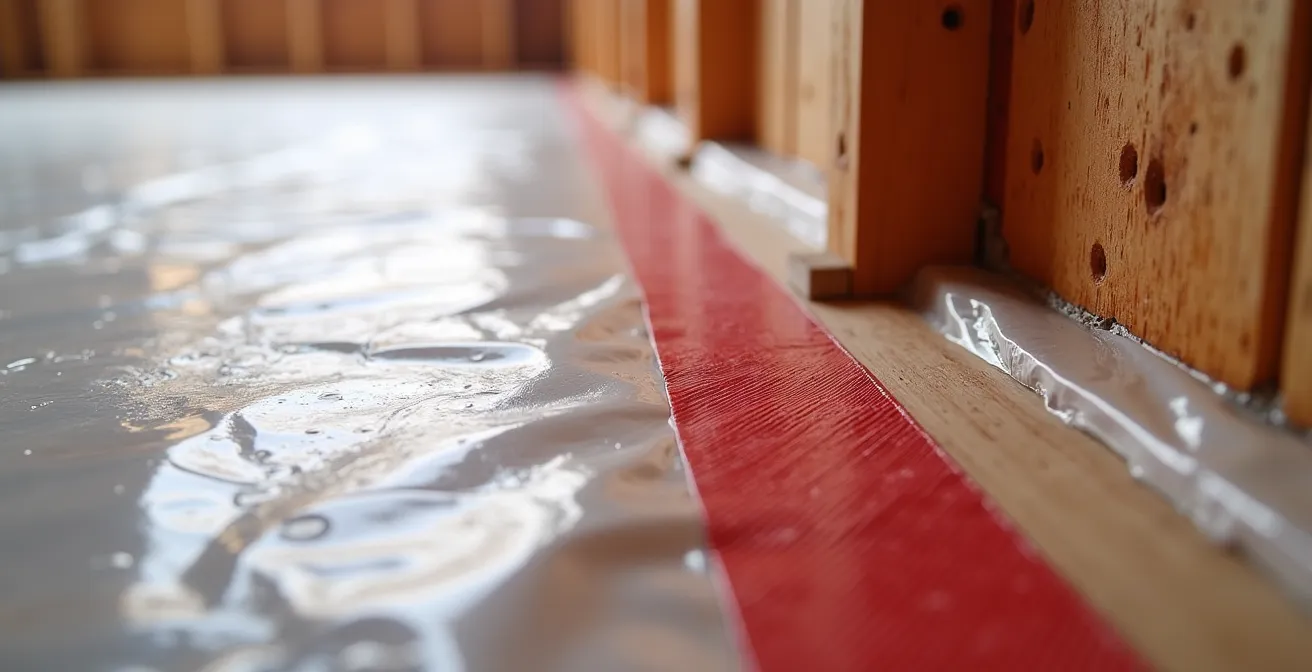
The focus of the inspection is on system integrity. An inspector will specifically look for gaps at floor-to-wall transitions, around windows and doors, and where the wall vapour barrier meets the ceiling vapour barrier. Failure at any one of these points constitutes a failure of the entire system. Your team must be trained to view the vapour barrier not as a final step before drywall, but as one of the most critical components of the building’s long-term durability.
What New Net-Zero Standards Will Be Mandatory by 2030?
The 2020 NBC is a stepping stone. It is part of a long-term federal plan to have all new construction meet “Net-Zero Energy Ready” standards by 2030. This is not a distant goal; it is a clear trajectory that the building code is following, and contractors must prepare for this eventuality now. The code introduces a tiered system for energy performance, providing a clear roadmap to the 2030 mandate.
The NBC 2020 outlines five performance tiers, with each successive tier demanding higher levels of energy efficiency. While provinces and territories can choose which tier to adopt, the federal goal is universal adoption of the highest tier. Builders who are already constructing to Tier 3 or 4 are simply getting ahead of the curve. Those still building to the minimum prescriptive standards will face a significant and costly shock as the deadlines approach.
The ultimate goal is Tier 5, defined as “Net-Zero Energy Ready.” This standard demands performance levels far beyond what is common today. According to the 2020 National Building Code’s energy tiers, a Tier 5 building requires exceptional thermal performance and airtightness. This includes assemblies like:
- Attics/Roofs: Minimum R-80 effective
- Above-Grade Walls: Minimum R-40 effective
- Foundations: Minimum R-29 effective
- Airtightness: A maximum of 0.6 air changes per hour (ACH) at 50 Pascals, verified by a mandatory blower door test.
Achieving these targets is impossible with conventional 2×6 framing and standard insulation practices. It requires advanced techniques such as double-stud walls, continuous exterior insulation, high-performance windows (triple-pane), and an obsessive focus on air sealing. The 2030 mandate will transform every aspect of residential construction. Waiting to adapt is a losing strategy; the time to master these techniques and adjust business models is now.
Key Compliance Mandates
- R-value requirements are strictly dictated by climate zone; there is no national standard, only regional mandates.
- Substantial renovations (typically >25% of an assembly) legally trigger mandatory upgrades to current code standards.
- System integrity is paramount: A continuous, perfectly sealed air and vapour barrier is more critical to passing inspection than the nominal R-value of the insulation material itself.
OBC vs. NBC: How Ontario’s Code Differs from the National Standard?
The National Building Code (NBC) serves as a model code, but it is not law until it is adopted or adapted by a province or territory. Jurisdictions have the authority to amend the NBC to address specific local concerns, and Ontario is a prime example of a province that consistently mandates higher standards. For contractors working in Ontario, complying with the NBC alone is insufficient; you must adhere to the Ontario Building Code (OBC), specifically the energy efficiency requirements outlined in its Supplementary Standard SB-12.
The OBC is often more stringent than the NBC, particularly regarding effective R-values and airtightness. A key difference is Ontario’s emphasis on “effective” thermal resistance over “nominal” R-values. This accounts for thermal bridging—heat loss through framing members—which significantly degrades the performance of an insulated assembly. The OBC also made airtightness testing mandatory for new homes long before it was widely adopted elsewhere.
This table highlights some of the critical differences between the national model and Ontario’s current legal requirements.
| Component | NBC 2020 Zone 5 | OBC 2024 (SB-12) | Key Difference |
|---|---|---|---|
| Attic (Nominal) | R-50 | R-60 | OBC requires higher value |
| Walls (Effective) | R-20 | R-22 to R-24 | OBC specifies effective R-value |
| Basement Walls | R-20 | R-20 effective | OBC requires continuous insulation |
| Air Leakage Testing | Optional | Mandatory for new homes | OBC requires blower door test |
Compliance Example: Ottawa Basement Wall
To meet the OBC’s requirement for an effective R-20 in a basement wall in Ottawa, a contractor cannot simply install R-20 batts in a 2×6 stud wall. The thermal bridging through the wood studs would reduce the effective R-value to approximately R-16, failing the code. To comply, a common solution is a hybrid approach: a 2×4 stud wall with R-14 batts, PLUS a continuous layer of at least R-10 rigid insulation installed against the concrete foundation wall before the framing is built. This dual-layer system breaks the thermal bridge, achieving the mandated effective R-20. The total material cost is approximately $8-$10 per square foot, significantly higher than a simple prescriptive approach allowed under the base NBC.
What Exclusion Clauses in Insulation Contracts Should Raise Red Flags?
A contract is a tool of risk allocation. As a builder or homeowner, your insulation contract must clearly assign responsibility for code compliance to the installer. Vague language and broad exclusion clauses are significant red flags, indicating that the contractor may be attempting to shift the liability for poor workmanship or non-compliant installation onto you. An inspector will hold the builder responsible, regardless of what a subcontractor’s contract says. Therefore, your agreements must be ironclad.
As the industry authority NAIMA Canada states in its guidelines, a properly structured contract is the first line of defense against compliance issues. They note:
A good insulation contract must specify compliance with the 2020 National Building Code as adopted by the provincial building code and all municipal amendments as of the contract date
– NAIMA Canada, Building Codes & Standards Guidelines
This level of specificity is non-negotiable. Any contract that falls short should be rejected. Scrutinize every line for clauses that attempt to limit the installer’s responsibility. The following clauses are immediate grounds for concern and should be struck or clarified:
- Generic Compliance: A clause stating the work “meets building code” is too vague. It must specify the exact code version (NBC 2020 and the current provincial code).
- Air Leakage Disclaimers: Any clause that disclaims responsibility for the results of a blower door test is a major red flag. The installer’s work is a primary factor in the building’s airtightness.
- Unlimited Material Substitution: The contractor must not have the right to substitute specified materials without prior written approval. This prevents the use of cheaper, lower-performance products.
- Moisture/Mould Disclaimer: A clause disclaiming all responsibility for moisture or mould issues is unacceptable. Improper vapour barrier installation is a direct cause of these problems, and the installer must be held liable.
- Nominal R-Value Warranty Only: The contract should warrant the performance of the assembly, including mitigating thermal bridging, not just the nominal R-value printed on the insulation bag.
What Does NBC Section 9.36 Mean for Your Basement Renovation?
Section 9.36 of the National Building Code is the central chapter governing energy efficiency. For basement renovations, its implications are direct and transformative. Gone are the days of simply putting fibreglass batts between studs against a concrete wall. Section 9.36 effectively mandates the use of continuous insulation to combat thermal bridging and control moisture at the foundation level.
A key mandate of this section is that for foundation assemblies, 100% of the basement wall insulation must be continuous from the slab up to ground level, and often extending above grade to overlap with the wall assembly’s continuous insulation. This means a layer of rigid or semi-rigid insulation (like rigid foam or mineral wool board) must be installed against the concrete *before* the stud wall is framed. Placing insulation only within the stud cavities no longer complies because the wood studs act as thermal bridges, creating cold stripes on the interior wall where condensation and mould can form.
This “continuous insulation” approach is fundamental to the code’s goal of creating a robust, durable, and healthy building envelope. It treats the foundation not just as a structural element, but as a critical part of the home’s thermal and moisture control system. The benefits extend beyond energy savings, as demonstrated in projects addressing other building science issues like radon ingress.
Case Study: Radon Mitigation through Code-Compliant Insulation
In an Eastern Ontario basement renovation, the contractor was required to meet the R-20 effective insulation value. They did so by installing continuous rigid foam insulation against the foundation walls and meticulously air-sealing the rim joists and all penetrations, as per Section 9.36 principles. This integrated approach not only achieved the thermal performance target but also had a dramatic impact on indoor air quality. The comprehensive air sealing inherent in the process reduced radon levels in the basement by 65%. The total investment of approximately $6,500 for the 1,000 sq ft basement addressed both the mandatory energy code and a critical health and safety requirement simultaneously, proving that a well-executed insulation plan is a multi-purpose system.
Ensure every project plan submitted explicitly references these requirements. Non-compliance is not an option; it is a guaranteed project delay and cost overrun. Begin by auditing your standard specifications against these mandates today.