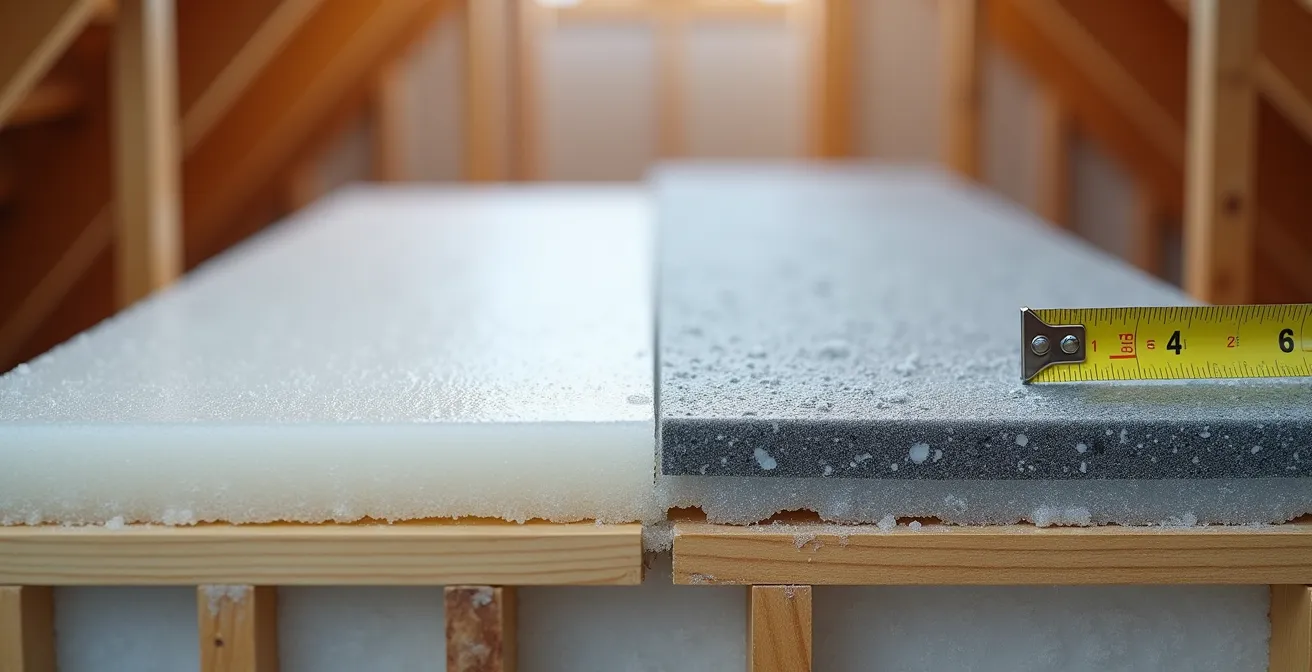
High-performance insulation in tight spaces is no longer a compromise, but a choice between two molecularly-engineered technologies: Aerogel and Vacuum Insulated Panels (VIPs).
- Vacuum Insulated Panels (VIPs) offer the absolute highest R-value per inch but are rigid and demand flawless installation.
- Aerogel provides slightly lower but still exceptional R-value with crucial flexibility for complex shapes and thermal bridges.
Recommendation: Use VIPs for large, flat, predictable surfaces and flexible Aerogel blankets to eliminate thermal weak points around curves and joints, creating a hybrid, truly high-performance thermal envelope.
For architects and homeowners in Canada, the battle against the cold is often fought in inches. Traditional insulation methods require significant wall thickness to achieve modern energy code standards, a luxury not afforded in heritage retrofits, dense urban construction, or complex architectural forms like dormers. This spatial constraint has historically forced a painful compromise between thermal performance and usable interior space. The question has always been: how do we fit a high R-value into a sliver of wall?
The common approach involves layering rigid foam boards or using high-density spray foam, but even these solutions hit a physical limit. They can’t deliver the performance needed for the most challenging spaces without encroaching on valuable square footage. But what if the solution wasn’t about adding more material, but about engineering better material? What if we could manipulate physics at the nanoscale to stop heat transfer in its tracks?
This is precisely where the next frontier of building science emerges. Instead of thinking in terms of thickness, we must now think in terms of molecular engineering. This article moves beyond conventional materials to decode two of the most potent, ultra-thin insulation technologies available today: Aerogel and Vacuum Insulated Panels (VIPs). We will dissect their underlying physics, explore their practical applications in challenging Canadian contexts, and provide a clear framework for deciding which technology—or combination of both—is the right fit for your high-stakes project.
This guide will navigate the technical specifications, installation complexities, and long-term performance of these materials, empowering you to make informed decisions when every inch counts. Explore the sections below to understand how these nano-insulators are rewriting the rules of thermal design.
Summary: Decoding the High-Tech Insulation Showdown
- How to Insulate Thin Dormer Walls to R-20 Without Losing Space?
- The Nano-Insulation Solution for Cold Spots Around Heritage Windows
- Are Vacuum Insulated Panels (VIPs) Worth $50 per Square Foot?
- How to Install Vacuum Panels Without Puncturing the Seal?
- Do Gas-Filled Insulation Panels Lose Their R-Value Over 20 Years?
- Why Modular Panels Are Replacing Stick Framing in Fly-In Communities?
- Why Does Nominal R-Value Drop When Temperatures Hit -20°C?
- Which Insulation Gives the Highest R-Value per Inch for Thin Walls?
How to Insulate Thin Dormer Walls to R-20 Without Losing Space?
Dormer walls represent a classic architectural challenge: complex angles, limited depth, and a high potential for thermal bridging. Achieving a high R-value in such a constrained space with traditional insulation is often physically impossible. While many Canadian building codes require R-22 to R-24 for exterior walls, this is based on standard stud cavities. In a thin dormer, the goal shifts to maximizing performance within the available 1 to 2 inches.
The solution lies not in a single material, but in a hybrid strategy leveraging the unique strengths of both VIPs and Aerogel. For the flat cheek walls of the dormer, Vacuum Insulated Panels can be used to provide a powerful thermal break, delivering an R-value of up to R-35 per inch. However, VIPs cannot be cut or bent, making them unsuitable for the awkward corners and joints inherent in dormer construction. This is where flexible aerogel blankets become indispensable.
As detailed in a case study on sensitive retrofits, a thin layer of an aerogel blanket can provide a significant boost in R-value where only minimal space is available. By using aerogel strips to wrap around framing and fill the gaps between VIPs, you create a continuous, uncompromised thermal envelope. This combination addresses both the broad surfaces and the critical thermal bridges, effectively stopping heat loss at every potential weak point. The final assembly must include a meticulously sealed vapour barrier on the warm side, a critical step to prevent interstitial condensation during harsh Canadian winters.
The Nano-Insulation Solution for Cold Spots Around Heritage Windows
Heritage buildings, particularly those in cities like Old Montreal or Quebec City, present a unique thermal dilemma. Original window assemblies are often architectural treasures but also notorious cold spots, creating drafts and condensation. Replacing them is frequently out of the question due to preservation rules. The challenge is to drastically improve thermal performance around the frame without altering its historic appearance. This is a problem that cannot be solved with bulky insulation; it requires a solution that operates on a completely different scale.
This is where the power of nano-insulation becomes clear. Aerogel, a synthetic porous ultralight material derived from a gel, is composed of over 99% air trapped within a solid, sponge-like structure of silica nanoparticles. This structure is the key to its power. It severely restricts the three methods of heat transfer: convection, conduction, and radiation. In fact, research shows aerogel achieves lower thermal conductivity than still air at 0.024 W/mK vs 0.026 W/mK, effectively outperforming the very air it’s made from.
This paragraph introduces the complex structure of aerogel and its unique thermal properties. The illustration below visualizes how this material is applied in a real-world scenario to combat thermal bridging in a sensitive area.
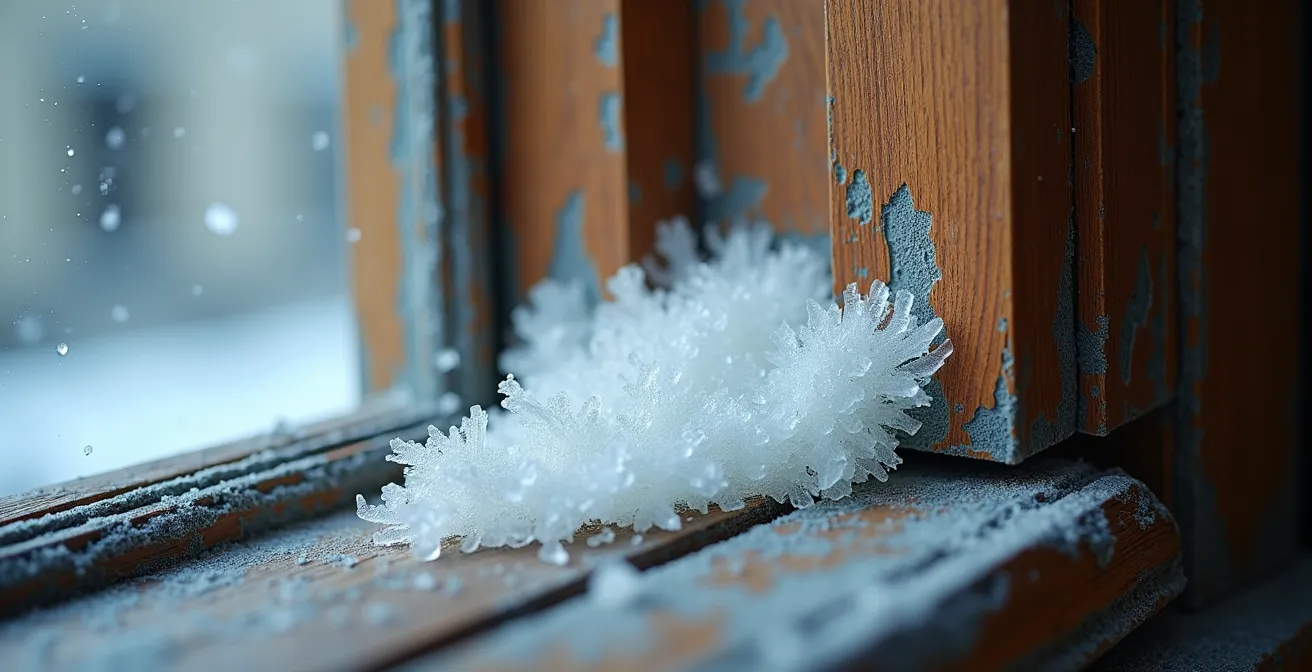
As the image demonstrates, thin, flexible aerogel strips can be precisely cut and fitted into the reveals and cavities around a window frame. This targeted application creates a thermal break, isolating the cold exterior frame from the warm interior wall. By stopping heat from conducting through the assembly, it eliminates the cold spots responsible for drafts and condensation, dramatically improving comfort and energy efficiency while remaining completely invisible. This is a surgical approach to insulation, made possible only by materials engineered at the nanoscale.
Are Vacuum Insulated Panels (VIPs) Worth $50 per Square Foot?
The initial sticker shock of Vacuum Insulated Panels (VIPs) can be daunting for any project manager or homeowner. At approximately $50 per square foot, they represent a significant upfront investment compared to traditional insulation. To justify this cost, one must shift the evaluation from a simple material-to-material comparison to a holistic analysis of spatial economics and long-term performance, especially in high-value Canadian real estate markets.
A VIP consists of a rigid, microporous core (like fumed silica) from which the air has been evacuated, all sealed within a thin, gas-impermeable envelope. By removing air molecules, heat transfer via conduction and convection is virtually eliminated, leaving only radiation as a minor pathway. This is why VIPs have about one-fifth the thermal conductivity of conventional insulation, giving them an unparalleled R-value per inch. Where spray foam offers R-7 per inch, a VIP can deliver R-30 to R-35 in that same inch.
The true value of VIPs is unlocked when floor space is at a premium. The following table breaks down the cost-benefit analysis, comparing a VIP system to a traditional double-stud wall designed to achieve a similar high R-value, a common practice in high-performance Canadian construction.
| Factor | VIP System | Traditional Double-Stud Wall |
|---|---|---|
| Material Cost per sq ft | $50 | $8-12 |
| Wall Thickness Required | 1-2 inches | 9-12 inches |
| R-Value Achieved | R-20 to R-35 | R-30 to R-40 |
| Space Saved (sq ft per 100 linear ft) | 60-80 sq ft | 0 sq ft (baseline) |
| Installation Complexity | High (specialized labor) | Moderate (standard framing) |
As the data reveals, a VIP wall assembly can be up to 10 inches thinner than its traditional counterpart. For a 100-linear-foot perimeter, this translates to reclaiming 60-80 square feet of valuable, sellable floor space. In markets like Toronto or Vancouver, where real estate is valued in thousands of dollars per square foot, the return on investment for VIPs becomes not just viable, but compelling. The cost is not for insulation; it is for space.
How to Install Vacuum Panels Without Puncturing the Seal?
The extraordinary thermal performance of a Vacuum Insulated Panel (VIP) is entirely dependent on one critical factor: the integrity of its vacuum seal. A single puncture, even a microscopic one, will allow air to rush in, equalizing the pressure and reducing its R-value from a spectacular R-30 to a dismal R-5, the level of the core material alone. Therefore, installation is not a construction task; it’s a zero-tolerance surgical procedure.
As the experts at Wikipedia Contributors emphasize in their article on Vacuum Insulated Panel construction, “VIP products cannot be cut to fit as with conventional insulation, as this would destroy the vacuum.” This single constraint dictates the entire installation process. Every panel must be custom-ordered to the exact dimensions required, based on meticulous site measurements and a detailed layout plan. There is no room for on-site adjustments.
Handling and fastening these panels requires specialized protocols to prevent damage. The following steps outline a zero-damage installation methodology:
- Pre-Sizing is Paramount: Order pre-sized VIP panels based on detailed wall measurements and a CAD layout to avoid any on-site cutting.
- Protective Backing: Install a protective layer, such as magnesium oxide board, on the substrate before placing the VIPs to guard against screws or imperfections from behind.
- Handle with Care: Use suction cup lifters for handling. Avoid applying direct pressure with fingers or tools, which can create micro-fractures in the envelope.
- Edge-Grip Fastening: Secure panels using specialized adhesives or mechanical fasteners that grip only the protected edges of the panel, never penetrating the face.
- Seal the Gaps: The spaces between VIPs are significant thermal bridges. These must be filled with high-performance insulation like aerogel strips or closed-cell spray foam to maintain a continuous thermal barrier.
- Final Inspection: Before covering the wall with drywall, a thermal imaging inspection is crucial to verify the integrity of every panel and seam.
This paragraph introduces the fragile nature of VIPs and the necessity for careful installation. The image below depicts a critical verification step in this process, ensuring the system’s integrity before concealment.
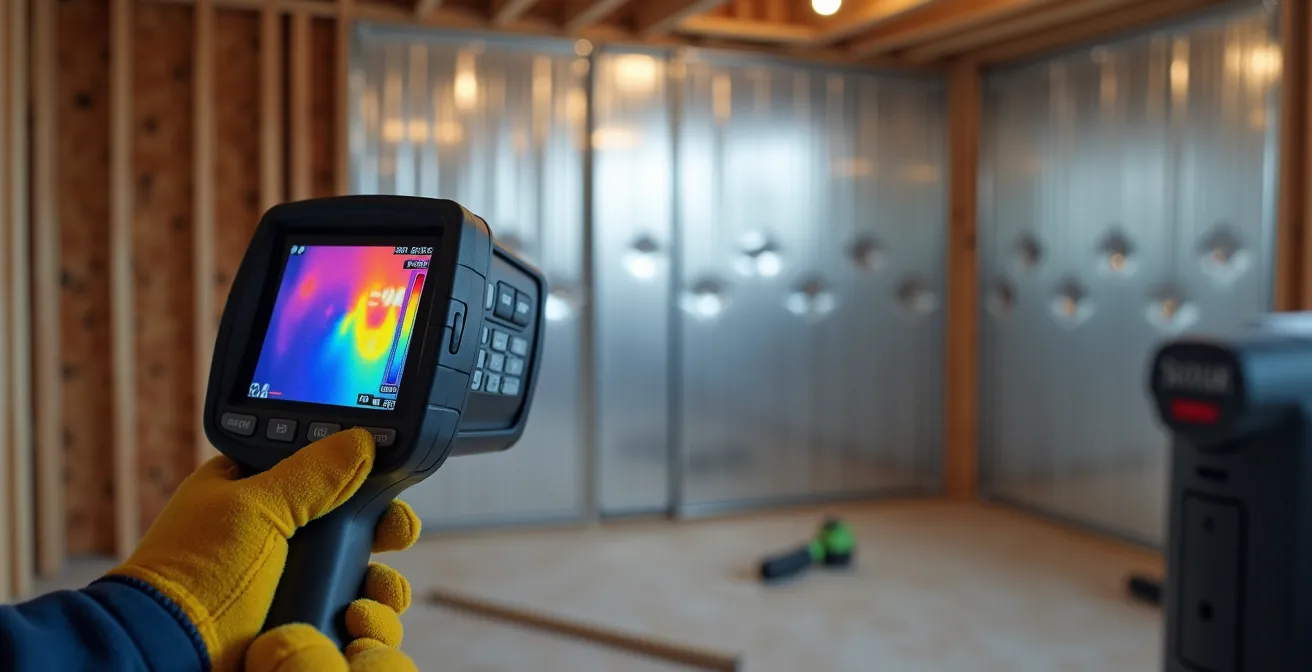
As shown, a thermal imaging camera provides immediate visual feedback on the performance of the installed system. Cold spots (appearing dark blue or purple in most thermal palettes) would instantly reveal a punctured panel or a poorly sealed joint, allowing for correction before it’s too late. This quality assurance step is non-negotiable for any VIP installation.
Do Gas-Filled Insulation Panels Lose Their R-Value Over 20 Years?
The long-term stability of high-performance insulation is a critical concern for architects and builders. A building’s thermal envelope is expected to perform for decades, so any degradation in R-value over time can compromise the energy efficiency and comfort of the structure. This is a particularly relevant question for VIPs, whose performance hinges on maintaining a near-perfect vacuum.
The reality is that no seal is perfect. Over a lifespan of many years, air will gradually enter the panel through the microscopic pores of the envelope material. This process, known as gas permeation, slowly increases the internal pressure of the panel. As more air molecules enter the core, heat transfer through gaseous conduction and convection begins to increase, and the panel’s R-value deteriorates. This is an unavoidable physical process.
However, reputable manufacturers account for this. The stated or “design” R-value of a VIP is not its day-one performance but rather a time-averaged value calculated over a projected service life, typically 25 years or more. The initial R-value is significantly higher, but it is engineered to degrade slowly so that it still meets the specified design performance at the end of its lifespan. This built-in performance buffer ensures the panel delivers on its long-term promise.
The rate of degradation depends heavily on the quality of the envelope material and the manufacturing process. High-quality VIPs use multi-layered metallized films with extremely low gas permeability rates. Choosing a product with robust third-party testing and certification for long-term performance is essential to ensure the building’s thermal integrity for decades to come.
Why Modular Panels Are Replacing Stick Framing in Fly-In Communities?
In Canada’s remote northern and fly-in communities, construction is dictated by logistics. The cost, weight, and volume of building materials transported by air or sea are primary project constraints. Traditional “stick framing” requires shipping vast quantities of lumber, insulation, and sheathing, which is both expensive and complex. This logistical challenge is driving a paradigm shift towards prefabricated, high-performance modular panels.
These panels are engineered systems, not just collections of materials. They integrate structure, insulation, and cladding into a single, factory-built component. The key to their effectiveness in arctic climates is the use of ultra-lightweight, super-insulating materials like aerogel. Because aerogel is a solid material that contains about 99.8% air, it provides tremendous thermal resistance with minimal weight. This drastically reduces transportation costs and simplifies on-site assembly, which must often be completed within a very short building season.
Case Study: Nunatta Campus Expansion in Iqaluit, Nunavut
A prime example of this approach is the Nunatta Campus expansion in Iqaluit. Facing the extreme climate at 63° North Latitude, the project utilized 152 aerogel-filled translucent window panels. These advanced components delivered an impressive R-18 rating, allowing the design to achieve a 30% glazed facade. This is a revolutionary departure from typical northern buildings, which traditionally feature minimal glazing (around 0.3%) to limit heat loss. The use of lightweight, super-insulated modular panels enabled a design that prioritizes natural light and connection to the outdoors without compromising thermal performance, a feat impossible with conventional methods.
By moving construction into a controlled factory environment and leveraging advanced materials, modular panels offer a solution that is faster, more efficient, and better suited to the extreme logistical and climatic challenges of Canada’s north. They represent a shift from building on-site to assembling high-performance systems.
Why Does Nominal R-Value Drop When Temperatures Hit -20°C?
A common but poorly understood phenomenon in building science is the degradation of insulation performance in extreme cold. The nominal R-value printed on a product is typically tested at a standard temperature of around 24°C (75°F). However, for many conventional insulation types, particularly those containing trapped gases, this R-value can drop significantly when the exterior temperature plummets to -20°C or -30°C, as is common during a Canadian winter.
This performance drop is often due to convection within the insulation material itself. In fibrous materials like fiberglass or mineral wool, the air pockets are relatively large. As the temperature difference across the insulation increases, it can induce tiny convective loops within these pockets, where air circulates and transfers heat more effectively, thereby lowering the overall R-value. Some blowing agents in foam insulation can also experience changes in state at very low temperatures, affecting their insulating properties.
This is another area where nano-insulators like aerogel demonstrate their superior physics. The nanoporous structure of aerogel is so incredibly fine that it effectively suppresses the movement of air molecules, preventing convection from occurring even under extreme temperature differentials. Its performance remains remarkably stable across a vast temperature range. For instance, GORE Thermal Insulation, an aerogel product, has a thermal conductivity of about 0.020 W/m•K and maintains this stability in both extreme heat and cold. This is further validated by testing which shows that as the temperature difference across an aerogel sample increases, its ability to insulate remains consistent, unlike many traditional materials whose performance falters when needed most.
For critical applications in harsh climates, choosing an insulation whose performance is not temperature-dependent is paramount. The stable thermal conductivity of aerogel and the vacuum-based physics of VIPs ensure they deliver their advertised R-value when the outdoor temperature is at its most punishing, providing reliable protection for the building envelope.
Key Takeaways
- When space is the primary constraint, next-generation materials like VIPs and Aerogel are the only options that can achieve high R-values in a 1-2 inch profile.
- VIPs offer the highest R-value per inch (R-30+) but are rigid and fragile, requiring meticulous, pre-planned installation.
- Aerogel offers slightly less R-value (R-10/inch) but provides critical flexibility, making it ideal for curves, joints, and eliminating thermal bridges.
Which Insulation Gives the Highest R-Value per Inch for Thin Walls?
When faced with a thin wall assembly, the single most important metric becomes R-value per inch. This measurement dictates how much thermal resistance can be packed into a limited depth. For decades, the choice was between various types of foam and fiber, but the advent of nanotechnology has completely reshaped the top end of the performance spectrum.
Based on a typical k-value of 0.007 W/(m·K), the R-value of a typical 25-millimetre-thick (1 in) VIP would be 3.5 m²·K/W (20 h·ft²·°F/BTU)
– Wikipedia Contributors, Vacuum Insulated Panel – Thermal Performance
This statement highlights the game-changing potential of vacuum insulation. An R-value of 20 in a single inch was previously unimaginable. However, VIPs are not the only players in this high-performance category. Aerogel blankets offer another powerful, albeit different, solution. The choice between them, and how they stack up against more conventional high-performance options, depends on the specific application, budget, and structural complexity.
To provide a clear decision-making framework, the following table compares the leading insulation options available on the Canadian market, ranked by their performance in thin-wall applications.
| Insulation Type | R-Value per Inch | Cost Factor | CCMC Status | Best Application |
|---|---|---|---|---|
| VIP Panels | R-20 to R-35 | Highest ($50/sq ft) | Case-by-case | Space-critical retrofits |
| Aerogel Blankets | R-10 to R-12 | High ($20-30/sq ft) | Some products | Curved surfaces, thermal bridges |
| Closed-cell Spray Foam | R-6 to R-7 | Moderate ($3-5/sq ft) | Approved | Air sealing + insulation |
| Rigid Foam Board | R-5 to R-8 | Low-Moderate ($2-4/sq ft) | Approved | Continuous exterior |
| Fiberglass Batts | R-3.2 to R-3.8 | Low ($0.50-1/sq ft) | Approved | Standard cavities |
The data is unequivocal: Vacuum Insulated Panels hold the undisputed title for the highest R-value per inch. However, their rigidity and cost make them a specialized tool. Aerogel blankets, with their unique combination of high R-value and flexibility, emerge as the most versatile solution for complex geometries and eliminating thermal bridges. For many projects, the ultimate solution is not a choice of one or the other, but a hybrid approach that deploys each material where its strengths can be best utilized, creating a truly seamless and superior thermal envelope.
Now that you are equipped with a deep understanding of these futuristic materials, the next step is to apply this knowledge. Evaluate your project’s specific constraints—be it space, geometry, or budget—to engineer a thermal solution that moves beyond compromise and toward optimal performance.